
Do job simulations count as work experience? Not in the sense of employment, an internship or a placement: you were not hired, supervised or paid. They count as something narrower and still useful: evidence that you tried a role, did real-style tasks and can explain what you did. List them under projects, training or certifications, and be exact about what they were.
*Checked 24 October 2026. Statements about other providers and about what universities advise come from the pages named in the sources, as we read them that day.*
What is a job simulation?
A job simulation is an online project that puts you in a role for a short time. You read emails and documents, do tasks and get feedback or model answers. Forage runs employer-branded ones, usually from 30 minutes to 5 hours. An EDWartens job simulation is one role's project at a simulated company, with days 1 to 5 free (about ten hours), every task checked and a model answer shown.
The simulated company is deliberate. It means nobody can mistake the work for employment. Our job simulation FAQ answers the common questions in plain words.
So do job simulations count as work experience?
It depends on the reader and the meaning of "work experience". This table shows how the terms usually line up:
| Term | What it normally means | Does a job simulation fit? |
|---|---|---|
| Employment | A contract, pay and an employer | No |
| Internship or placement | Time inside a real employer, with a supervisor | No |
| Virtual work experience | A loose label for online programmes that introduce a job or sector | Partly. A simulation is one kind, but it is still not a placement |
| Work samples or projects | Specific work you can show and explain | Yes. This is where a simulation fits best |
| Training or certification | A course or programme you completed | Yes |
Two things are worth knowing. First, UCAS lists free Virtual Work Experiences from Springpod (about 6 to 10 hours, with a certificate) and says they can be included in personal statements and apprenticeship applications. So an online programme can legitimately appear in an application. Second, TARGETjobs (11 August 2026) says a virtual internship with the right features is an equally valid form of work experience to a face-to-face one. That article is about virtual internships, which differ from a self-paced simulation, so read the label and the detail before you copy the wording.
What do the simulation providers themselves say?
They say not to call it employment, which is why an honest answer is easier to defend. Forage's own advice is to add a simulation under extracurricular activities, certifications or achievements, and not under internship or job experience. A University of Arizona careers page says the same and adds that you must not include a virtual experience program as work experience or employment on a CV or resume.
We take the same line. An EDWartens simulation is not employment, an internship or a work placement, and our own FAQ says so on every page. If your school, college or university will not treat it as a placement, that is a fair position. You can still use it as evidence of interest and skills.
Where should you put it on a CV?
Put it under projects, training or certifications, never under employment. A good entry names four things: the role, the simulated company, the provider and two things you did.
| Weak wording | Better wording |
|---|---|
| "Maintenance engineer, Kelbridge Foods, 2026" | "Maintenance Electrical Engineer job simulation, Kelbridge Foods (simulated company), EDWartens UK, 2026. Reviewed an isolation certificate, closed a work order and found a hidden starter fault." |
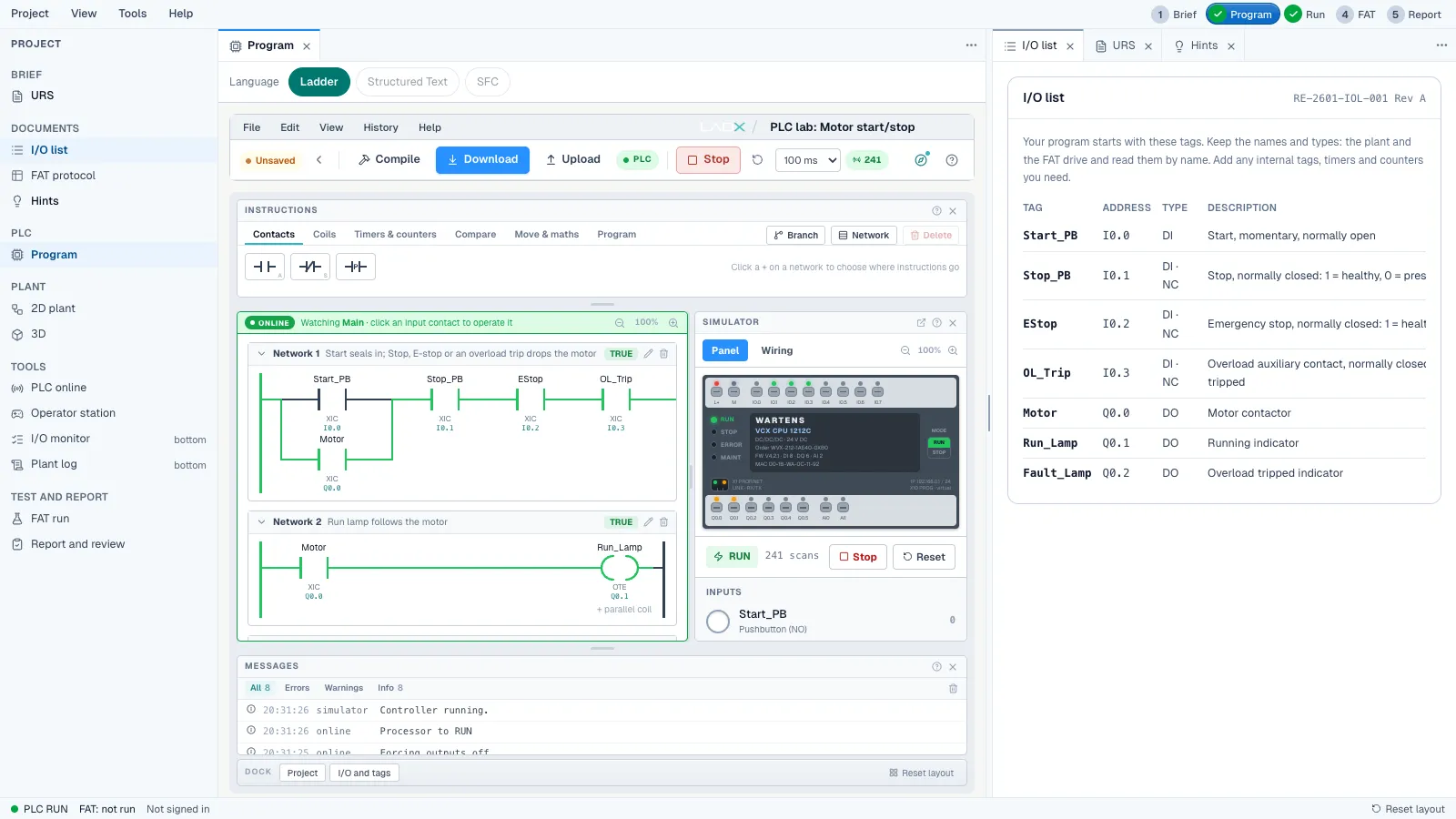
| "Worked on PLC projects" | "PLC Programmer job simulation, Tarnbrook Controls (simulated company). Wrote an I/O list and a cause and effect matrix, then programmed bottle counting and bowl level control and tested them against criteria." |
| "Gained industry experience" | "Completed a four-hour engineering simulation with an optional assessment (provider, year)." |
The weak versions are not just vague. The first implies employment, which an interviewer will find out is untrue, and that does more harm than a blank CV. The better versions are specific and still modest.
If your other experience is thin, our guide to engineering work experience for career changers shows how to lead with a related background and add the simulation as a project.
How do you write about it in a personal statement or application?
Describe what you did, one decision you made and what you learned, in your own words. For example: "In a maintenance simulation I was asked to leave a guard off to finish a job faster. I refused, wrote down why and learned that the isolation boundary has to be clear before work starts."
That sentence works because it is about thinking, not about a certificate. It also fits real tickets: the Maintenance Electrical Engineer simulation has a ticket where the isolation boundary is not clear, and the PLC Programmer one has a request for a small favour from the client's supervisor. Each has a better and a worse answer, and the model answer explains why.
How do you make a simulation count for more?
A simulation counts for more when you can prove you did the work and show what you took from it. Five steps help:
- Finish it. A started programme says little. Finished tasks, with scores or feedback, say more.
- Keep the evidence. Save your work record, the documents you wrote and any verification link. An EDWartens work record shows your scores by task and the dates, and it is yours to share.
- Write three lines on what you did, what went wrong first and what you would do differently.
- Pair it with something real. A short course, a part-time job, a volunteering role or an in-person placement makes the simulation part of a pattern, not a stand-alone line.
- Ask the reader. Before you apply, ask the school, college or employer what they accept and how they want it described.
How should you talk about it at interview?
Pick one finished piece of work and walk through it: the brief, what you did, what went wrong and what you would do differently. Say "job simulation" and name the simulated company. Interviewers value accuracy. Then be ready to say what the simulation did not show, such as site contact, a supervisor or live equipment, and what you plan to do about it.
Our UK jobs pages show what employers ask for in each family, so you can match your example to a real advert.
Is a job simulation certificate worth it?
It is worth it if you want a graded, verifiable record to link on a CV or LinkedIn, and not worth it if you only need to show you tried a role. Forage and Springpod give a free certificate on completion (checked 24 October 2026). Ours costs £14.99 including VAT, is graded from checked work, comes with a public verification page and QR code, and is not accredited or a qualification. Days 1 to 5 are free and include checked tasks and a work record without the certificate. We cover the question in our job simulation certificate guide.
Note that the video above is a 27-second short from a US university careers centre. Its title uses the phrase "real work experience", which is more generous than Forage's own written advice. Follow the written guidance in the sources below when you describe yours.
Do employers value job simulations?
We cannot speak for employers, and anyone who says all of them do is guessing. Forage's own article claims that students who complete a simulation are three to four times more likely to be hired by partner companies, while its FAQ says at least 2.6 times, with no independent data cited for either. Treat both figures as marketing, not evidence.
What is more reliable is simpler. Specific work you can explain is easier to discuss than a general interest. A simulation gives you that, if you describe it accurately and do not claim more than it was.
How do job simulations compare with the alternatives?
Which one to choose depends on the job you want. If you want a big employer name or a finance or consulting simulation, Forage is the better choice. If you are 13 to 19, Springpod and its programmes (and UCAS's listing) suit you. If you want PLC, electrical or maintenance practice with every task checked, a role-based simulation such as ours fits. See our Forage alternatives for engineers and the free virtual work experience for engineering guide for the full comparison.
Start free
Try the first five days of a role for free and with no card: the PLC Programmer job simulation or the Maintenance Technician job simulation, which needs no experience to start. Fill gaps with the free PLC courses and read live maintenance and electrical jobs to see what employers ask for. The certificate (£14.99) and Premium (£53.99) are optional, both including VAT. A simulation is practice, not employment, and it does not promise a job.