
Free course · AI and machine learning
Prompt Engineering for Engineers
A course for engineers on writing AI prompts with checkable output and testing them on a golden set. Free to learn; the certificate is optional and paid.
Free to learn. Verifiable certificate £19 when you pass the final exam (optional, VAT included).
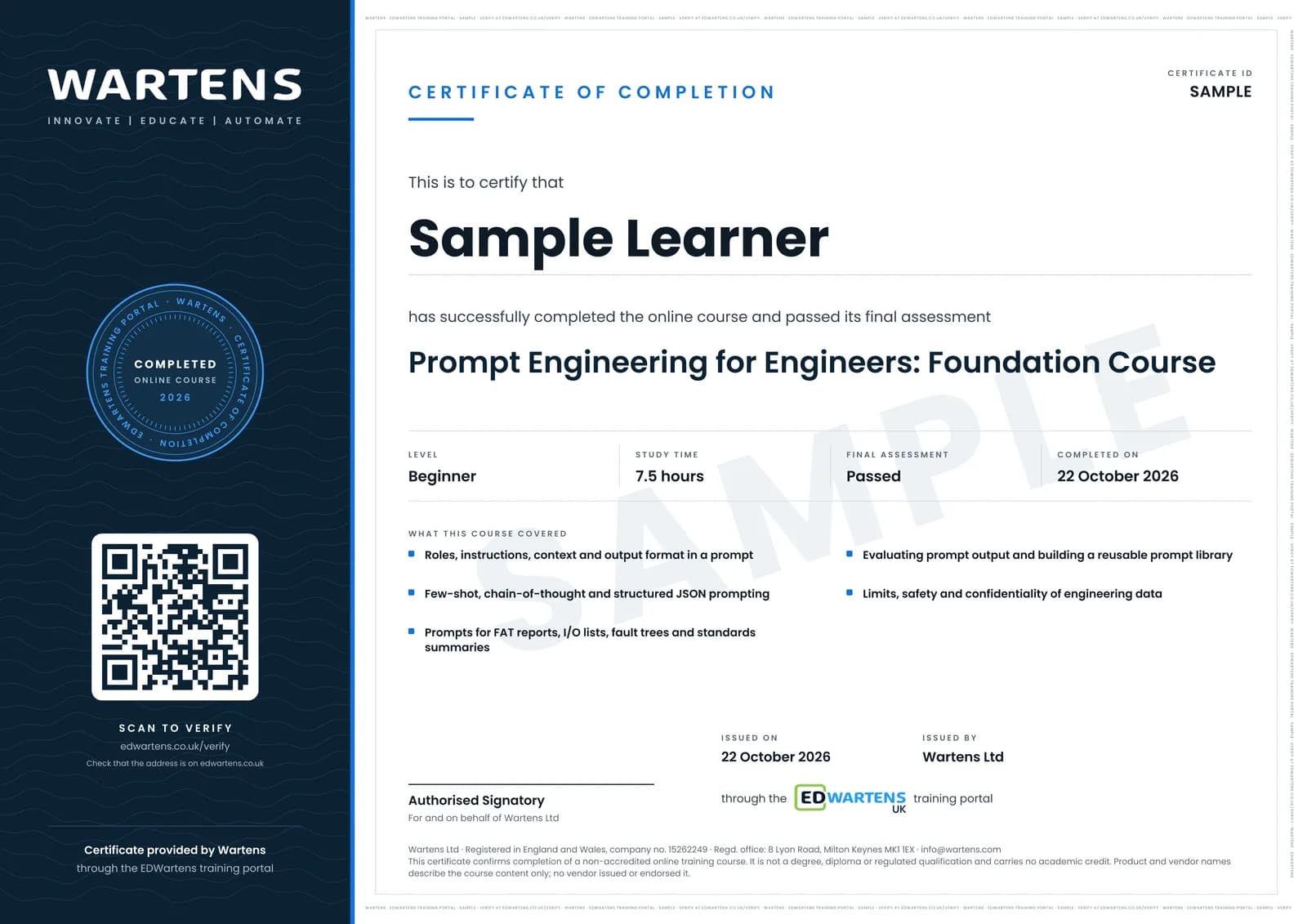
Sample certificate. Optional, issued when you pass the final exam.
- Level
- Beginner
- Modules
- 12
- Video
- 13 hours
- Price
- Free
Outcome
What you will be able to do
Write prompts with role, task, context, format and constraints; use few-shot examples, chain of thought and decomposition; separate system and user prompts; get JSON and CSV out reliably; assemble the right context; generate engineering documents and code from data tables with rules that stop invention; use Copilot in Excel safely; and build a tested prompt library entry with a golden set and a score.
- Write a five-part prompt with a refusal rule that turns invention into a visible blank
- Fix output format with few-shot examples and get JSON with a schema at temperature 0
- Make calculations checkable with chain of thought, and run the arithmetic as code
- Generate a FAT report section, a procedure or an I/O description column from a data table without invented facts
- Prompt for code with pinned versions and run everything; use Copilot in Excel safely
- Test a prompt against a golden set, iterate to a score and write a library entry
Software
Any chat tool (ChatGPT, Claude, Gemini, Copilot) or Google Colab with a free OpenRouter key.
Hardware
None.
Syllabus
12 modules
Each module has video lessons, notes and a short quiz. The final exam closes the course.
- A prompt is a specification3 lessonsLab
- Zero-shot, one-shot and few-shot examples3 lessons
- Thinking step by step3 lessons
- System prompts and roles1 lesson
- Structured output: JSON and tables2 lessonsLab
- Context engineering2 lessonsLab
- Engineering documents from data tables1 lessonLab
- Prompting for code3 lessons
- Prompting inside Excel, Word and email2 lessons
- Evaluating prompts and the prompt library2 lessons
- Safety, confidentiality and injection2 lessonsLab
- Final assessment0 lessons
How it works
How this course works
- Watch the video lessonsOne module at a time, at your own pace.
- Take the module quizA short quiz at the end of each module shows what stuck.
- Keep your notesWrite in My notes beside each module and ask the trainer if you are stuck.
- Practise in the labOptionalTry a task from the module in the EDWartens Lab, in your browser.
- Sit the final examPass it once you have been through the modules.
- Certificate, if you want oneOptionalPaid, and only after you pass. Anyone can check it online.
EDWartens Lab
Practise this in the EDWartens Lab
Write real prompts and test them: get exact JSON for ten emails, stop the model inventing a missing fact, and defeat an instruction hidden in an email.
Works alongside Prompt Engineering for Engineers. The Lab is ai for industry practice in your browser: no install, no hardware, free to use. Sign in as a learner and it opens with your account.
Levels to try with this course
AIW-06 · AI Workbench
Prompt to spec
Open in the lab (opens in a new tab)AIW-08 · AI Workbench
A safe agent
Open in the lab (opens in a new tab)
Optional. Skip it whenever you like: it never blocks your progress or your certificate.
Why practise in a lab
Technical work is judged on what you can do: wiring, commissioning, finding a fault. Doing a task yourself teaches more than watching it a second time, and a lab lets you try it safely before you meet real equipment. It does not replace working on real hardware.
- Practise safely, so a mistake costs nothing.
- The lab checks your work like a site test, so you know when it is right.
- Free, in your browser, with nothing to install.
Certificate
An optional certificate when you pass
Learning is free. Pass the final exam and you can have a certificate for £19, including VAT, with a number employers can check online. It records that you completed a free online course; it is not a regulated qualification or a CPD certificate.
- Your name, the course, its study time and your final exam score
- A unique certificate number and a QR code to its verification page
- Issued by Wartens Ltd; add it to your LinkedIn profile in one click
- Pay now or after you pass: it is issued the moment you pass the final
Credits
Who made the lessons
The video lessons belong to their creators. EDWartens wrote the study plan, notes, quizzes and the final exam.
- Anthropic
Prompting 101, the prompt-engineering deep dive, Lesson 7 and the prompting tips
- freeCodeCamp.org
the prompt engineering tutorial
- IBM Technology
the four methods of prompt engineering and context engineering explainers
- Jeff Su
the prompt formula in eight minutes
- Tina Huang
Google's prompt engineering course in twenty minutes
- Tech With Tim
the prompt engineering full course and the Cursor tutorial
- Great Learning
the prompt engineering full course
- Dave Ebbelaar
structured output explained
- Elvis Saravia
few-shot prompting explained
- CodeEmporium
chain-of-thought prompting explained
- Microsoft Developer
the prompt engineering lessons of Generative AI for Beginners
- Kevin Stratvert
the Copilot in Excel tutorial
- edureka!
prompt engineering for code generation and GitHub Copilot
- Simplilearn
the introduction to prompt engineering
- Analytics Vidhya
zero-, one- and few-shot prompting explained
- Telusko
structured JSON output
- Grow with Google
few-shot prompting in Google AI Essentials
- Eye on Tech
chain-of-thought prompting in three minutes
Questions
About this course
Is prompt engineering still a useful skill?
How do you test whether a prompt works?
How do I stop an AI model from inventing values in engineering documents?
Is this just tips for ChatGPT?
Do I need to code?
What is the project?
Do I need a paid AI account?
Is the course really free?
What certificate do I get?
Who made the video lessons?
Want a live class and career support?
The Professional Module is five live days of Siemens PLC, HMI and SCADA with an instructor, then a resume session and a CPD certificate.