
Free course · AI and machine learning
Machine Learning with Python
scikit-learn end to end on plant data: regression on energy against production, classification of motor-current signatures, the honest evaluation habits that make a model trustworthy, and a motor-fault classifier trained, tuned and reported the way an interviewer wants to see it.
Free to learn. Verifiable certificate £19 when you pass the final exam (optional, VAT included).
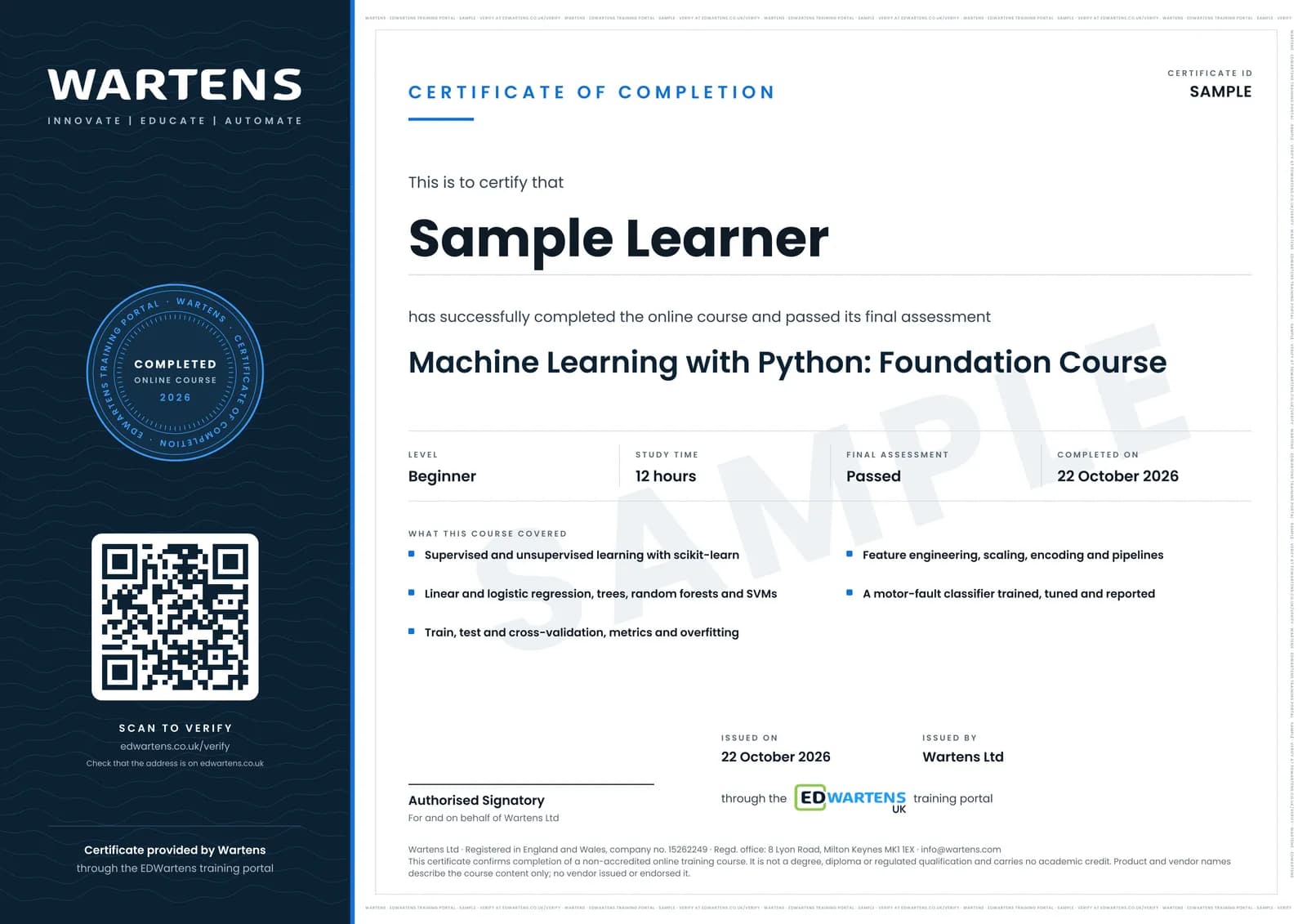
Sample certificate. Optional, issued when you pass the final exam.
- Level
- Beginner
- Modules
- 13
- Video
- 18 hours
- Price
- Free
Outcome
What you will be able to do
Frame a plant problem as regression, classification or clustering; fit and read linear and logistic regression; use trees, random forests, SVM, KNN and Naive Bayes; split without leakage, including by time and by machine; choose the right metric and read a confusion matrix; engineer physics-based features; build pipelines, cross-validate and tune with GridSearchCV; use k-means, PCA and IsolationForest; save and serve a model as an API.
- Fit a regression whose coefficients you can explain in kWh per unit
- Split train and test without leakage — by time for logs, by motor for fleets
- Read a confusion matrix and choose recall or precision with the person who owns the cost
- Engineer features from physics: imbalance, temperature rise, vibration ratios, rolling trends
- Cross-validate, tune with GridSearchCV and report a score with its spread
- Train a motor-fault classifier, save it with joblib and serve it as an API
Software
Google Colab (free). scikit-learn, Pandas and matplotlib are pre-installed.
Hardware
None.
Syllabus
13 modules
Each module has video lessons, notes and a short quiz. The final exam closes the course.
- What machine learning is, for an engineer2 lessons
- Linear regression: the line and the plane2 lessons
- How a model learns: gradient descent, and saving models2 lessons
- Categories, splitting and leakage2 lessonsLab
- Logistic regression and the confusion matrix2 lessonsLab
- Decision trees, random forests and boosting4 lessonsLab
- SVM, KNN, Naive Bayes and scaling3 lessons
- Cross-validation, bias–variance and metrics3 lessonsLab
- Feature engineering and outliers4 lessonsLab
- Pipelines, tuning and regularisation2 lessons
- Unsupervised: k-means, PCA and anomalies2 lessons
- The end-to-end project4 lessons
- Final assessment0 lessons
How it works
How this course works
- Watch the video lessonsOne module at a time, at your own pace.
- Take the module quizA short quiz at the end of each module shows what stuck.
- Keep your notesWrite in My notes beside each module and ask the trainer if you are stuck.
- Practise in the labOptionalTry a task from the module in the EDWartens Lab, in your browser.
- Sit the final examPass it once you have been through the modules.
- Certificate, if you want oneOptionalPaid, and only after you pass. Anyone can check it online.
EDWartens Lab
Practise this in the EDWartens Lab
Train a model on plant data, move the decision threshold and weigh the cost of errors in the Lab's AI workbench.
Works alongside Machine Learning with Python. The Lab is ai for industry practice in your browser: no install, no hardware, free to use. Sign in as a learner and it opens with your account.
Levels to try with this course
AIW-01 · AI Workbench
Data health check
Open in the lab (opens in a new tab)AIW-02 · AI Workbench
Train and evaluate without leakage
Open in the lab (opens in a new tab)AIW-04 · AI Workbench
Overfitting: tune the tree
Open in the lab (opens in a new tab)AIW-03 · AI Workbench
Choose the metric and the threshold
Open in the lab (opens in a new tab)
Optional. Skip it whenever you like: it never blocks your progress or your certificate.
Why practise in a lab
Technical work is judged on what you can do: wiring, commissioning, finding a fault. Doing a task yourself teaches more than watching it a second time, and a lab lets you try it safely before you meet real equipment. It does not replace working on real hardware.
- Practise safely, so a mistake costs nothing.
- The lab checks your work like a site test, so you know when it is right.
- Free, in your browser, with nothing to install.
Certificate
An optional certificate when you pass
Learning is free. Pass the final exam and you can have a certificate for £19, including VAT, with a number employers can check online. It records that you completed a free online course; it is not a regulated qualification or a CPD certificate.
- Your name, the course, its study time and your final exam score
- A unique certificate number and a QR code to its verification page
- Issued by Wartens Ltd; add it to your LinkedIn profile in one click
- Pay now or after you pass: it is issued the moment you pass the final
Credits
Who made the lessons
The video lessons belong to their creators. EDWartens wrote the study plan, notes, quizzes and the final exam.
- codebasics
the Machine Learning Tutorial Python series, the feature-engineering lessons and the end-to-end project
- Krish Naik
the R-squared and bias–variance explanations
- freeCodeCamp.org
Machine Learning for Everybody, the companion course
- StatQuest with Josh Starmer
a lesson in "Decision trees, random forests and boosting"
Questions
About this course
How much maths do I need?
Do I need to know Python first?
What are the projects?
Do I need a GPU?
Is the course really free?
What certificate do I get?
Who made the video lessons?
Want a live class and career support?
The Professional Module is five live days of Siemens PLC, HMI and SCADA with an instructor, then a resume session and a CPD certificate.