A mechanical fitter installs, services and repairs machinery, and you can become one by apprenticeship, college, starting as an operative or applying direct with relevant experience. The National Careers Service describes the job as maintenance fitter work: fitting pipework, valves, pumps and motors, planned maintenance checks, finding and fixing faults, and emergency breakdowns. Pay figures from different sources disagree because they measure different things, so this guide shows each source, its date and its limits, and then the routes in.
What does a mechanical fitter do?
The National Careers Service profile for a maintenance fitter lists these tasks:
- Installing pipework, valves, pumps and motors.
- Carrying out planned maintenance checks.
- Finding and fixing faults.
- Replacing worn parts, resetting instrument controls and cleaning machinery.
- Responding to emergency breakdowns, such as on a factory production line.
Make UK's Level 3 Engineering Fitter programme lists typical job titles: controls and systems fitter, electrical fitter, electronic fitter, instrumentation fitter, mechanical fitter and pipe fitter. The word "fitter" covers a family of jobs, and an advert's duties tell you which one it is. Our mechanical fitter jobs page shows current UK adverts.
Hours matter too. The National Careers Service says maintenance fitters typically work 42 to 44 hours a week, often including evenings, weekends and shifts. Our guide to the 4 on 4 off shift pattern explains one common pattern.
What is the difference between a mechanical fitter and a maintenance engineer?
A fitter is mostly mechanical: bearings, couplings, belts, pumps, gearboxes and pipework. A multi-skilled maintenance engineer covers mechanical, electrical and basic controls work, and a maintenance engineer can lead a team. Some employers use the titles loosely, so read the duties. If you want the wider role, our multi-skilled maintenance engineer guide compares them, and our maintenance engineer interview questions show what employers ask.
How do you become a mechanical fitter?
There are five routes. They all end in the same place, an employed fitter, and which one suits you depends on your age, qualifications and money.
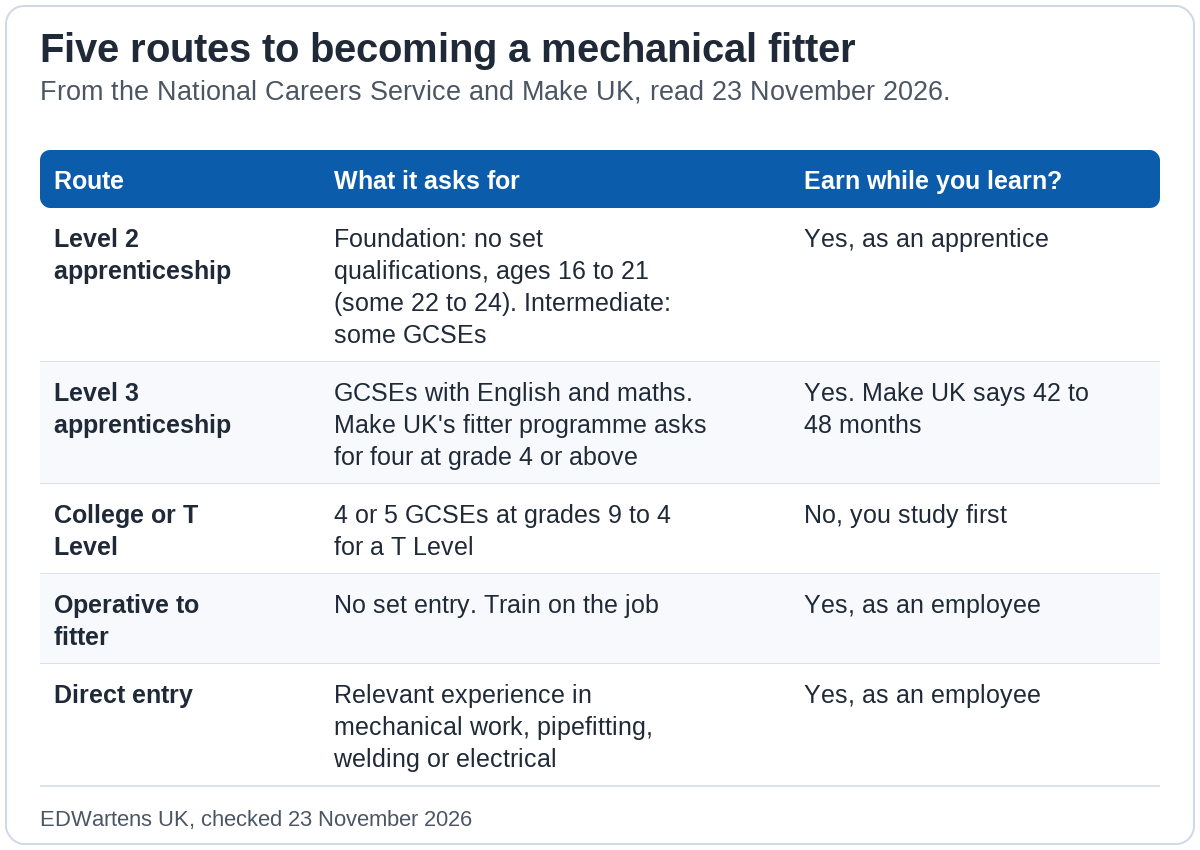
The National Careers Service lists these routes for a maintenance fitter:
- Apprenticeship. A Level 2 foundation apprenticeship (no specific qualifications, ages 16 to 21 with some exceptions to 24), a Level 2 intermediate Engineering Fitter apprenticeship, or a Level 3 advanced apprenticeship such as Engineering Maintenance Technician or Maintenance Operations Engineering Technician.
- College. Engineering, mechanical or electrical courses, fabrication and welding, or a T Level in Maintenance, Installation and Repair for Engineering and Manufacturing.
- Work. Start as an engineering operative or trainee craftsperson and train on the job.
- Direct application. With relevant experience in areas such as mechanical engineering, pipefitting, welding or electrical engineering.
Make UK describes its Level 3 Engineering Fitter programme as typically 42 to 48 months, leading to a BTEC Level 3 Diploma in Advanced Manufacturing Engineering and professional recognition with the IET as an engineering technician. It says the programme is for new entrants and no prior experience is expected. If you are over 25 or changing career, read our guide to engineering apprenticeships for adults for the funding and pay rules, and our guide to PLC apprenticeship vs short course vs degree for the wider comparison.
What does a mechanical fitter earn?
Three sources, three answers, and each is right about something different.
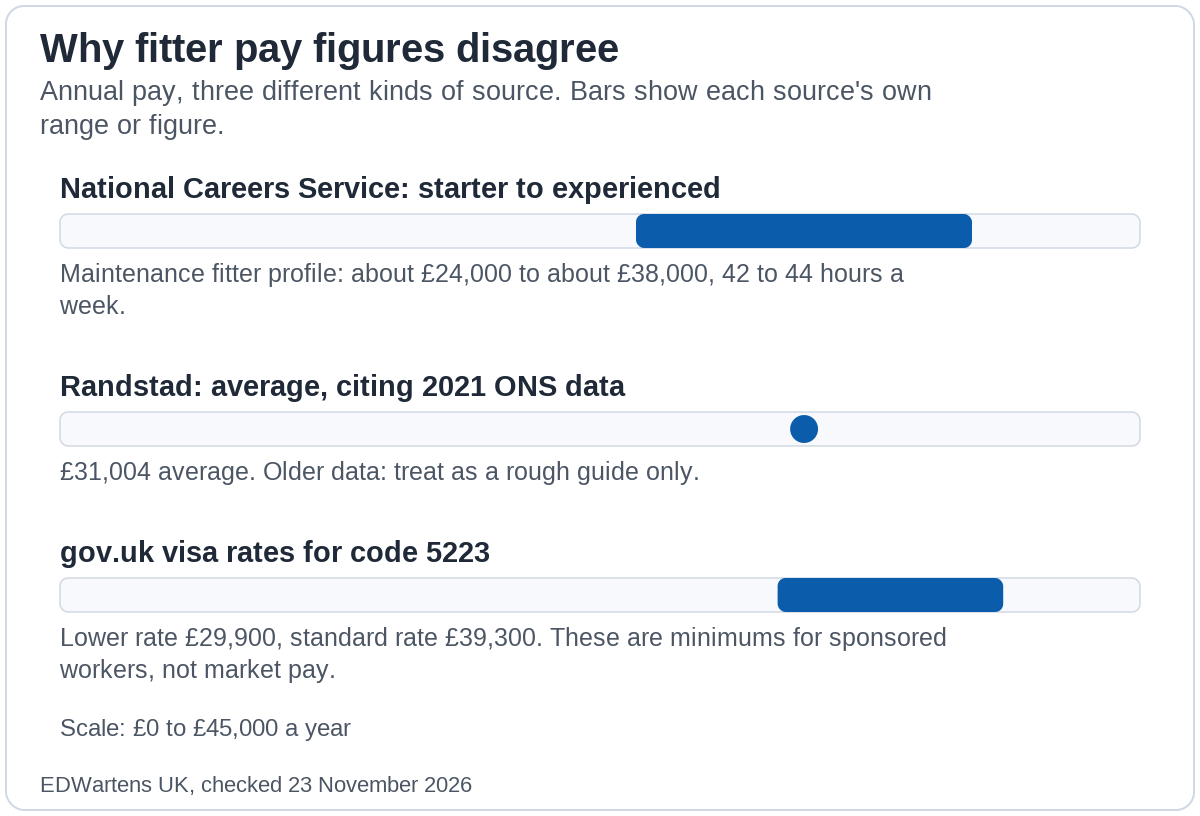
| Source | Figure | What it measures | Limits |
|---|---|---|---|
| National Careers Service | About £24,000 starter to about £38,000 experienced | Typical salaries for a maintenance fitter | A range for a job profile, not live adverts |
| Randstad job profile | £31,004 average, £29,509 entry, about £32,866 experienced | Average pay citing the ONS Annual Survey of Hours and Earnings | Links to the 2021 edition, so it is dated |
| gov.uk Temporary Shortage List, code 5223 | £39,300 standard rate, £29,900 lower rate | The minimum pay a sponsored worker must receive in that code | A visa minimum, not a market survey |
Hours change what a salary is worth. The same £30,000 a year works out at about £15.38 an hour over a 37.5 hour week and about £13.74 an hour over 42 hours (the arithmetic is salary divided by 52 weeks and by the weekly hours). Ask whether overtime and shift allowances are paid on top, because the National Careers Service says fitters often work 42 to 44 hours a week.
Apprentices are paid less while they learn. The legal minimum for an apprentice is £8.00 an hour from April 2026 in the first year and the age rate after that, as our adult apprenticeship guide shows. Randstad says apprentices work 30 hours a week during training. For pay you can see in live adverts, use our salaries page, which shows pay only where an advert states it, and the entry-level jobs page for trainee posts.
What safety passports and tickets do fitters need?
The National Careers Service says many jobs require an industry safety certificate, such as the CCNSG Safety Passport Scheme. Requirements depend on the site: construction, power, oil and gas and process plants each have their own. Ask the employer which tickets it expects you to hold on day one and which it will arrange. The electrician's card scheme is a different thing: our ECS card guide covers electricians, and a mechanical fitter is not expected to hold an ECS card.
What do employers test on a fitter?
Expect practical questions on the basics. A good way to prepare is to practise reading what is on the part. Take a bearing marked 6208-2RS, an example from our free course. The 6 means a single-row deep groove ball bearing. The 08 is the bore code: multiply by five to get a 40 mm bore. The 2RS means rubber seals on both sides, so it comes greased and sealed and should not be washed in solvent.
| Part of the code | Meaning in 6208-2RS |
|---|---|
| 62 | Deep groove ball bearing, light series |
| 08 | Bore code: 08 multiplied by 5 is a 40 mm bore |
| 2RS | Rubber seals on both sides |
Other typical checks are:
- Alignment. Name parallel and angular misalignment and the checks before aligning a shaft, including soft foot.
- Torque. Tighten flange bolts in a controlled sequence, not round the circle.
- Belts and chains. Check V-belt tension and pulley alignment, and say when chain wear means replacement.
- Lubrication. Pick a grease or oil and avoid mixing incompatible products.
- Safe working. Isolation, lifting and permits to work, because the first question is always whether it is safe to touch.
Can a mechanical fitter get a Skilled Worker visa?
Possibly, but the rules are in flux. Metal working production and maintenance fitters (code 5223) are medium skilled on gov.uk's list of eligible occupations, and gov.uk's page says medium-skilled jobs qualify only if they are on the immigration salary list or the temporary shortage list. Code 5223 is on the current list with a standard rate of £39,300 and a lower rate of £29,900. The Migration Advisory Committee recommended keeping it for 18 months in its report of 23 July 2026, and we found no gov.uk page confirming a decision on 23 November 2026. The employer must also hold a sponsor licence, and a licence is not a promise to sponsor a job. Our Skilled Worker 2027 guide explains the dates and our guide to checking a sponsor licence the register. This is general information, not legal advice.
How can you learn the mechanical basics for free?
Our free Mechanical Maintenance Fundamentals course has eight modules and 19 videos from other creators' channels, with our own notes, quizzes and a final exam. It covers rolling bearings, why they fail, grease and oil, shaft alignment and couplings, belts and chains, gearboxes, fasteners and torque, and vibration and condition checks. The Pumps, Compressors and Rotating Equipment course goes deeper on machines you will meet. The maintenance engineer learning path puts the courses in order.
Here is a short video from one of our courses showing a fitter's day. It was made at an alumina refinery site, so it is not a UK pay or routes guide, but it shows the work.
Credit: The Careers Department on YouTube.
Start free
Take a free course, then try the Mechanical Maintenance Engineer job simulation, a working day at a simulated UK company with the first five days free. A simulation is practice, not employment. The optional £19 certificate of completion on each free course is not a regulated qualification or a safety ticket.