
An engineering apprenticeship over 25 is allowed: gov.uk sets a minimum age of 16 and no upper age limit, and a degree or other earlier qualification does not stop you applying. What changes for adults is the money. From 1 August 2026 the government pays 95% of the training cost for apprentices aged 25 and over at employers that do not pay the apprenticeship levy, and from the second year most adult apprentices must be paid at least the age-based minimum wage. This guide explains how that works, which engineering apprenticeships adults start and what to try if nobody takes you on.
Is there an age limit for an engineering apprenticeship over 25?
No upper limit. gov.uk's page on applying says you can start an apprenticeship if you are 16 or over and not in full or part-time education. It adds that you can have a previous qualification, such as a degree, and still start one. The page you apply through, Find an apprenticeship, covers England only.
| Rule | Age | Source |
|---|---|---|
| Start an apprenticeship | 16 or over, no upper limit, not in full or part-time education | gov.uk, Apply for an apprenticeship |
| Level 2 foundation apprenticeship | 16 to 21, with some exceptions to 24 | National Careers Service |
| 95% government funding for non-levy employers | Apprentice aged 25 and over | gov.uk, Apprenticeship funding |
| £2,000 hiring payment for non-levy employers | Apprentice aged 16 to 24 only | gov.uk, 1 October 2026 |
Apprenticeships are real jobs. gov.uk's guide says you are an employee, you earn a wage and receive holiday pay, and you get time for study related to your role of at least 20% of your normal working hours. They last from 8 months to 6 years depending on the type and level. A Level 2 apprenticeship is equivalent to GCSEs and a Level 3 to A levels.
For a sense of who starts as an adult, a government science and engineering blog from February 2025 describes a colleague who completed a heavy goods vehicle service and maintenance apprenticeship in his 30s. His cohort ranged from about 25 to over 40 and he kept earning while he learned. It is one person's story, not a pay benchmark or a promise.
The short video below is an employer's own recruitment film, not government guidance. Scottish and Southern Electricity Networks (SSEN) says it has no upper age limit for its apprenticeships and names roles such as fitter, jointer and linesperson for mature learners who want a career change. It describes SSEN's schemes only, and rules may have changed since it was made, so rely on the figures in this guide.
Credit: Scottish and Southern Electricity Networks on YouTube.
Which engineering apprenticeships do adults start?
Adults typically look at Level 2 and Level 3 routes. The National Careers Service lists these for engineering maintenance technicians and maintenance fitters:
- Level 2 Foundation (Engineering and Manufacturing): open to ages 16 to 21, and to 22 to 24 in some cases, so it is usually not an option over 25.
- Level 2 Intermediate (Engineering Fitter): some GCSEs, usually including English and maths.
- Level 3 Advanced (Engineering Maintenance Technician or Mechatronics Maintenance Technician): the main adult route into maintenance. The National Careers Service says entry is 5 GCSEs at grades 9 to 4 including English and maths, but employers set their own entry requirements.
- Level 3 Engineering Fitter: Make UK describes its programme as about 42 to 48 months, leading to a BTEC Level 3 Diploma and professional recognition with the IET as an engineering technician. Make UK asks for four GCSEs at grade 4 or above including maths, plus English at grade 4 or above, and says no prior experience is expected for new entrants.
If you do not have GCSEs, ask the employer and the training provider what they will accept. Entry requirements differ by employer and provider.
What are you paid as an adult apprentice?
The legal minimum depends on your age and how far through the apprenticeship you are. gov.uk's National Minimum Wage page says apprentices get the apprentice rate if they are under 19, or 19 or over and in the first year. After the first year, a 19 or over apprentice gets the minimum for their age.
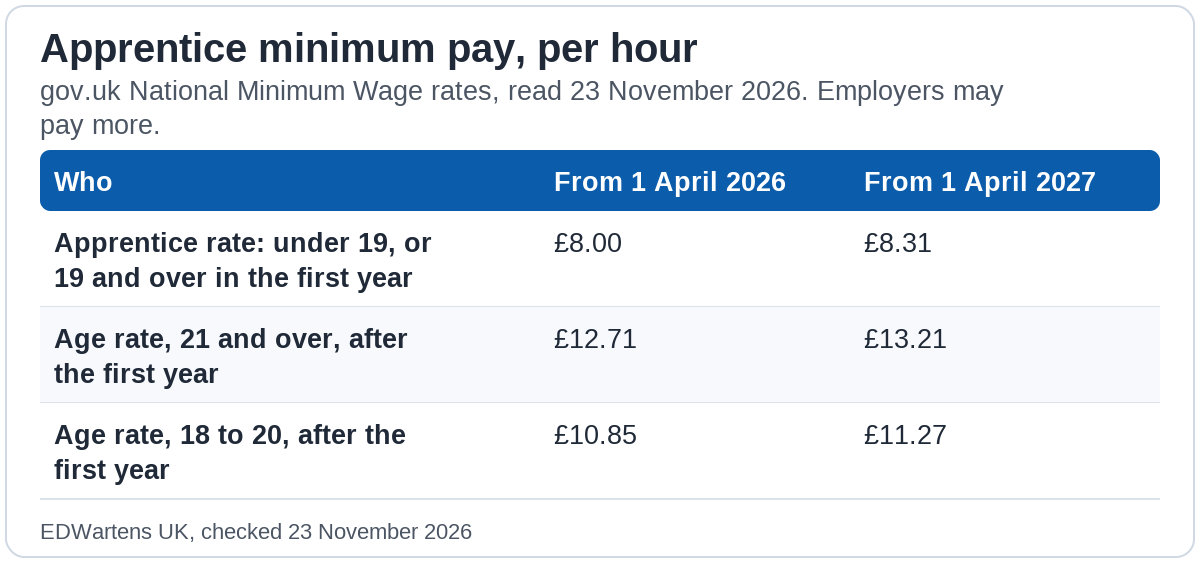
Here is the arithmetic for a 28 year old starting in 2026. These are minimums, before tax, at an illustrative 37.5 hour week. Employers may pay more, and many do.
| Period | Hourly minimum | At 37.5 hours a week |
|---|---|---|
| Year one, from 1 April 2026 | £8.00 | £300.00 |
| After year one, until 31 March 2027 | £12.71 | about £477 |
| After year one, from 1 April 2027 | £13.21 | about £495 |
The jump after year one is the real cost barrier for employers. An apprentice under 19 stays on the apprentice rate, while an adult moves to the age rate after twelve months. That is arithmetic from the gov.uk rates, not a survey of what employers think. If an advert quotes a figure, read it against these minimums. For typical pay once qualified, see our salaries page, where pay is shown only if an advert states it, and the National Careers Service profile for engineering maintenance technicians, which shows about £27,000 for starters and about £48,000 for experienced technicians.
Who pays for the training in 2026?
Employers do not pay full training fees for most apprentices. gov.uk's funding rules for new starts from 1 August 2026 are below.
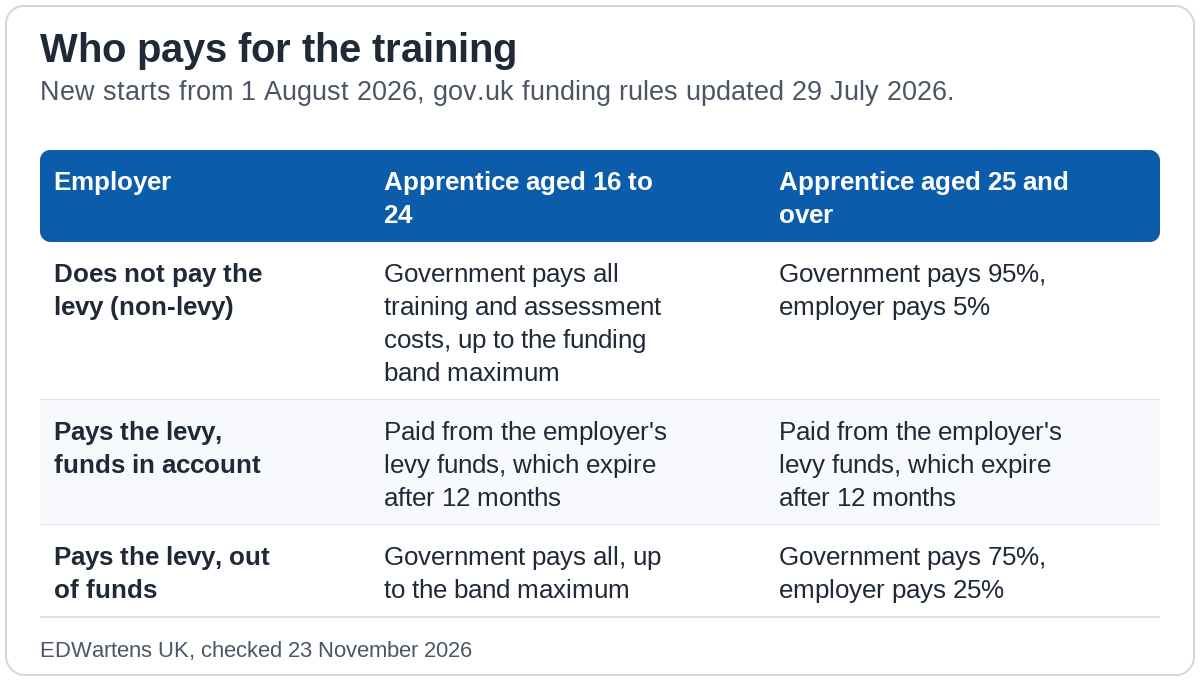
For an adult at a smaller employer, the government pays 95% of the training cost up to the funding band maximum and the employer pays 5%. For levy payers whose funds have run out, the employer's share for apprentices aged 25 and over rises from 5% to 25% for new starts from 1 August 2026, and the government pays 75%. gov.uk's levy factsheet says existing apprentices keep the earlier 95% government rate. The apprentice never pays training fees.
Two other 2026 changes affect the market. A £2,000 hiring payment for smaller employers starts from 1 October 2026, but only for apprentices aged 16 to 24, so it does not apply to you. And funding is being withdrawn from 16 apprenticeship standards for new starts from September 2026. Ask a provider whether the standard you want is still funded. Our employer guide to the 2026 funding covers the employer side.
How do you find and apply for an adult apprenticeship?
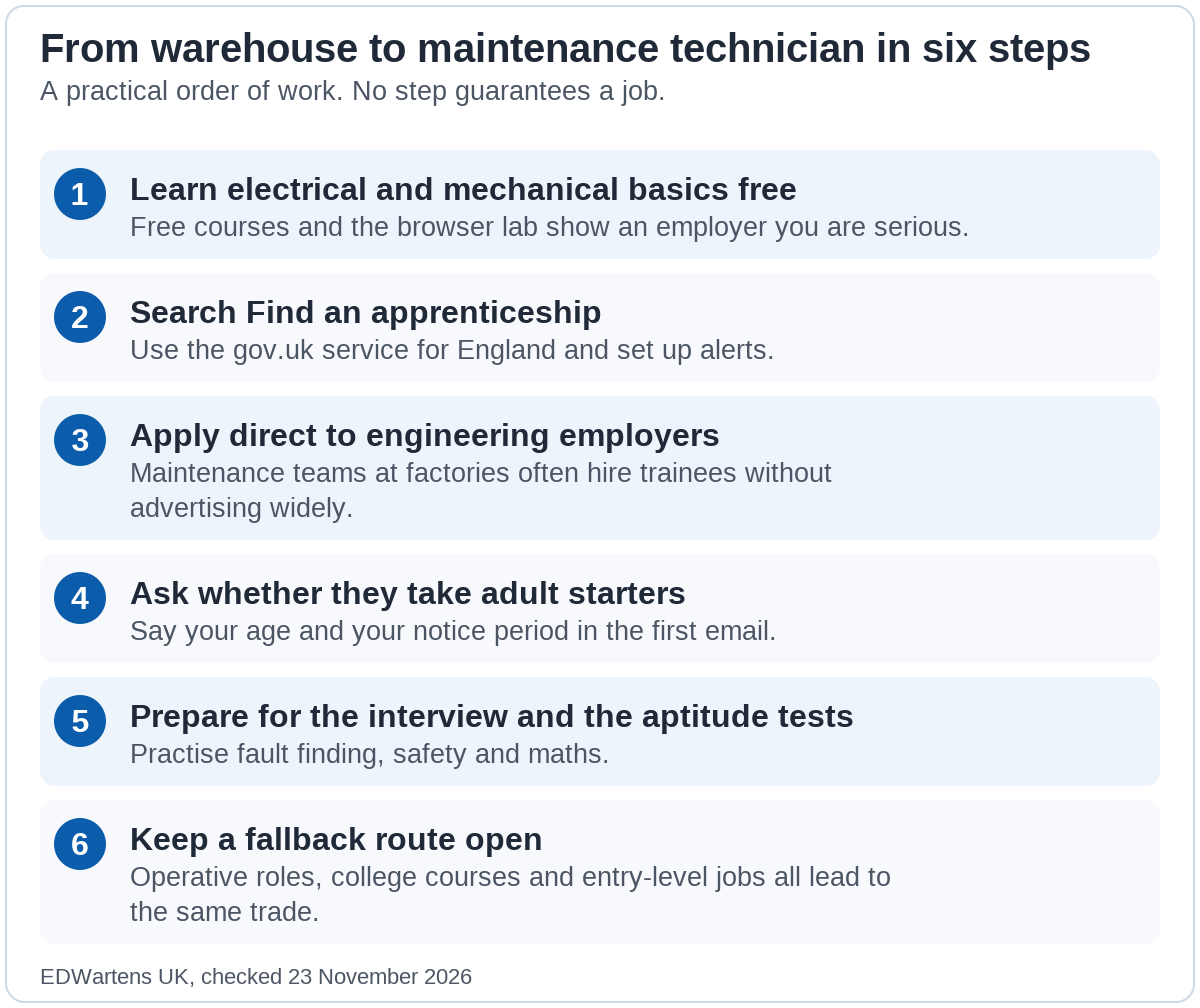
- Set up alerts on the gov.uk Find an apprenticeship service, filter by engineering and your area, and check each advert for age or qualification wording.
- Look at our apprenticeship jobs page and entry-level jobs, which list trainee roles.
- Contact the maintenance or engineering manager of local factories directly and ask whether they take adult apprentices or trainees. Say that you are an adult applicant early, so nobody is surprised.
- Ask local colleges and independent training providers about apprenticeships that start in your area.
What does a week as an adult apprentice look like?
Expect long weeks and a lot of juggling. The National Careers Service says engineering maintenance technicians typically work 40 to 42 hours a week and may work evenings, weekends and bank holidays on shifts. gov.uk says an apprentice gets study time of at least 20% of normal working hours, and how that time is delivered depends on the provider. If you have a family or a mortgage, check three things before you apply: the shift pattern, the travel to the training centre and the pay in year one. A gap between your current pay and £8.00 an hour can make an apprenticeship hard for an adult with bills to pay, so do the sums first and ask the employer whether it pays above the minimum.
What can you do if nobody takes you on?
Three routes lead to the same trade. The National Careers Service says you can start as an engineering operative and become a technician through on-the-job training and promotion. You can study at college. Or you can build skills free and apply for trainee or entry-level jobs. Our free engineering apprenticeship preparation path is not an apprenticeship, but it covers the electrical and mechanical basics. The page for career changers explains funded adult routes and the eligibility rules, and the maintenance engineer job simulation lets you practise a working day, with the first five days free. A simulation is practice, not employment.
For a wider comparison, read PLC apprenticeship vs short course vs degree and how to become a PLC engineer in the UK.
How do you stand out as an adult applicant?
Show evidence of electrical and mechanical basics before you apply. Employers hiring trainees want to see that you can follow safe working, read a simple circuit and turn up reliably. Finish a free course, such as Electrical Fundamentals for Technicians or Mechanical Maintenance Fundamentals, and keep the optional £19 certificate of completion, which anyone can verify. It is not a regulated qualification and does not replace an apprenticeship. Mention any transferable skills: shift work, safety training, driving licences and teamwork all count.
Start free
Try the free Multi-Skilled Maintenance Engineer course and browse live entry-level jobs to see what employers ask for. For the trade side, our multi-skilled maintenance engineer guide explains the role.