
To hire an apprentice in England in 2026, a non-levy employer gets government funding for all training and assessment costs (up to the funding band maximum) for apprentices aged 16 to 24, 95% of those costs for apprentices aged 25 and over, and a hiring payment of up to £2,000 for 16 to 24 year olds who start training from 1 October 2026. You still pay the apprentice's wages, which start at £8.00 an hour in 2026, and you provide supervision and time for training. This guide sets out what changed in 2026, who counts as a non-levy employer, what an engineering apprentice costs and how to advertise the vacancy.
What changed on 1 August and 1 October 2026?
Three dates matter for a smaller employer.
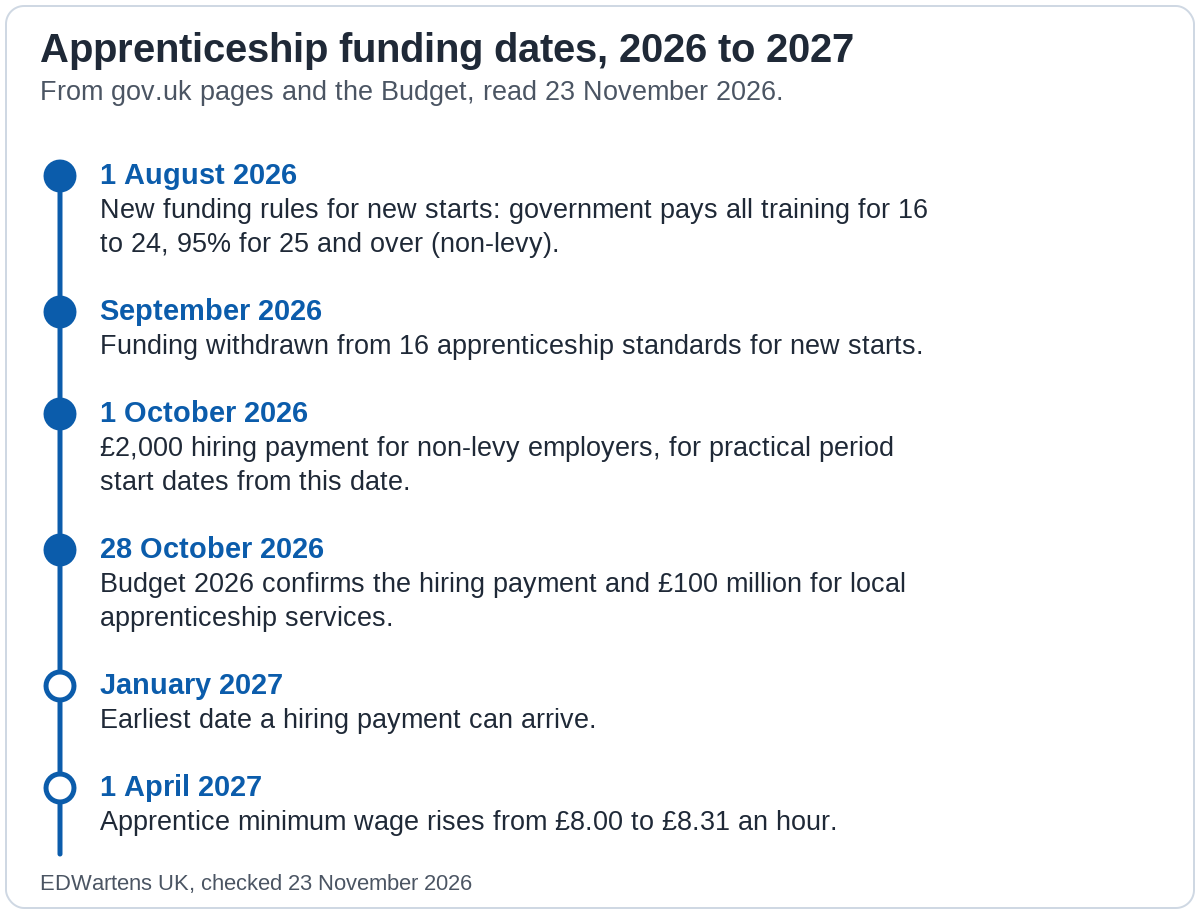
- 1 August 2026: new funding rules for new starts. gov.uk's funding page says non-levy employers get full funding of training and assessment costs, up to the band maximum, for apprentices aged 16 to 24, and the government contributes 95% for those aged 25 and over.
- September 2026: gov.uk's levy factsheet (2 September 2026) says funding is withdrawn from 16 apprenticeship standards for all new starts, with existing apprentices funded to completion. Employers can still fund these standards privately. Ask your provider whether the standard you want is still funded.
- 1 October 2026: the £2,000 hiring payment for non-levy employers applies where the apprenticeship agreement has a practical period start date from this day. The Budget document (28 October 2026) confirms it and adds £100 million over two years to expand local apprenticeship services so that all current mayors can offer tailored support.
Are you a non-levy employer?
You are probably a non-levy employer if your annual pay bill is £3 million or less. gov.uk says employers whose yearly pay bill exceeds £3 million pay the apprenticeship levy at 0.5% of the pay bill, with an allowance of £15,000 a year. A levy payer funds apprenticeships from funds in its apprenticeship service account, which expire after 12 months. Levy payers who run out of funds are funded for 16 to 24 year olds in full and for 25 and over at 75%, with the employer paying 25%.
Connected companies are counted together, so check with your accountant if you are part of a group.
What funding can you get when you hire an apprentice, by age?
| Apprentice age at start | Non-levy employer | Levy payer out of funds |
|---|---|---|
| 16 to 24 | Government funds all training and assessment, up to the band maximum | Same: government funds all, up to the band maximum |
| 25 and over | Government pays 95%, employer pays 5% | Government pays 75%, employer pays 25% |
Extras exist for some groups. gov.uk says employers get an extra £1,000, in two equal instalments, for apprentices aged 16 to 18 and for those aged 19 to 24 who are or were in care or have an education, health and care plan. Providers get a matching extra £1,000 for supporting them. If you are thinking of an adult hire, our guide to engineering apprenticeships for adults over 25 explains the 95% and 75% rules from the apprentice's side.
How does the £2,000 hiring payment work?
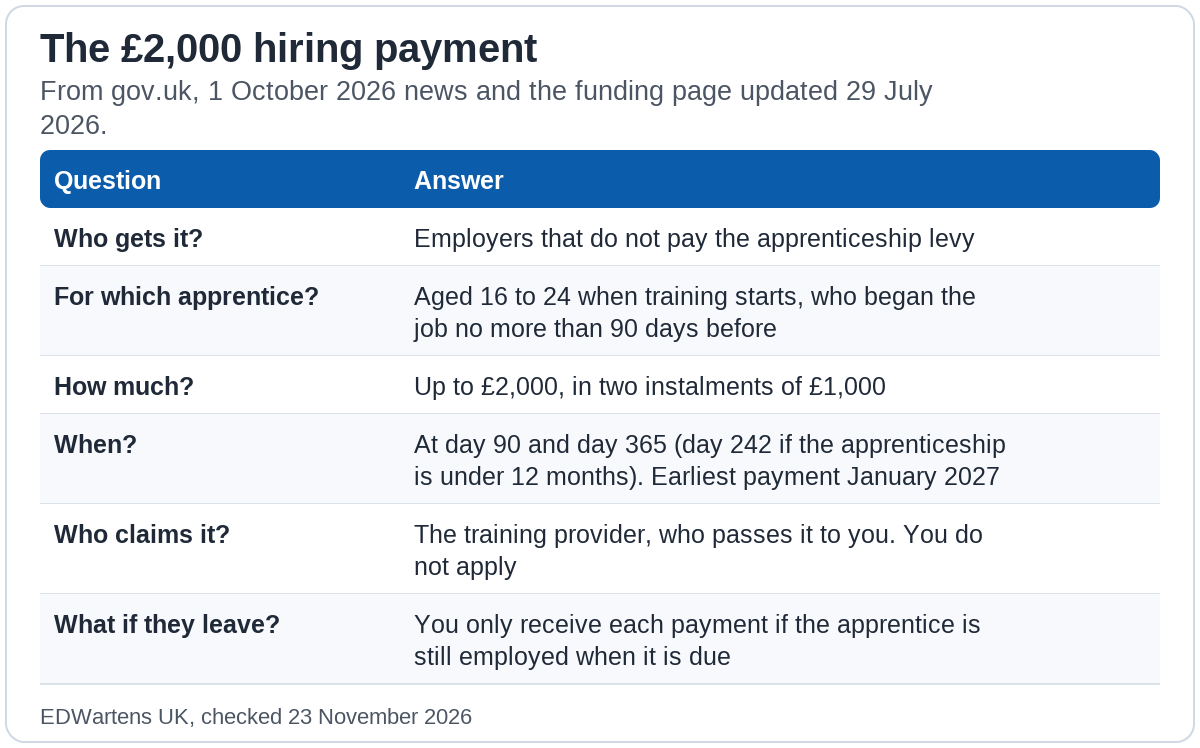
The payment is a contribution towards your costs of employing a young apprentice, not a wage subsidy for adults and not a training fee. gov.uk's funding page adds that the apprentice must be in a PAYE scheme added to the employer's account used for funding, and not employed by that employer for more than 90 days before the practical period start date. gov.uk's news item (1 October 2026) says the payment comes in two £1,000 instalments, you do not apply for it and the training provider passes it on within 30 working days of receiving it. The factsheet gives the earliest payment as January 2027. Do not count on it in your first-year budget until you have confirmed the timing with your provider.
For an official walk-through, the Department for Education's sector communications team recorded a webinar on the funding rules that apply from 1 August 2026. It runs about an hour. It covers the new hiring payment for non-levy employers (from about 10 minutes 40 seconds in) and employer co-investment (from about 34 minutes in), then takes questions. The recording is dated 17 June 2026 and says its information is correct at the time of publishing, so rules may have changed since it was made.
Credit: DfE Sector Comms on YouTube.
What does an engineering apprentice cost?
The legal minimum wage depends on age and year. gov.uk's rates say apprentices get £8.00 an hour from 1 April 2026 if they are under 19, or 19 or over and in the first year, rising to £8.31 from 1 April 2027. After the first year, a 19 or over apprentice gets the minimum for their age: £10.85 for 18 to 20 and £12.71 for 21 and over from April 2026. Arithmetic at an illustrative 37.5 hour week and 52 weeks, before employer National Insurance, pension and any extras:
| Apprentice | Hourly minimum | Yearly wage bill at minimum |
|---|---|---|
| Aged 16 to 18, or first year of any adult | £8.00 | £15,600 |
| Aged 21 or over, second year | £12.71 | about £24,785 |
These are floors. The market sets the real figure, and engineering employers often pay more. Add supervision time, equipment, tools, safety kit and the hours a mentor spends teaching. gov.uk says an apprentice must get at least 20% of their normal working hours for study related to their role. Read our guide to apprenticeship vs short course vs degree for the case for each route.
What does the first year look like for two different hires?
Take two illustrative hires at a non-levy employer, using only the gov.uk rules above. A 17 year old starting a Level 3 fitter apprenticeship in January 2027: training and assessment are funded up to the band maximum, the employer receives an extra £1,000 in two instalments because the apprentice is aged 16 to 18, and the £2,000 hiring payment is available in two instalments if the conditions are met. The wage floor is £8.00 an hour until April 2027, about £15,600 a year at 37.5 hours.
A 28 year old starting the same standard: the government pays 95% of the training cost and the employer pays 5%. There is no hiring payment, because it applies only to apprentices aged 16 to 24. The wage floor is also £8.00 in the first year, then £12.71 an hour (£13.21 from April 2027) from the second year. The adult hire costs more in wages from year two. They may also bring a driving licence and prior experience, but that depends on the person. Neither choice is right for every team. Decide on the person and the supervision you can give, then use the funding to make the sums work.
Which engineering apprenticeships fit a maintenance team?
For a maintenance or fitting team, the usual choices are Level 3 routes. The National Careers Service lists Level 3 Engineering Maintenance Technician and Mechatronics Maintenance Technician apprenticeships for maintenance technicians, and Level 3 Maintenance Operations Engineering Technician for fitters. Make UK describes its Level 3 Engineering Fitter programme as typically 42 to 48 months, leading to a BTEC Level 3 Diploma in Advanced Manufacturing Engineering and professional recognition with the IET as an engineering technician. For school leavers with no prior qualifications, a Level 2 foundation apprenticeship is open to ages 16 to 21 (some exceptions up to 24) and, per the levy factsheet, is fully funded with an 8 month minimum. Our guide to the mechanical fitter route and the multi-skilled maintenance engineer role show what the trade involves.
How do you advertise an apprentice vacancy?
gov.uk's employer guide sets out the steps: choose an apprenticeship and a training provider through the Find apprenticeship training service, check your funding and extra payments, create an apprenticeship service account, advertise the role through your account or let your provider post it, and agree an apprenticeship agreement and training plan with the apprentice. Apprentices can be new or existing employees.
Beyond the national service, our employers page lets you post a vacancy free of charge at present with no placement fee, and entry-level jobs lists trainee roles. Free does not mean guaranteed applicants. Candidates who want to prepare can try our free engineering apprenticeship preparation path, which is not an apprenticeship. For trainees in controls, our guide to what employers want from trainee PLC engineers, graduate schemes and hiring a controls engineer may help. Colleges and providers can find out about working with us on our partners page; EDWartens holds no adult skills funding and is not a Skills Bootcamp provider.
What should you check before you advertise?
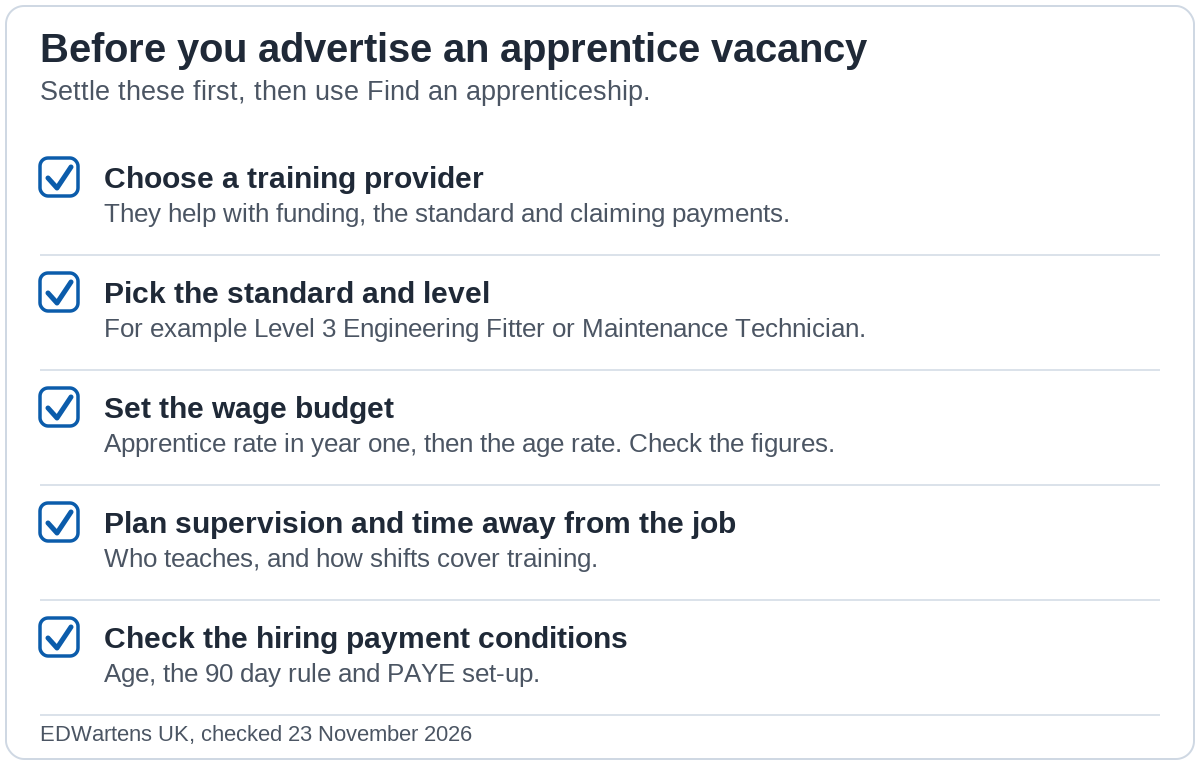
Ask the provider to put funding, the start date and the hiring payment conditions in writing. Funding rules are updated often, so confirm them on gov.uk when you sign.
Start free
A new apprentice benefits from basics before day one. Point them to the free Electrical Fundamentals for Technicians and Mechanical Maintenance Fundamentals courses, each with an optional £19 certificate of completion. Use our maintenance engineer job description template to write the role.