
Recruitment agency fees in the UK are usually a percentage of the hired person's first-year salary, set in the agency's terms of business and charged only when a hire starts, apart from retained searches that bill in stages. A vendor guide dated 12 February 2026 puts permanent construction and engineering fees at 15 to 20% and temporary margins at 18 to 25%, but your own agreement decides what you pay. This guide sets out how fees are calculated, what the law says about temp-to-perm transfer fees, the free ways to advertise engineering jobs and what to check before you sign.
What are typical recruitment agency fees in the UK?
There is no standard price list. Agencies agree a percentage with each client, so published ranges are guides. The routes below are the ones a manufacturer or maintenance team normally weighs up.
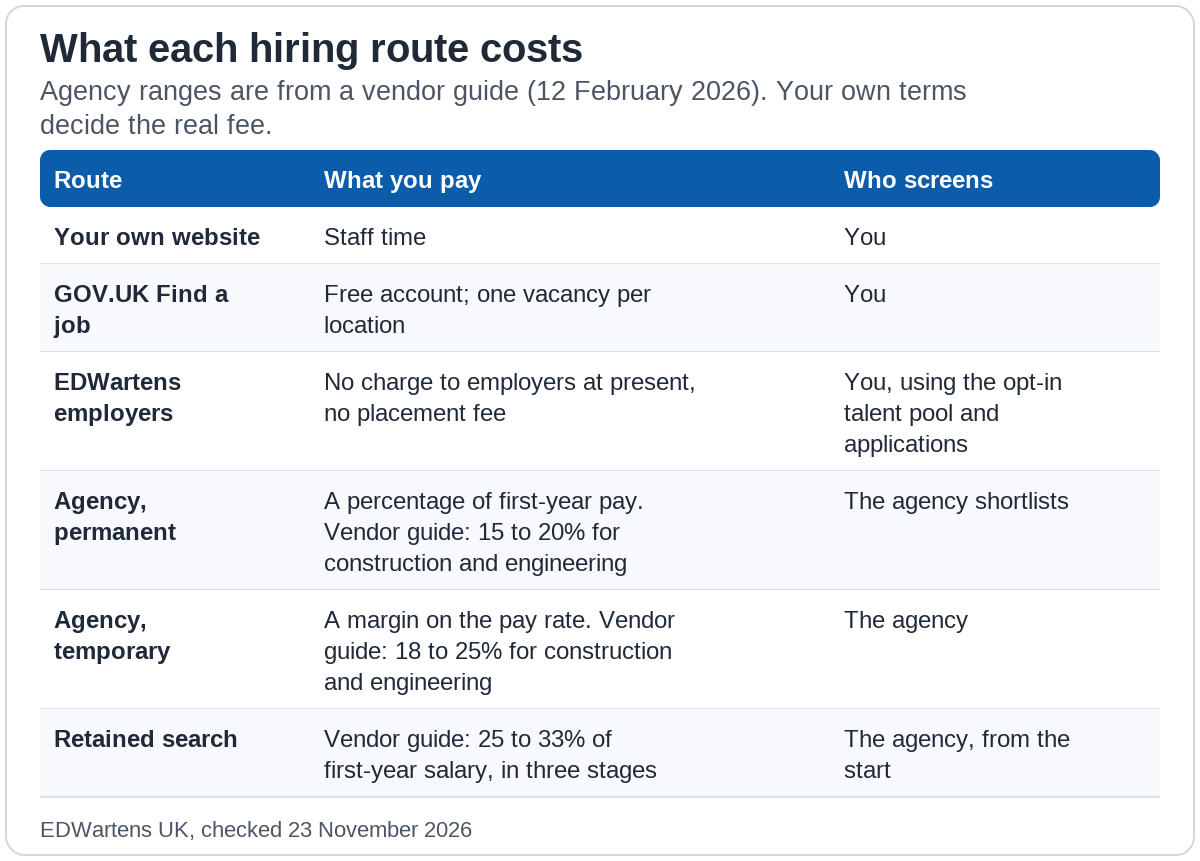
The agency percentages come from Recruitly's guide to recruitment agency fees (updated 12 February 2026), which is a software vendor's summary of what agencies on its platform charge. It gives permanent contingency recruitment at 15 to 20% of first-year salary, temporary margins on the worker's pay rate of 15 to 30% (18 to 25% in construction and engineering) and retained search at 25 to 33% of first-year salary, paid in three stages. We name it because it is the most specific dated source we could open, and we treat it as indicative.
How is an agency fee calculated?
One large agency's published terms of business for permanent and fixed-term placements (February 2026) show the mechanics. They say the placement fee is calculated as a percentage of the candidate's salary package, that the percentage is agreed in writing or defaults to the agency's standard fee schedule, and that fees exclude VAT. Terms differ between agencies, so read yours.
An illustration with arithmetic only: a maintenance engineer advertised at £45,000 a year.
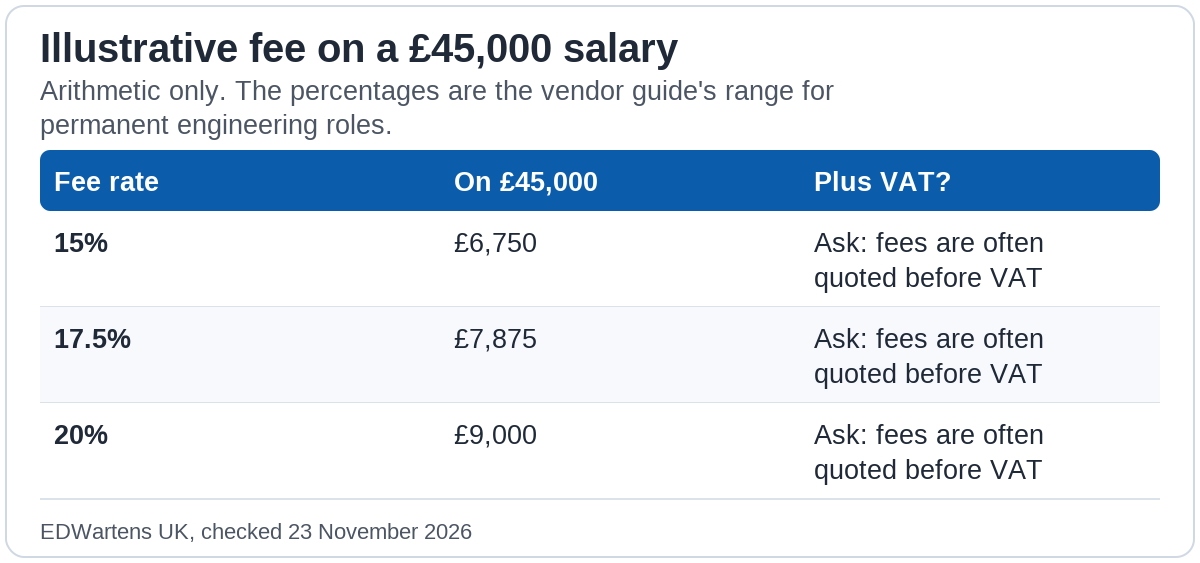
Ask three questions that change the total: what counts as salary (basic pay only, or allowances and bonuses), whether VAT is added and whether the percentage falls for several hires. A £2,000 shift allowance, for example, moves a 17.5% fee by £350 if the terms count it.
Retained search is different because the fee is invoiced in stages before anyone is hired. On the same £45,000 salary, the vendor guide's 25 to 33% range would be £11,250 to £14,850 in total. The agency terms we read bill 33% of the fee when the agency agrees to start, 33% when the shortlist is presented or after 30 days and the balance when the candidate accepts, so a retained search can cost money even if the hire does not happen. Ask what happens to the stage payments if you fill the role yourself.
| Stage in the agency terms we read | When it is invoiced | Share of the fee |
|---|---|---|
| 1 | When the agency agrees to start the search | 33% |
| 2 | When the shortlist is presented, or 30 days after agreeing, whichever is sooner | 33% |
| 3 | When the candidate accepts an offer | The balance |
What are the rules on temp-to-perm transfer fees?
gov.uk sets the rules for fees when a temporary worker becomes permanent. According to its guidance on employment agencies, an agency can charge a transfer fee only if the contract gives the hirer the option to extend the assignment, the hirer does not take it up and the hirer gives the worker a permanent job within the time limits. Those limits are: less than 8 weeks after the end of the initial assignment, or less than 14 weeks after it started if that is later. All transfer fees and conditions must be in the contract, an agency cannot charge a transfer fee in any other situation and a hirer can recover money paid for fees that break the rules.
| Condition for a transfer fee (all must apply) | Rule from gov.uk |
|---|---|
| The contract | Gives the hirer the option to extend the assignment, and sets out the fee and conditions |
| The option | The hirer does not take it up |
| The timing | The permanent job starts less than 8 weeks after the initial assignment ends, or less than 14 weeks after it started if that is later |
| Anything else | No transfer fee can be charged, and a hirer can recover fees that break the rules |
In practice, if you plan to hire a temporary maintenance engineer permanently, check the date arithmetic against your agreement before you offer a permanent contract. Our guide to hiring a controls or PLC engineer covers contract and permanent choices for specialist roles.
What happens if the hire leaves early?
Look for a rebate or replacement clause. The same agency's terms say no rebate of placement fees will be made. If the candidate does not start or leaves within nine weeks including notice, the agency will use reasonable endeavours to find a replacement, on conditions: the candidate leaves of their own volition, invoices are settled, the request is exclusive to that agency and the agency is told in writing within 14 days. That is one agency's wording and not a market rule. The point is to compare the clause before you sign, not after a hire leaves.
What are the free ways to advertise engineering jobs?
Three places cost nothing to post to, and each does a different job.
- GOV.UK Find a job. gov.uk's guide for employers (updated 23 June 2026) says you can create a free account to post vacancies online. Each vacancy is location specific, so you post separately for different towns or areas.
- EDWartens. Our employers page lets you post jobs, search an opt-in talent pool and request a shortlist, with no charge to employers at present and no placement fee. Jobs posted on EDWartens are shown in full and can be applied for on the site. Free does not mean guaranteed: we do not promise applicants or hires. "Vetted" on a profile means a skills-evidence check, not an identity, reference or right-to-work check, which you must still do yourself. Our how we vet page explains.
- Your own website and networks. Staff referrals, a careers page and local colleges cost only time.
The UK engineering pay index shows the median advertised salary by role in live UK adverts on our board, which helps you set pay that attracts applicants.
What does a direct hire cost you in time?
An agency fee buys time as well as search, so count your own hours before you compare. A direct hire needs an advert, a screening pass, interviews, reference and right-to-work checks and an offer, and each step has an owner. Write the list for your team: who writes the advert, who reads CVs each day, who interviews, who does the checks and who signs the offer. If one person is doing all of it on top of a day job, the real cost of a direct hire is their time, and a fee may be good value. If you have a maintenance manager who knows what a good fitter looks like, the free routes are often enough. Either way, keep the dates: how long the vacancy was open, how many applications came in and how many reached interview. After one hire you will know what a direct route costs you, and you can compare it with the percentage on an agency's terms.
When is an agency still worth paying?
Sometimes, and it is reasonable to say so. An agency can be worth the fee when the role is hard to fill, such as a senior controls engineer, when you need a large volume of temporary cover quickly, when you lack HR capacity to screen or when you need contract cover for a project with a fixed end. Agencies are welcome on our board and their adverts are labelled Agency. What you pay for is search, screening and speed, so decide which of those you actually lack. If you have time and a clear advert, direct and free routes may serve you.
How do you write an advert that attracts direct applicants?
Be specific. State the pay, the shift pattern, any on-call, the kit and the sector. Vague adverts bring in few applicants and many poor fits. Our job description templates give a structure for each role: maintenance engineer, multi-skilled maintenance engineer, controls engineer, PLC engineer and electrical maintenance engineer. If the role has a rota, say so: our guides to the 4 on 4 off shift pattern and on-call pay show what candidates want to know. For trainee roles, see our guide to what employers want from trainee PLC engineers and our post on hiring an engineering apprentice, and our UK PLC and automation job market 2026 shows what the market looks like.
What should you check before you sign agency terms?
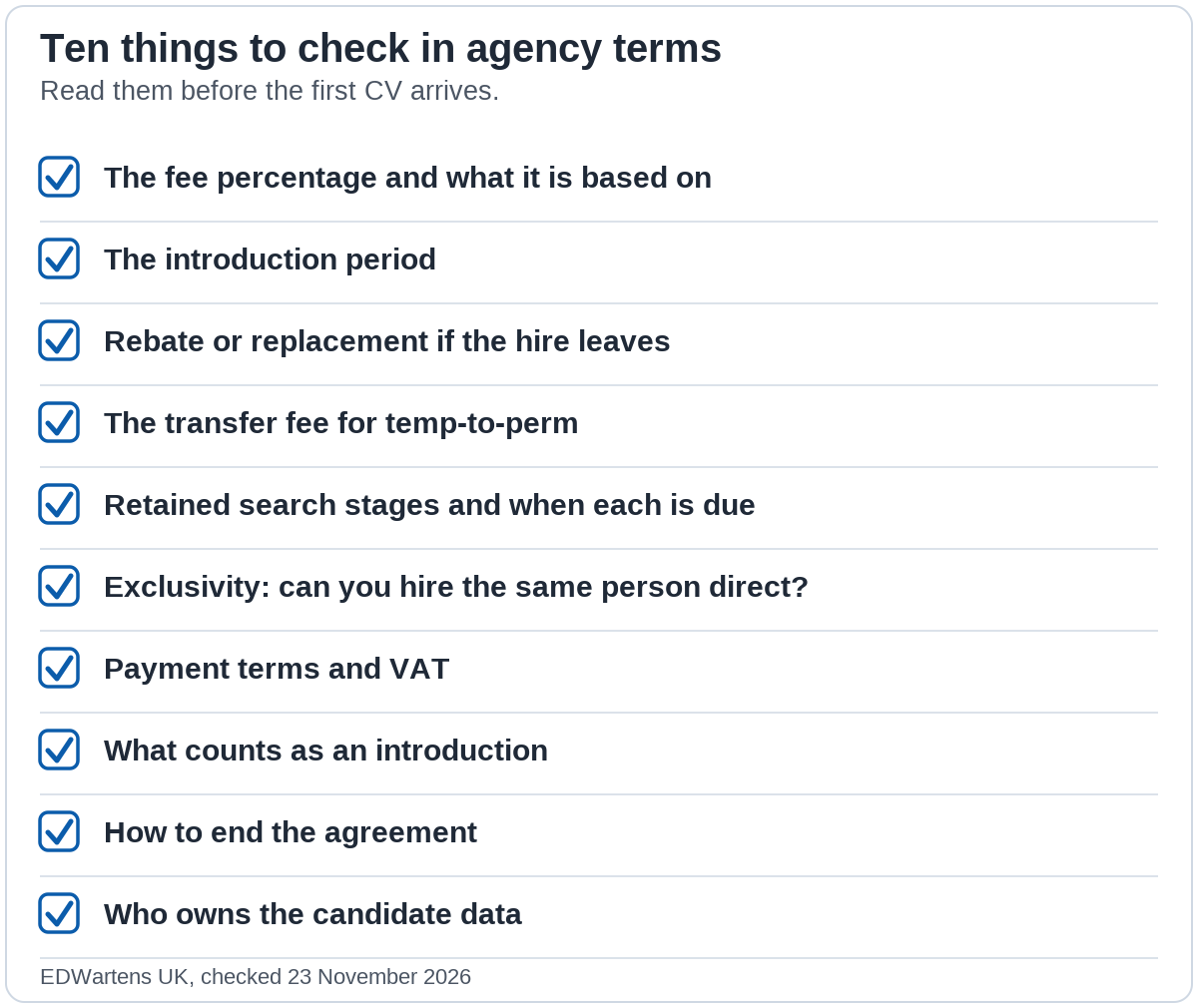
Ask for the terms before the first CV arrives. If a clause is unclear, ask for it in writing, and have a solicitor read anything you do not understand. Never rely on a verbal promise about fees or replacements.
Start free
If you hire trainees, point them to our free courses, which cover electrical and maintenance basics and carry an optional £19 certificate of completion. Post a job or search the talent pool and compare it with your agency terms.