
On call pay for a maintenance engineer in the UK is set by the employer's contract, usually as a weekly or nightly allowance plus extra pay for call-outs, and we found no published UK benchmark rate we can cite. What the law does set is what counts as working time: gov.uk says time on standby or on call at or near the workplace counts for the minimum wage, while time spent at home waiting to be called in does not. This guide explains the three common ways on-call is paid, how the working time rules apply, how to compare two offers with a worksheet and what to ask at interview.
What do on-call, standby and call-out mean?
Employers use the words loosely, so ask which one an advert means.
- On-call or standby: you are available to be contacted and to attend a fault outside your normal hours, for example for a week on a rota.
- Call-out: the work you actually do when called, including travel if the contract counts it.
- Standby allowance: money paid for being available, whether or not you are called.
- Sleep-in or on-site: you stay at the workplace, which is treated differently from being at home.
The National Careers Service describes engineering maintenance technicians as working 40 to 42 hours a week, with evenings, weekends and bank holidays on shifts, and does not mention on-call. So an on-call rota is something to ask about, not something to assume. Our guide to the 4 on 4 off shift pattern covers base pay, shift allowance and overtime for shifts, and this guide covers the on-call part.
How is on-call pay for a maintenance engineer set?
There are three common patterns. Contracts mix them.
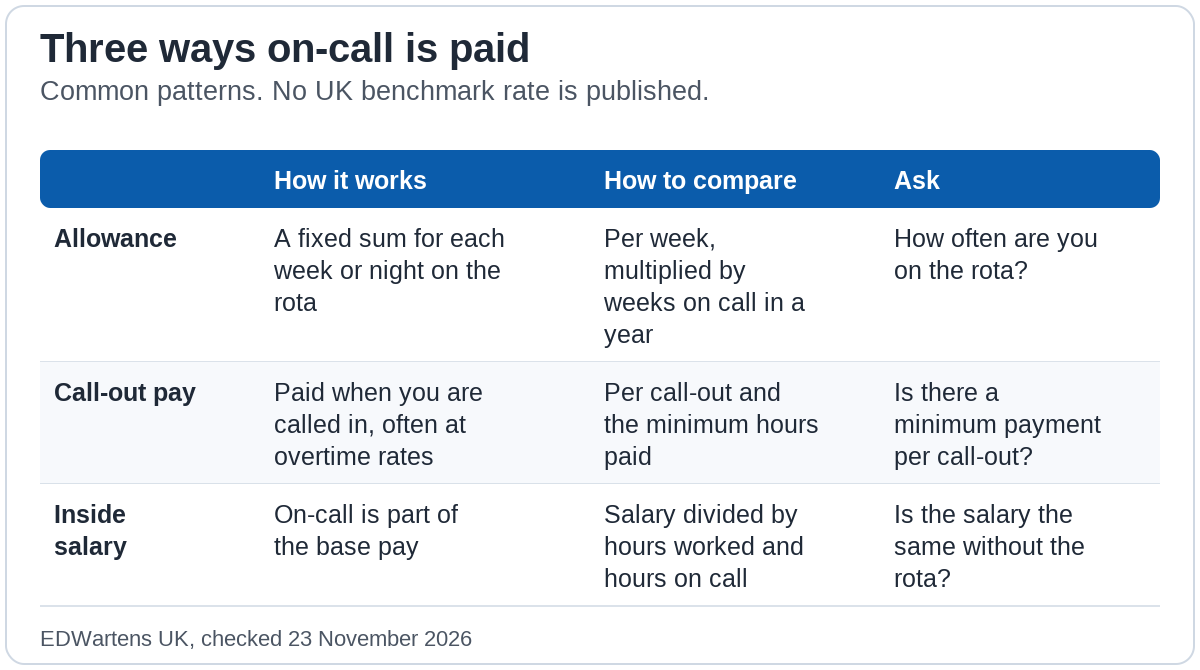
An allowance pays for being available. Call-out pay rewards the hours you work. Inside salary means the money is in the base and you are expected to be on call without a separate payment. None is better in itself. What matters is how often the rota runs, how many call-outs you can expect and whether the base would be the same without it.
Can we say what the market pays? Not with a source. We searched for a UK benchmark for private-sector maintenance engineers and found no published rate we can cite. Advertised pay on our board is shown only where an advert states it. Our salaries page and the UK engineering pay index show advertised salary by role, and our PLC engineer salary guide gives context for base pay. For scale, the ONS Annual Survey of Hours and Earnings 2026 puts median full-time pay across all jobs at £40,911 in April 2026, up 4.5% on the year.
Does on-call time count as working time?
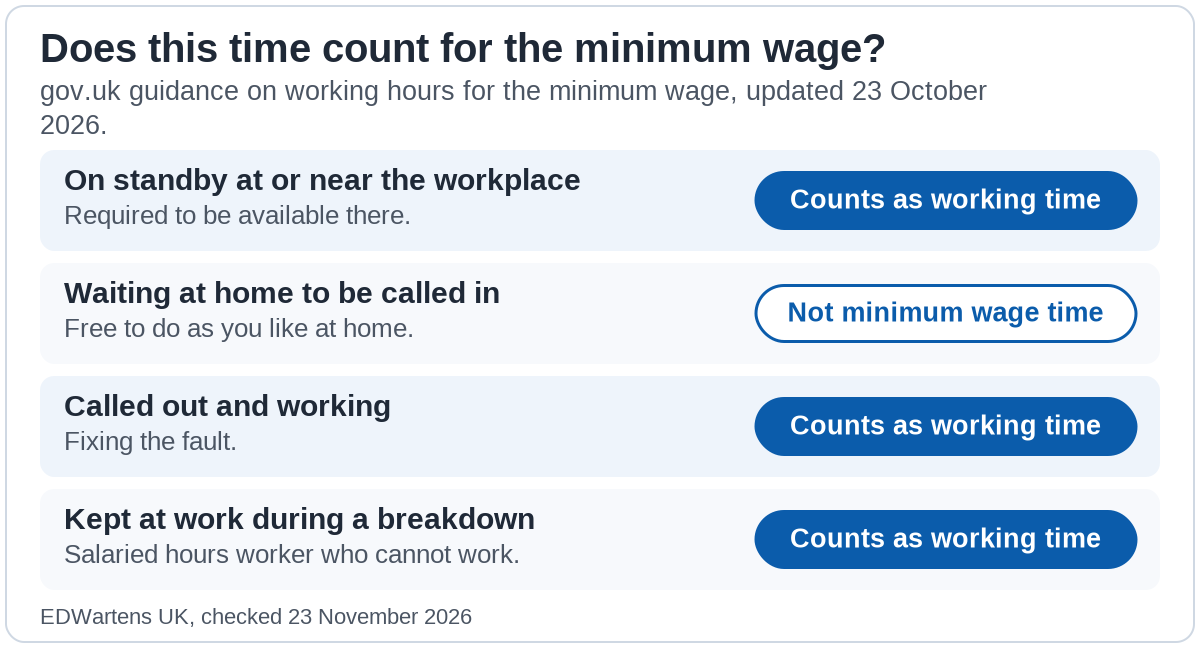
For the minimum wage, it depends on where you are. gov.uk's guidance on working hours for the minimum wage (published 1 March 2021, updated 23 October 2026) says time you are required to be available for work, on standby or on call at or near your workplace, counts as working time, unless you are at home. A worker waiting at home to be called in is not owed the minimum wage for that time. It also says salaried hours workers who are kept at their workplace but cannot work, for example because of a machine breakdown, still count as working.
The Acas page on being on call (updated 21 March 2025) adds that on-call time can count as working time if the worker is doing work the employer requires, and is more likely to count the more control the employer has over where you are and what you do. It says workers must be paid at least the National Minimum Wage on average during their pay reference period. Hours you actually work on a call-out count as working hours.
Does on-call count towards the 48-hour week, and what about rest?
The gov.uk page on maximum weekly working hours says you cannot work more than 48 hours a week on average, usually over 17 weeks, and that you can choose to opt out. It does not say how on-call counts, and Acas says on-call time can count if you are doing work the employer requires, so ask your employer how it records on-call hours.
| Rule | What it says | Source |
|---|---|---|
| Minimum wage, standby or on call | Counts at or near the workplace, not at home | gov.uk |
| Weekly limit | 48 hours on average, usually over 17 weeks, unless you opt out | gov.uk, Acas |
| Daily rest | At least 11 hours' uninterrupted rest between working days | Acas |
| Weekly rest | At least 24 hours in a 7-day period | Acas |
Rest matters after a night call-out. Acas says workers must get at least 11 hours' uninterrupted rest between finishing work and starting the next day, and at least 24 hours of rest in a 7-day period. If the employer cannot give the daily rest, it must make sure you still get it, which Acas calls compensatory rest. Take an example. If a call-out ends at 3.30am, 11 hours of rest means you would not be due back until 2.30pm, so a 7am shift would have to move, or the employer would have to make sure you still get the rest. Ask how this works in practice before a day shift. Acas also says on-call workers are entitled to the same rest breaks as everyone else if they need to be available for work.
Acas has also recorded a webinar on the Working Time Regulations. It covers who is protected, what may count as working time, the average 48-hour limit and opt-outs, and daily and weekly rest including compensatory rest. It is about working time in general, not on-call pay, and it was published in October 2026, so check Acas for later changes.
Credit: Acas on YouTube.
What is the difference between an allowance and being paid for hours?
An allowance rewards availability: you give up evenings, drinks and travel plans for a week. Hours worked reward effort: you drive in, find the fault and fix it. A good contract pays both, and the question is the rate for each. When a contract pays only an allowance, ask how call-outs are treated: some employers count them as overtime, some give time off in lieu and some include a set number of call-outs in the allowance. When a contract pays only call-out hours, ask what happens in weeks you are on the rota but are not called, because you still carry the disruption. Whichever applies to you, write the pattern into your worksheet so you can see what a quiet week and a busy week are worth.
How do you compare two offers with on-call?
Put the whole package into one yearly figure. The sheet below has blank cells for you to fill in.
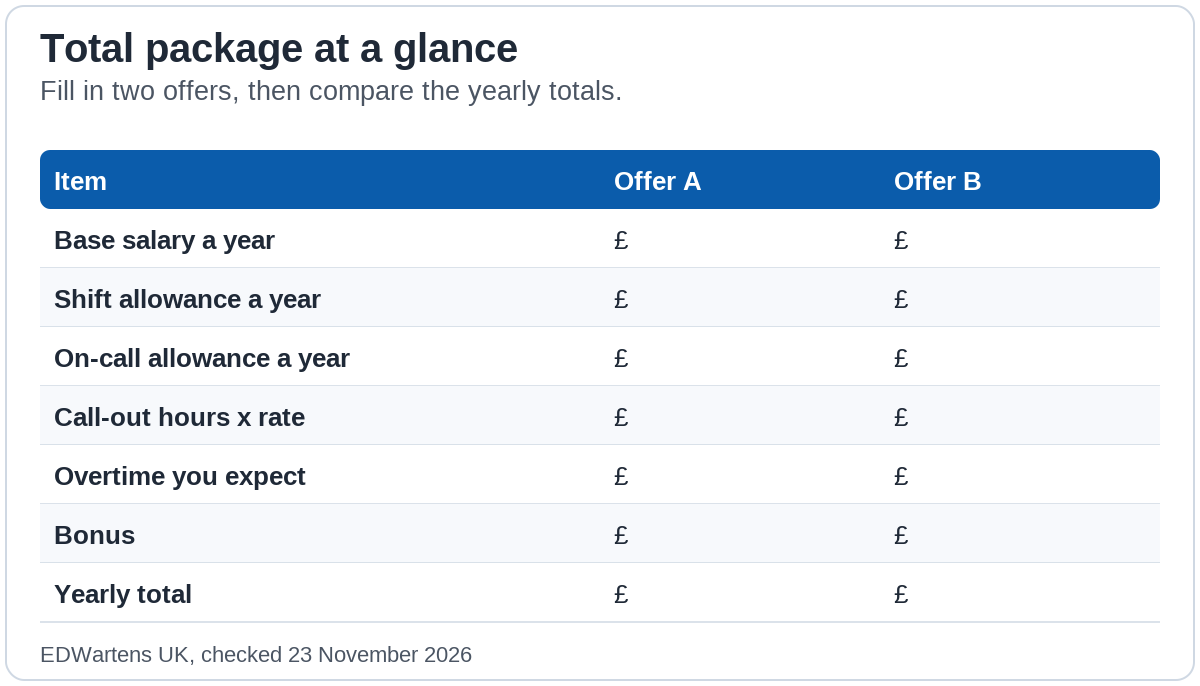
Here is an example using made-up numbers, only to show the arithmetic.
| Offer A | Offer B | |
|---|---|---|
| Base salary | £38,000 | £35,000 |
| On-call allowance | none | £70 a week, one week in four (13 weeks) = £910 |
| Call-outs | none | 20 hours a year at 1.5 times base hourly rate = about £538 |
| Yearly total | £38,000 | about £36,448 |
Offer B's hourly rate is £35,000 divided by 52 weeks and 37.5 hours, about £17.95, so 1.5 times is about £26.92 an hour. Offer B is about £1,552 a year lower, and the engineer in offer B also gives up a week in four. That is not a judgement. Some people choose the rota for the training, the overtime or the chance to progress. The point is that two headline numbers are not comparable until you count the on-call.
What should you ask at interview about on-call?
- How many engineers are on the rota, and how often would I be on call?
- Is there an allowance, call-out pay or both, and what is the rate?
- Is there a minimum payment per call-out, and does travel count?
- Do I attend on site or support remotely?
- What rest do I get after a night call-out, and who covers my shift?
- Is on-call written in my contract, and can the rota change?
- Is the salary the same if I am not on the rota?
Our maintenance engineer interview questions cover the rest of the interview. If you are comparing a travelling role, our field service engineer guide lists questions on travel time and nights away.
How should employers state on-call in an advert?
Say it plainly: how often, what is paid and whether attendance is on site. Candidates compare offers, and an advert that states the rota attracts people who accept it. Use our maintenance engineer job description template, and read our guide to engineering recruitment agency fees if you are weighing how to hire. Post your role on our employers page, which is free at present with no placement fee. The electrical maintenance engineer role page lists current adverts for the role, so you can read how they word shifts and on-call.
Start free
If you are moving into maintenance, the free Multi-Skilled Maintenance Engineer course covers shift handovers and logging work in a CMMS, which matter on a rota. The free PLC electrical troubleshooting course helps with the faults you will be called out to. The optional £19 certificate of completion is not a regulated qualification. Read our multi-skilled maintenance engineer guide for the role.