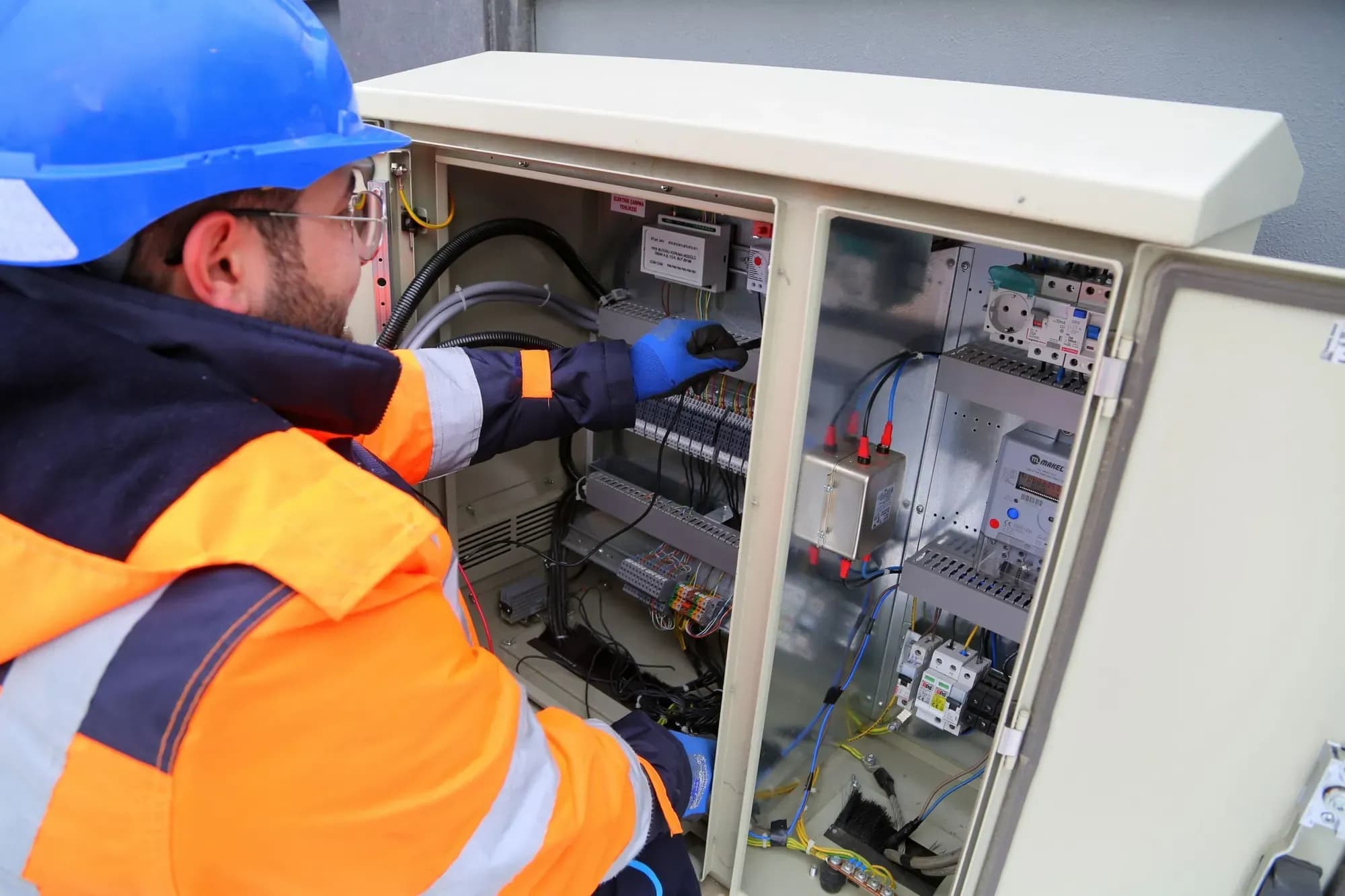
A field service engineer installs, services and repairs equipment at customers' sites, usually travelling from job to job and reporting back to a service manager. In industrial automation the equipment is machines, drives, controls and PLC systems, and the usual route in is a trade or maintenance background plus customer skills. No single qualification is required: employers advertise for electrical, mechanical or controls experience, a driving licence and the ability to explain a fault to a customer. This guide covers what the job involves, how it differs from maintenance and commissioning, what the pay evidence says and how to get in.
What does a field service engineer do?
The job moves with the customer. A day might start with a callout to a stopped packaging line, continue with planned maintenance at another site and end with a service report. Typical duties on adverts for automation equipment include:
- Installing and commissioning new equipment at the customer's site.
- Planned preventative maintenance to a schedule or a service contract.
- Fault finding and repair, often against the clock because the customer's line is stopped.
- Training the customer's operators and maintenance staff.
- Writing service reports, ordering parts and recording hours.
Customers judge you on how quickly the line restarts and on how clearly you explain what went wrong. That is why service adverts stress communication as much as technical skill, and why a clear, short service report is part of the job rather than paperwork afterwards. Safe isolation, permits to work and site rules on someone else's premises matter as much as they do on your own site.
The title is used across many sectors, from lifts and domestic appliances to medical, telecoms and IT equipment. Search results for it mix all of them, so read each advert for the equipment and the skills asked for. This guide is about industrial and automation field service. Our field service engineer jobs page shows current UK adverts.
How is field service different from maintenance and commissioning?
All three share electrical and mechanical fault finding. The difference is who the customer is and where you spend your time.
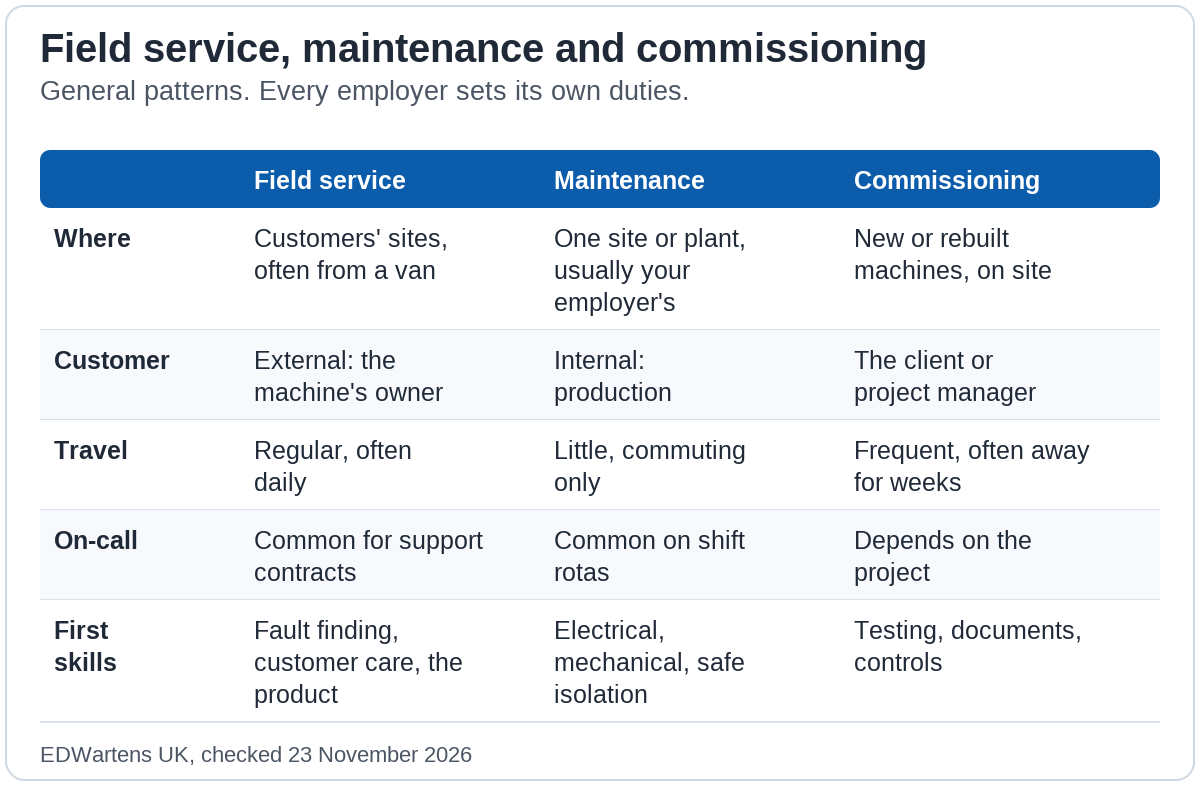
A maintenance engineer works on one site and keeps its machines running, as our multi-skilled maintenance engineer guide explains. A commissioning engineer brings new or rebuilt equipment into service, which our commissioning engineer guide covers. Field service sits between them: you know one machine range well, but your sites change. That is why many field service engineers move across from maintenance after a few years, and why the move back is also common.
What do employers ask for?
There is no standard entry requirement, so the advert is the guide. The National Careers Service profile for engineering maintenance technicians lists an apprenticeship, college courses or starting as an operative as the routes into maintenance, and field service adverts often ask for the same background. Common requests are:
| Employers often ask for | Why |
|---|---|
| Electrical or mechanical trade background | You fix equipment, so you need the basics |
| Controls and PLC basics | Modern machines are controlled by software |
| A full UK driving licence | You travel to sites, often in a company van |
| Customer service skills | You work in front of the customer |
| A recognised qualification (such as an HNC or an apprenticeship) | Some employers ask for one; many do not |
| Willingness to work away or on call | Some roles involve nights away or a call-out rota |
ITJobsWatch, which analyses UK adverts, found Customer Service in 27.3% of permanent field service engineer adverts in the six months to 23 November 2026, Preventative Maintenance in 14.5%, Problem-Solving in 14.1% and an HNC in 11.0%. Those percentages describe adverts across all sectors, so use them as a guide to which skills appear, not as a recipe for industrial automation.
How much does a field service engineer earn?
There is no single reliable figure, because the title spans industries. Here is the evidence, with its limits.
| Source | Figure | Limits |
|---|---|---|
| ITJobsWatch, adverts for field service engineer, six months to 23 November 2026 | Median £43,500 from 502 quoted salaries among 608 permanent adverts, up 21.43% on the year | Tracks IT-skewed adverts, so it can overstate IT and office field service and understate industrial work |
| National Careers Service, engineering maintenance technician | About £27,000 starter to about £48,000 experienced | A related job, not field service itself |
| ONS Annual Survey of Hours and Earnings 2026 | Median full-time pay £40,911 in April 2026, up 4.5% | All jobs, not engineers |
So £43,500 is a median for adverts that use the title, not a promise for automation field service, and the National Careers Service range is wide. Adverts often add overtime, a van, a callout allowance or mileage, so compare the whole package. Our salaries page and the UK engineering pay index show advertised pay by role where adverts state it. We do not estimate pay that an advert does not state.
How do you compare two field service offers?
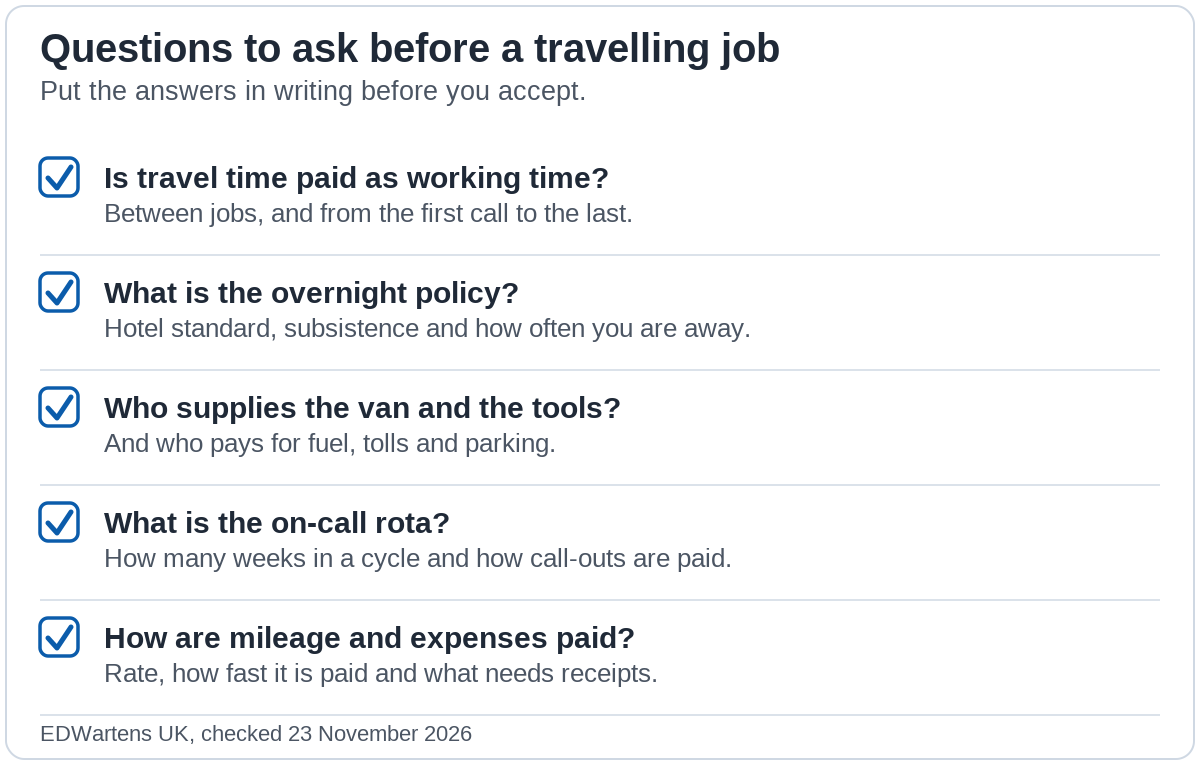
Two adverts with the same salary can be very different jobs. Put these side by side before you decide:
- Territory. A regional patch from home is a different life from national cover with nights away.
- Vehicle and tools. Is there a company van, who pays for fuel and can you use it privately?
- On-call. How many weeks in a cycle, and what is paid per week or per callout?
- Training. Does the employer pay for manufacturer courses and give you time to take them?
- Hours and overtime. Are overtime and travel time paid, or inside the salary?
Write the answers in the total package worksheet in our on-call pay guide, then compare the yearly totals rather than the headline number. If an employer will not answer these questions before an offer, that tells you how it will treat you afterwards.
How do you get into field service engineering?
Most people arrive from an adjacent trade. A practical route over about twelve months looks like this:
- Build the basics. Learn electrical safety, fault finding and basic controls. The free Electrical Fundamentals for Technicians and PLC electrical troubleshooting courses cover this.
- Get a trade or maintenance post. An apprenticeship, a college course or an operative role gives you site experience. See our guide to engineering apprenticeships for adults if you are changing career.
- Choose a product range. Service engineers become useful on a specific family of machines, drives or controls. Learn one well.
- Show customer skills. Write a clear fault report. Our CV tips for automation engineers show how to present that.
- Apply for assistant or trainee service posts. Entry-level adverts exist, and our entry-level jobs page lists some.
If you already work with PLCs, the paid Siemens Module and Allen-Bradley Module cover the controls side. They are independent of the vendors, are not official Siemens or Rockwell courses, and you practise in our browser lab rather than on real vendor software. They do not promise a job, so read the course pages before you pay.
What are the downsides to ask about?
Travel is part of the job, so ask about it before you accept. The National Careers Service notes that maintenance technicians may work evenings, weekends and bank holidays on shifts, and field roles can add callouts and nights away. For what counts as working time for the minimum wage, see the gov.uk guidance on working hours for which it must be paid. Our on-call pay guide covers standby and call-out money.
How can you practise fault finding for free?
A field service engineer is paid to find the fault quickly. The RealPars video below walks through a systematic way to troubleshoot industrial electrical circuits, and it is part of our free electrical course.
Credit: RealPars on YouTube. For hands-on practice, the EDWartens Lab has free browser simulators for motor control and PLC logic, and our job simulations include the Commissioning Engineer, Maintenance Electrical Engineer and Multi-skilled Maintenance Engineer days. A simulation is practice, not employment. To compare with PLC fault finding, read our PLC troubleshooting guide.
Start free
Take the free Multi-Skilled Maintenance Engineer course, then browse live field service jobs. The optional £19 certificate of completion shows you finished the course, and anyone can verify it. It is not a regulated qualification and does not promise an interview or a job.