Free course · Mechanical maintenance
Mechanical Maintenance Fundamentals
This free course teaches the mechanical maintenance basics that keep UK factories running: identifying and fitting bearings, recognising failure modes, greasing correctly, shaft alignment and couplings, belts and chains, gearboxes, fasteners and torque, and simple vibration checks. It suits apprentices, operators, electrical technicians who want mechanical skills, and career changers heading into maintenance. It helps with mechanical fitter, maintenance technician and multi-skilled maintenance roles. A bench with a bearing, a torque wrench and a belt gauge makes practice more real.
Mechanical Maintenance Fundamentals is a free online beginner Mechanical maintenance course with 8 modules, self-paced video lessons. Learning is free; an optional verifiable certificate costs £19 including VAT when you pass the final exam. Last updated 28 October 2026.
Free to learn. Verifiable certificate £19 when you pass the final exam (optional, VAT included).
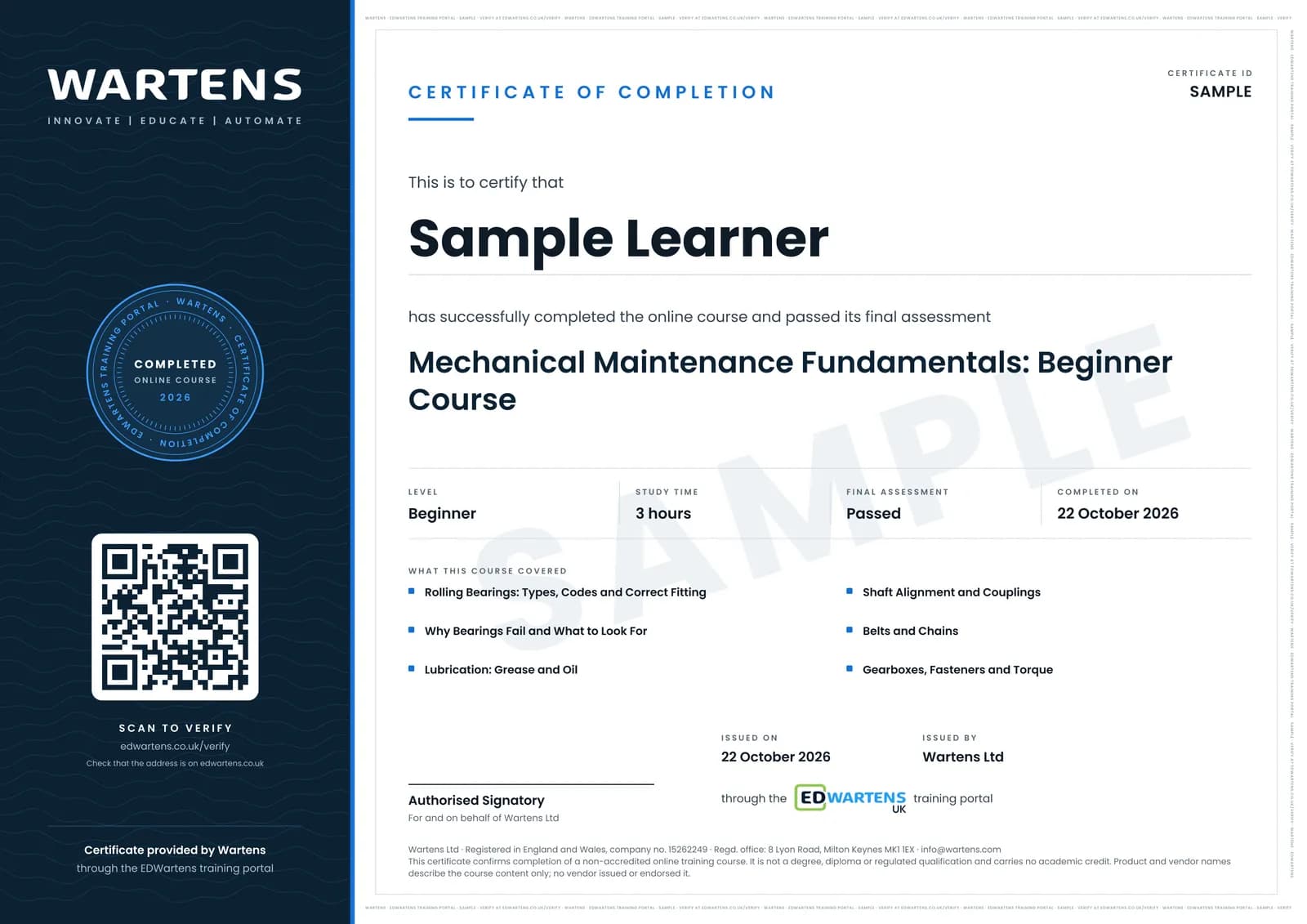
Sample certificate. Optional, issued when you pass the final exam.
- Level
- Beginner
- Modules
- 8
- Video
- Self-paced
- Price
- Free
Video time only: reading the notes, the quizzes and the final exam take extra time, at your own pace.
Outcome
What you will be able to do
Identify bearing types and read basic designations, fit a bearing correctly, recognise common failure modes, choose and apply lubricant, carry out a basic shaft alignment check, set belt tension and measure chain wear, inspect a gearbox, tighten bolts in sequence with a torque wrench, and run a simple condition check route.
- Identify bearing types and read a basic bearing designation
- Fit a bearing without damaging it
- Recognise the main bearing failure modes
- Calculate a sensible grease quantity and spot over-greasing
- Check soft foot and describe the order of an alignment
- Set V-belt tension and measure chain elongation
- Tighten a flange in a cross pattern with a torque wrench and run a basic condition check route
Software
None required.
Hardware
None required. A bench with a bearing, a torque wrench and a belt gauge makes practice more real.
Syllabus
8 modules
Each module has video lessons, notes and a short quiz. The final exam closes the course.
- Rolling Bearings: Types, Codes and Correct Fitting3 lessons
- Why Bearings Fail and What to Look For3 lessons
- Lubrication: Grease and Oil3 lessons
- Shaft Alignment and Couplings3 lessons
- Belts and Chains3 lessons
- Gearboxes, Fasteners and Torque3 lessons
- Vibration and Condition Checks3 lessons
- Final Assessment1 lesson
How it works
How this course works
- Watch the video lessonsOne module at a time, at your own pace.
- Take the module quizA short quiz at the end of each module shows what stuck.
- Keep your notesWrite in My notes beside each module and ask the trainer if you are stuck.
- Sit the final examPass it once you have been through the modules.
- Certificate, if you want oneOptionalPaid, and only after you pass. Anyone can check it online.
Certificate
An optional certificate when you pass
Learning is free. Pass the final exam and you can have a certificate for £19, including VAT, with a number employers can check online. It records that you completed a free online course; it is not a regulated qualification or a CPD certificate.
- Your name, the course, its study time and your final exam score
- A unique certificate number and a QR code to its verification page
- Issued by Wartens Ltd; add it to your LinkedIn profile in one click
- Pay now or after you pass: it is issued the moment you pass the final
Credits
Who made the lessons
The video lessons belong to their creators. EDWartens wrote the study plan, notes, quizzes and the final exam.
- ADASH
lessons in this course
- Acoem USA
lessons in this course
- Maintenance Knowledge Hub
lessons in this course
- Motion
lessons in this course
- Oil & Gas field Quality control
lessons in this course
- Park Tool
lessons in this course
- Regal Rexnord
lessons in this course
- Renold Mac Chain
lessons in this course
- SKF Group
lessons in this course
- SKF Maintenance Products
lessons in this course
- Tameson
lessons in this course
- The Mechanical Engineer
lessons in this course
Jobs
Jobs this course can lead to
The skills in this course are used in maintenance engineer and technician work, for example as a mechanical fitter, a maintenance technician and a multi-skilled maintenance engineer. No course can promise a job, and employers also look for experience, so read what live adverts ask for.
Browse Electrical and maintenance technicians jobs
4,476 jobs live on the UK board
Browse Multi-skilled maintenance engineer jobs
671 jobs live on the UK board
Pay: Metal working production and maintenance fitters (SOC 5223, which includes automation maintenance technicians) had a median of £41,942 a year, full-time, in April 2026. Electrical service and maintenance mechanics (SOC 5246) had £44,785. Source: ONS, Annual Survey of Hours and Earnings 2026 (provisional). Checked 28 Oct 2026.
Questions
About this course
Last reviewed 28 October 2026.
Is this enough to get a mechanical maintenance job in the UK?
Do I need tools or a workshop?
Is the certificate an engineering qualification?
What does the Mechanical Maintenance Fundamentals course cover?
Where does Mechanical Maintenance Fundamentals start and where does it end?
How long is Mechanical Maintenance Fundamentals?
Do I need a workshop to learn this?
Which brand's procedures does the course follow?
Is this an apprenticeship qualification?
Does the course cover hydraulics?
Who made the video lessons?
Want a live class and career support?
The Professional Module is five live days of Siemens PLC, HMI and SCADA with an instructor, then career sessions with our engineers and a CPD certificate.