


Skilled Worker visa changes in 2027 for engineers come down to two things: a possibly shorter Temporary Shortage List for technician and trades jobs, and new salary requirements that the government says it is implementing from spring 2027. On 23 November 2026 gov.uk showed recommendations and a Budget statement, not a confirmed new list and not new salary figures. This guide separates what is already in the rules from what is only proposed, so you can read a job advert with the right questions.
What are the Skilled Worker visa changes for 2027, and what is only proposed?
Three kinds of statement are easy to mix up: rules that are in force, recommendations from the Migration Advisory Committee (MAC) and policy statements. Here they are in date order.
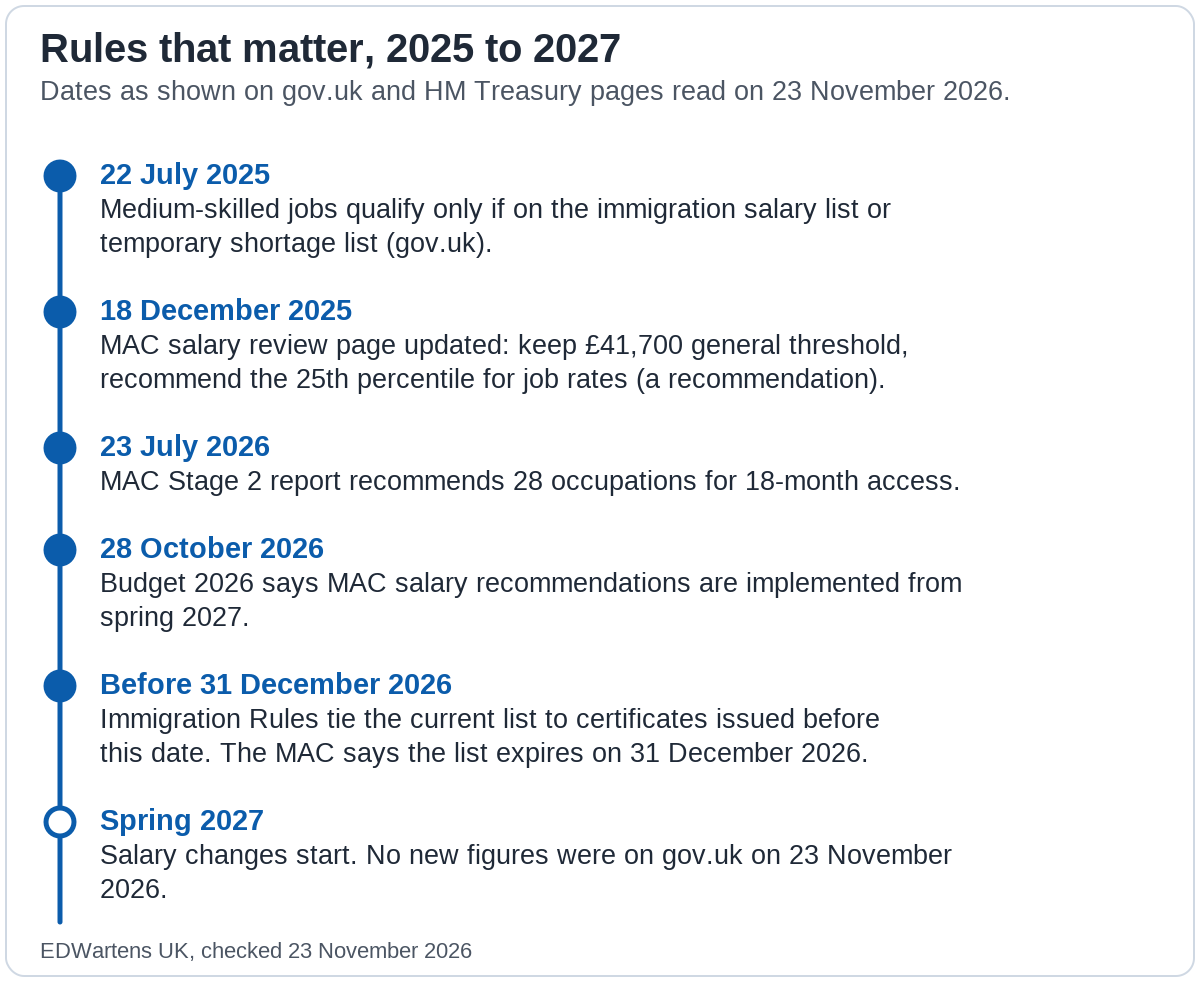
- In force: since 22 July 2025, gov.uk says a medium-skilled job qualifies only if it is on the immigration salary list or the temporary shortage list. Higher-skilled jobs follow the general rules.
- Recommended, not decided: the MAC's Stage 2 report on the Temporary Shortage List was published on 23 July 2026. It says: "we recommend 28 occupations for 18-month access". It also says no occupation warrants full three-year access.
- Policy statement: the Budget 2026 document (28 October 2026) says in paragraph 6.94 that the government "is implementing MAC recommendations on visa salary requirements from spring 2027".
Here is the position at a glance:
| Item | Status on 23 November 2026 | Source |
|---|---|---|
| General minimum: the higher of £41,700 or the going rate | In force | gov.uk, Skilled Worker visa: your job |
| Current list: certificates issued before 31 December 2026 | In the Immigration Rules | gov.uk, Appendix Skilled Worker |
| A list of 28 occupations for 18 months | Recommended by the MAC; decision not found | gov.uk, MAC Stage 2 report |
| Occupation thresholds at the 25th percentile and other salary changes | Government says it is implementing from spring 2027; no figures | Budget 2026, paragraph 6.94 |
We found no gov.uk page on 23 November 2026 that confirms which occupations will stay on the shortage list after the current arrangement. That may change quickly, so check gov.uk again before you act.
What is the Temporary Shortage List and when does it end?
It is a gov.uk list that lets some medium-skilled jobs qualify for the Skilled Worker route. gov.uk published the current version on 22 July 2025. The list page says that if your job is on it and is medium skilled, you can make an application. The page itself gives no end date.
The end date appears elsewhere, and the wording differs:
- The Immigration Rules (Appendix Skilled Worker, rule SW 6.1A, on a page gov.uk showed as updated on 29 October 2026) include a code from the list only where "an application has been made using a certificate of sponsorship issued by a sponsor to an applicant before 31 December 2026".
- The MAC's Stage 1 report says: "An expiry date of 31 December 2026 has been set for occupations on both the ISL and interim TSL." It adds that the MAC expects its recommendations "to be considered and acted upon before the 31 December 2026 expiry date".
Rule wording says "before 31 December 2026". The MAC says an expiry date of 31 December 2026. Other sources in 2026 quote the date in both ways, and we are not choosing between them. If a certificate might be assigned close to the turn of the year, ask the employer and an adviser which reading applies to you.
Which engineering jobs does the MAC recommend keeping?
The MAC report lists 28 occupations. These engineering-related codes are among them, with the current rates from the gov.uk list:
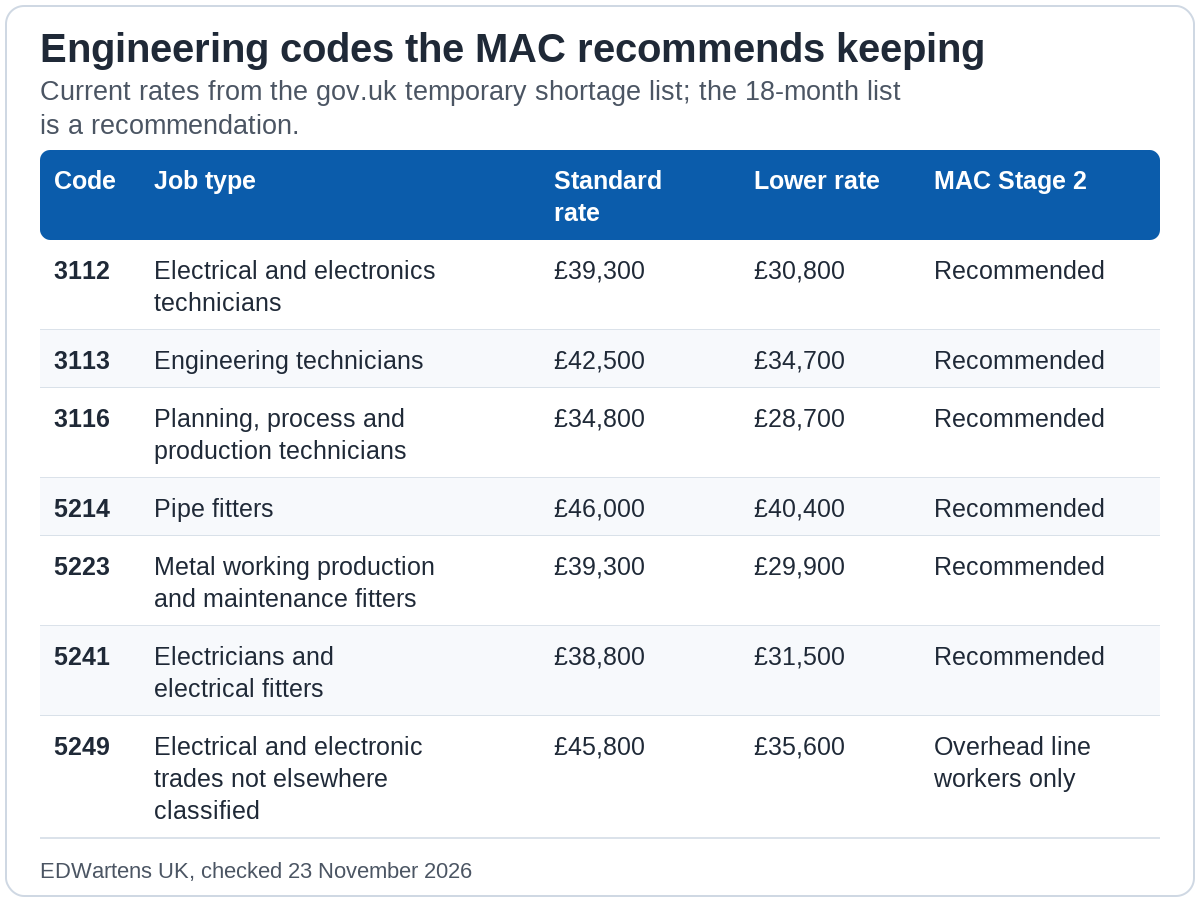
The standard rate applies if the certificate of sponsorship was first assigned after 4 April 2024. The lower rate applies if it was assigned before then and the person has continually held Skilled Worker visas since. Code 5249 is recommended for overhead line workers only.
Recommended means the MAC advises the Home Office to keep the code for 18 months. It is not the same as confirmed. The report does not set salary thresholds either; those come from a separate review.
One point needs care. The gov.uk page on the job says the minimum is the higher of £41,700 or the going rate, with limited lower options. The shortage list page shows its own standard and lower rates per code, some below £41,700. We do not try to reconcile the two for you. If an advert offers a salary between the two figures, ask the employer in writing which minimum it will use on the certificate, and check with gov.uk or an adviser before you rely on it.
What do the salary rules say now, and what changes in spring 2027?
Today, gov.uk's page on the job says your minimum is the higher of £41,700 a year or the going rate for the occupation code. A lower figure of £33,400 applies in limited cases if you do not meet the usual requirements and do not work in healthcare or education, and different rules apply if you are extending or updating a visa.
For 2027, the Budget document lists what is to be implemented from spring 2027:
- Occupation-specific thresholds reduced from the median to the 25th percentile of wages.
- The general threshold uprated using 2026 wage data.
- Thresholds updated each year using the latest ONS wage data (ASHE).
- New entrant discounts levelled into a single figure.
- The PhD discount removed.
It gives no new figures. The MAC's own review of salary requirements (the page was updated on 18 December 2025) recommended keeping the general threshold at £41,700, setting going rates at the 25th percentile and a single new entrant rate of £33,400. Those are recommendations. The Budget confirms the direction, not the numbers. You may see other figures quoted online. We do not repeat them because we found no gov.uk source for them.
Which engineering jobs sit at which skill level?
gov.uk's list of eligible occupations marks each code as higher or medium skilled. The employer, not the job title, picks the code that matches the duties, so two jobs with the same title can sit in different codes.
| Example job title on the gov.uk list | Code | Skill level on gov.uk |
|---|---|---|
| Control and instrumentation engineers | 2125 | Higher skilled |
| Mechatronic engineers, robotics engineers | 2129 | Higher skilled |
| Engineering technicians | 3113 | Medium skilled |
| Automation maintenance technicians | 5223 | Medium skilled |
| Installation and maintenance electricians, EV charging point installers | 5241 | Medium skilled |
| Electrical and electronics technicians | 3112 | Medium skilled |
So a degree-level controls or instrumentation engineer is on the general rules and is not affected by the shortage list. A maintenance technician, fitter or electrician depends on the shortage list, which is why the list is the question to watch. Our guide to engineering jobs with visa sponsorship covers the rules in force, and our PLC jobs and visa sponsorship guide covers controls roles.
Do the changes affect people already on a Skilled Worker visa?
We found nothing on gov.uk that says. The salary review page says the Home Office "will consider appropriate transitional arrangements" in light of the recommendations, and the Budget text does not describe them. gov.uk's job page already shows that rules differ for people extending or updating a visa: for example, extending applicants also qualify if their first certificate of sponsorship was issued before 22 July 2025. If you hold a visa now, the safest step is to ask your sponsor and a regulated adviser how the 2027 changes apply to your extension.
Why does timing matter for a job offer now?
A certificate of sponsorship is assigned by the employer once an offer is accepted, and you apply for the visa afterwards. gov.uk says you can apply up to 3 months before your start date. If the rules tie a code to certificates assigned before a date, then the date the employer assigns the certificate can matter as much as your start date. An employer that knows its sponsorship plan will be able to tell you when it expects to assign yours. An employer that cannot answer is telling you something too. None of this is a reason to rush into an offer: a rushed decision on pay, location or the employer's licence costs more than a delay.
What should you ask an employer before you accept?
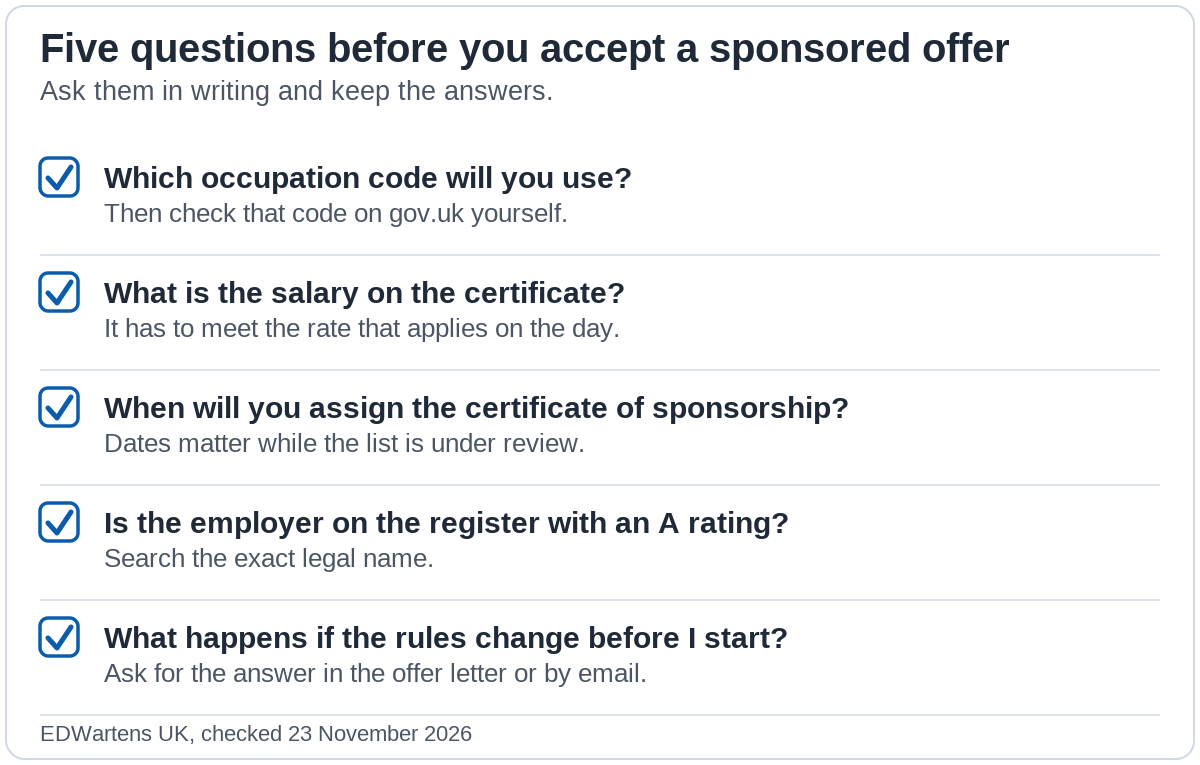
First check the employer on the register: our guide to how to check a visa sponsor licence and the visa sponsor checker show how. Then get the five answers in writing. Remember that a licence is not a promise of sponsorship for any job, and that nobody should charge you for it.
Where can you look for jobs while the rules settle?
Our visa sponsor jobs page shows jobs from licensed sponsors with the Skilled Worker rules at the top. Role pages for electrical maintenance engineer, instrument technician and mechanical fitter show current UK adverts, and salaries shows pay where adverts state it. For background on demand, read our UK PLC and automation job market 2026 and our guide to the multi-skilled maintenance engineer role. If you are a fitter, our mechanical fitter guide explains the route into the trade.
Start free
Building evidence of your skills helps with any job application, sponsored or not. The free Multi-Skilled Maintenance Engineer course and the Electrical Fundamentals for Technicians course each have an optional £19 certificate of completion. It is not a regulated qualification and does not change visa eligibility.