
To check a visa sponsor licence in the UK, search the Home Office register of licensed sponsors for the employer's exact legal name and town, then read the route and the rating next to it. An organisation on a Worker route with an A rating is approved to assign certificates of sponsorship. That does not mean it has a job for you, that your job is eligible or that it will sponsor you. This guide shows the steps, how to read a result and what to ask next.
What is the register of licensed sponsors?
It is a list the Home Office publishes on gov.uk. The page is called "Register of Worker and Temporary Worker licensed sponsors". It lists the organisations licensed to sponsor workers, the category of workers each is licensed to sponsor and its sponsorship rating. gov.uk first published it on 13 November 2013, and its page showed an update dated 23 November 2026 when we read it.
The file is a CSV of about 10.4 MB. That is a lot of rows for a phone or a spreadsheet that opens slowly, which is why most people search it through a tool. Two limits are worth knowing before you start. The register lists organisations, not vacancies. And it has no company number, so a name match on its own can point at the wrong business.
How do you check a visa sponsor licence step by step?
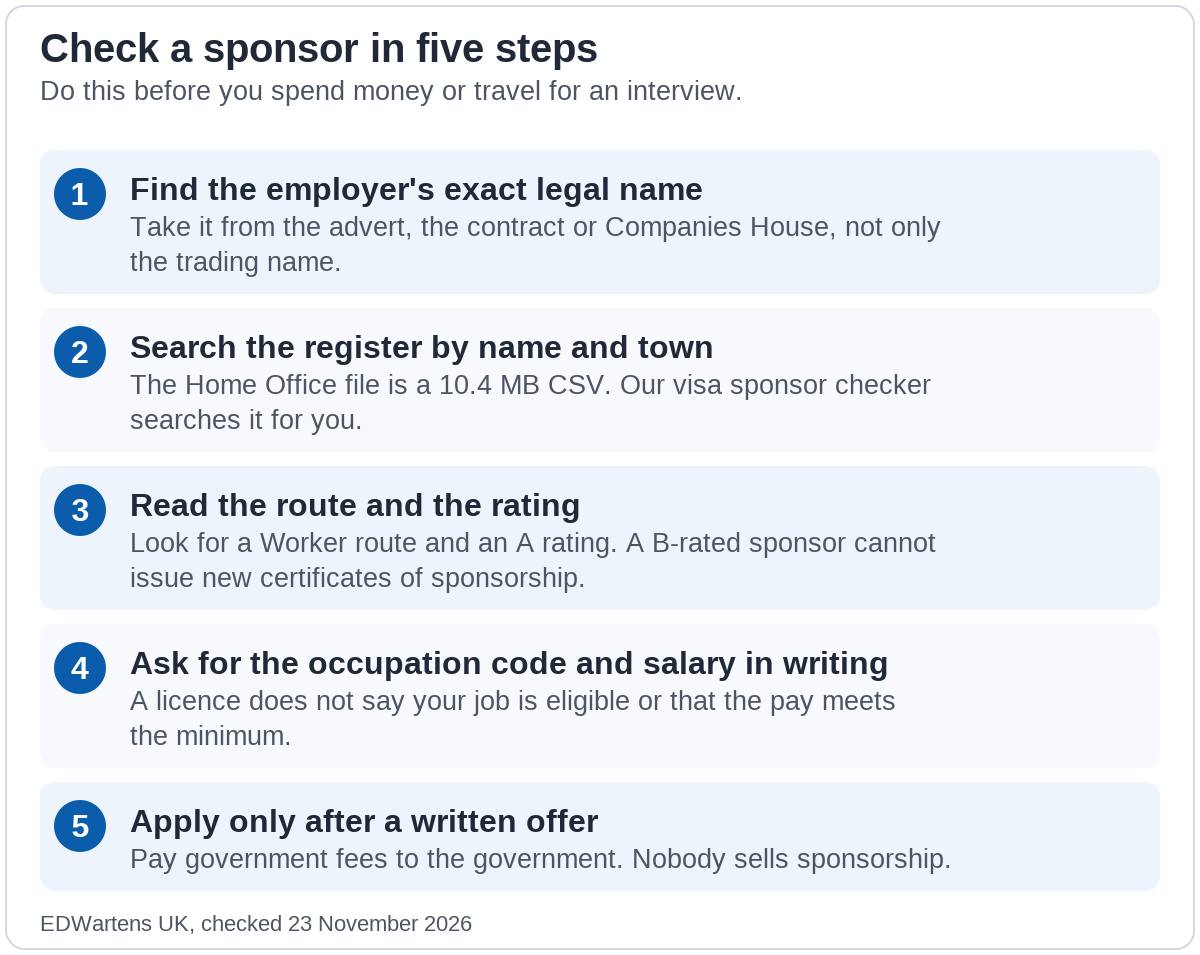
Use this order. It takes about ten minutes and costs nothing.
- Get the exact legal name. Take it from the contract, the offer letter or Companies House. A trading name such as "Northern Controls" may belong to a limited company with a different name.
- Search the register. On our visa sponsor checker type the name or part of it. You can narrow by town. The results show the name, town, county, the routes and the rating and the date of our copy of the register.
- Match the town. Several companies share similar names. A match on name and town is stronger than a match on name only.
- Read the route and the rating. More on this in the next section.
- Check the latest. Our copy is updated from the published file and shows its date. If the employer matters to you and the entry looks old, check the gov.uk file itself.
Our checker shows these columns for each match:
| Column | What it tells you |
|---|---|
| Name | The organisation as the register lists it |
| Town and county | Helps you match the right business |
| Routes | What the licence covers, for example Skilled Worker |
| Rating | A or B |
| Date of our copy | How fresh the data is |
| Live jobs | A link to jobs the employer has posted on our board, where there are any |
How do you read a result: route and rating?
Two columns matter. The first is the route, which says what the licence covers. For a job you want a Worker route. Temporary Worker routes are separate routes for temporary work and are a different matter.
The second is the rating. gov.uk's page on licence ratings says an A-rated licence "lets you start assigning certificates of sponsorship". A B rating is a downgrade. A B-rated sponsor will not be able to issue new certificates of sponsorship until it is upgraded, although it can still issue them to workers it already employs who want to extend their permission to stay.
| What you see | What it means | What to do |
|---|---|---|
| Worker route, A rating | The employer can assign certificates of sponsorship | Ask whether it will sponsor your role |
| Worker route, B rating | It cannot issue new certificates until upgraded | Ask directly before you invest time |
| Not found | It is not on the file we searched | Check the legal name again; if still absent, treat the offer as unconfirmed |
| Name matches but town does not | It may be a different business | Ask for the registered office and company number |
Agencies need care. An agency on the register sponsors its own staff. It is not sponsoring the end client's job. On our job board the "Licensed visa sponsor" tag is not applied to recruitment agencies for that reason. If you are offered a job through an agency, ask who the employer of record would be.
Does being on the register mean the company will sponsor you?
No. A licence only makes an employer eligible to sponsor. Whether it does so is a decision for each hire. Three more tests then apply, and our guide to engineering jobs with visa sponsorship explains each in detail.
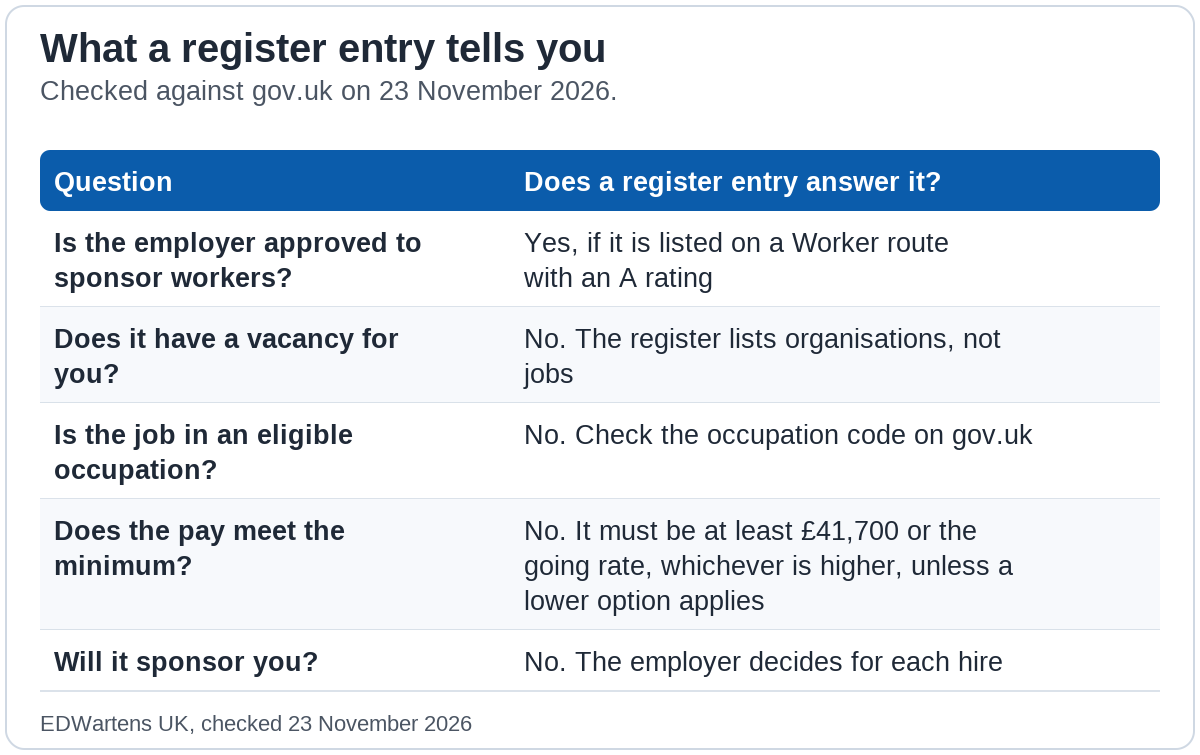
- The job must be eligible. gov.uk says you must have a confirmed job offer and a certificate of sponsorship, and the job must be in an eligible occupation. The employer chooses the occupation code, so ask which one.
- The pay must meet the minimum. gov.uk's page on the job says the minimum is the higher of £41,700 a year or the going rate for the occupation. A lower £33,400 figure applies in limited cases.
- The job must be at the right skill level. gov.uk says a medium-skilled job qualifies only if it is on the immigration salary list or the temporary shortage list. Those lists are under review, which our Skilled Worker 2027 guide explains.
What should you ask a licensed sponsor?
Send these questions by email so you have the answers in writing:
- Which legal entity will employ me, and what is its registered address?
- Does the company sponsor this role, and has it sponsored this type of role before?
- Which occupation code will you use on the certificate of sponsorship?
- What salary will be on the certificate, and what are the working hours?
- When would the certificate be assigned, and what is the start date?
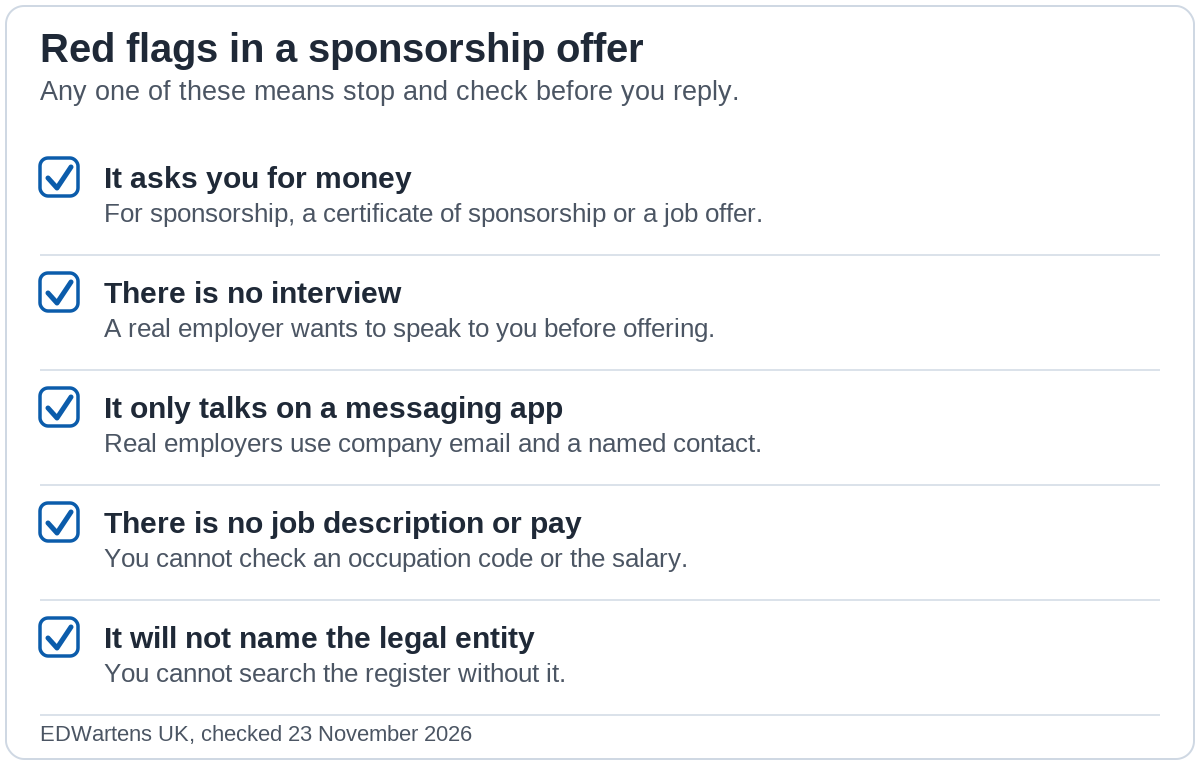
A real employer will answer without fuss. Vague answers, or a push to pay a fee or move to a messaging app, are reasons to stop.
How do you spot a fake sponsorship offer?
gov.uk's guidance for overseas applicants is blunt. It says a recruitment agency should never ask you to pay a fee for finding you work in the UK. It also says there are fees an employer must pay, not you, and it lists the certificate of sponsorship fee among the costs of sponsoring a visa. Paying these yourself risks a fake certificate and a refused visa. The guidance was written for health and care jobs, but those points apply to any sponsored job.
Its warning signs include a fee to get the job, a job offer without applying or talking to an agency, a position with no experience needed and a vague job description.
If you are targeted, gov.uk says to report visa and immigration scams to Report Fraud at reportfraud.police.uk, with a copy of the message, the sender's address, the date and time and details of any reply you sent. Our staying safe page explains how to report a job that appears on our board.
What does a worked example look like?
Take an invented case, used only for illustration. An instrumentation technician abroad receives an email from "Brightline Automation Services" offering a role in the Midlands. The advert gives no company number and no salary. The technician searches the name on the checker and finds "Brightline Automation Services Ltd" in the right county on a Skilled Worker route with an A rating. That is a good first sign, so the technician replies with the five questions above.
The answer comes back within two days from a named HR contact on a company address. It names the legal entity, gives a salary and says the certificate would be assigned after a second interview. Now the technician can check the occupation code and the pay on gov.uk. Had the reply asked for a "processing fee" instead, the register entry would not have mattered: gov.uk says the certificate fee is an employer cost, so the technician would stop. The register tells you who may sponsor. The reply tells you who is behaving like an employer.
What if the employer is not on the register?
Stop and ask why. There are only a few honest answers. The company may trade under another name, so ask for the legal entity. It may be a new licence that has not appeared in the file yet. Or it may not hold a licence, in which case it cannot sponsor you. Until you see the entry or a certificate of sponsorship from a named employer, treat the offer as unconfirmed. Our guide for Irish citizens working in UK automation and the one on EU engineers moving to the UK explain situations where a Skilled Worker visa is not the route.
Where do you find live jobs from licensed sponsors?
Our visa sponsor jobs page lists jobs where the employer appears on the register or says it may sponsor. The rules at the top of that page are the gov.uk ones. For jobs in controls and automation, our PLC jobs and visa sponsorship guide covers what to look for. The full board is at /jobs. Pay is shown only where an advert states it.
Start free
While you search, build evidence you can show. The free Multi-Skilled Maintenance Engineer course and the PLC electrical troubleshooting course each have an optional £19 certificate of completion that anyone can check on our verification page. The certificate is not a regulated qualification, and no course or simulation promises a job or a sponsor.