
Free course · Quality management
Welding Inspection and Mechanical QA/QC with NDT Basics
What a mechanical QA/QC inspector checks on a fabrication or piping job: the welding processes, joints and welding symbols, WPS, PQR and welder qualification, weld imperfections and visual inspection with gauges, destructive tests, penetrant, magnetic particle, radiographic and ultrasonic testing, material certificates and traceability, hydrotests, and the ITPs, NCRs and reports that record it all.
Free to learn. Verifiable certificate £19 when you pass the final exam (optional, VAT included).
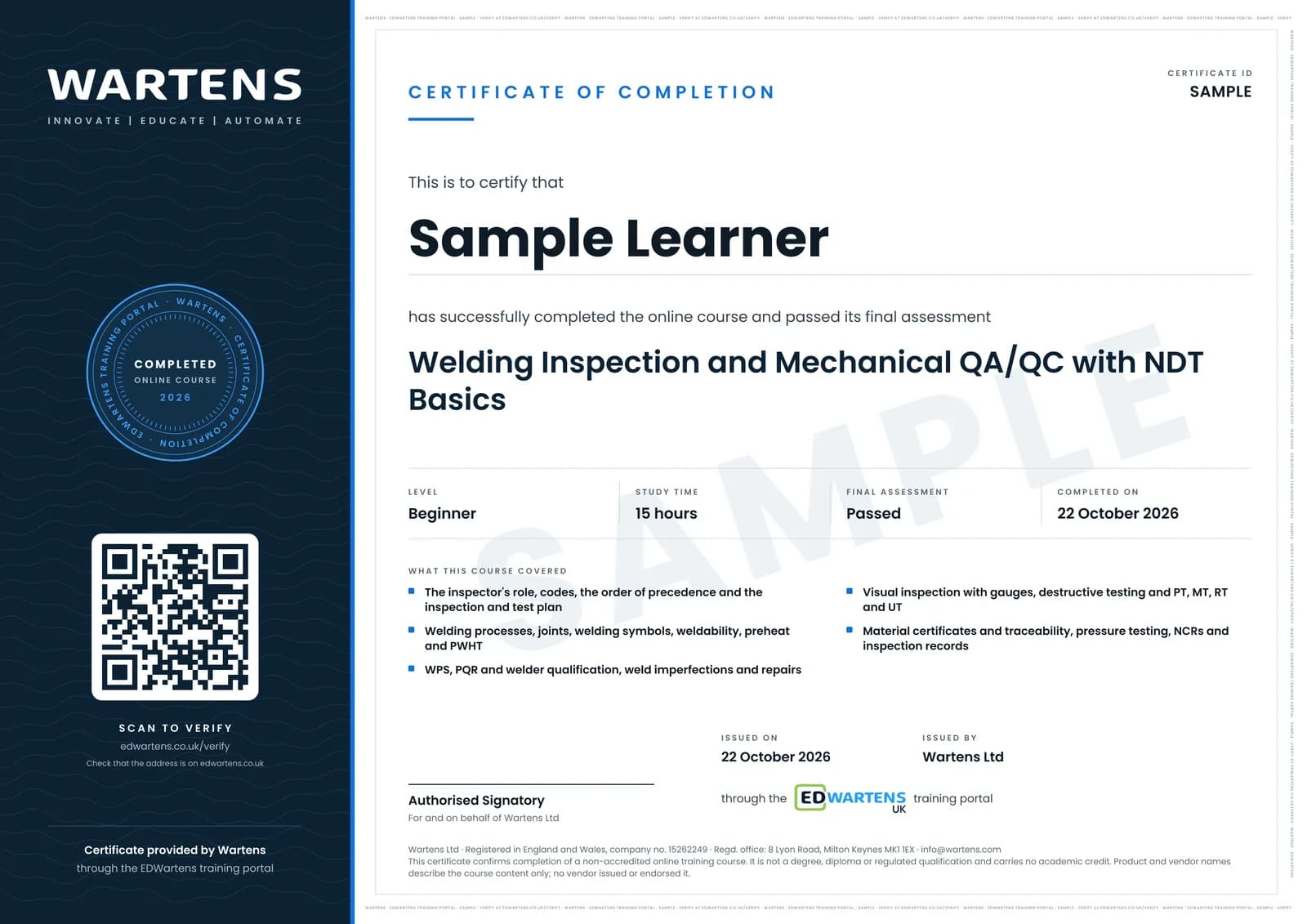
Sample certificate. Optional, issued when you pass the final exam.
- Level
- Beginner
- Modules
- 15
- Video
- 21 hours
- Price
- Free
Outcome
What you will be able to do
Explain what QA and QC inspectors do and read an inspection and test plan; describe how SMAW, GTAW, GMAW, FCAW and SAW work and what to check on each; calculate heat input and carbon equivalent; read welding symbols to ISO 2553 and AWS A2.4; check a WPS against its PQR and a welder's qualification against the joint; name weld imperfections, their causes and their prevention; carry out visual inspection with gauges before, during and after welding; judge destructive test results; explain how PT, MT, RT and UT each find defects and what each misses; review material certificates and keep traceability; calculate a hydrotest pressure and check a test pack; and write inspection reports and NCRs. It prepares you to study for CSWIP 3.1 and AWS CWI; it is neither of those qualifications.
- Read an inspection and test plan and say who inspects what, and where work stops at a hold point
- Explain how SMAW, GTAW, GMAW, FCAW and SAW work and calculate heat input from the welding parameters
- Read welding symbols to ISO 2553 and AWS A2.4, including the arrow side and other side conventions
- Calculate carbon equivalent and decide when preheat, hydrogen control and PWHT are needed
- Check a WPS against its PQR and a welder's qualification against the joint to be welded
- Measure and report weld imperfections with gauges and judge them against given acceptance criteria
- Explain what PT, MT, RT and UT each find and miss, and choose the method for a joint
- Review an EN 10204 type 3.1 certificate, calculate a hydrotest pressure, and write the report and NCR
Software
None. A spreadsheet (LibreOffice Calc is free) helps with the weld log and the heat input, carbon equivalent and test pressure calculations.
Hardware
None. A welding gauge, a steel rule and a torch make the visual inspection practice more real if you have them, but every task can be done from the measurements and drawings in the notes.
Syllabus
15 modules
Each module has video lessons, notes and a short quiz. The final exam closes the course.
- The QA/QC inspector's job: codes, specifications and the ITP3 lessons
- Welding processes I: the arc, SMAW and GTAW4 lessons
- Welding processes II: GMAW, FCAW, SAW and consumables4 lessons
- Joints, weld terms and welding symbols (AWS A2.4 and ISO 2553)2 lessons
- Welding metallurgy for inspectors: carbon equivalent, preheat, cracking and PWHT5 lessons
- WPS, PQR and welder qualification4 lessons
- Weld imperfections: types, causes, prevention and repair3 lessons
- Visual inspection before, during and after welding, with gauges4 lessons
- Destructive testing: tensile, bend, impact, hardness and macro1 lesson
- NDT I: penetrant testing and magnetic particle testing4 lessons
- NDT II: radiography and ultrasonic testing4 lessons
- Materials, certificates and traceability5 lessons
- Pressure testing: hydrostatic and pneumatic tests and test packs2 lessons
- Reports, NCRs, the final dossier and preparing for CSWIP 3.1 and CWI3 lessons
- Final Assessment1 lesson
How it works
How this course works
- Watch the video lessonsOne module at a time, at your own pace.
- Take the module quizA short quiz at the end of each module shows what stuck.
- Keep your notesWrite in My notes beside each module and ask the trainer if you are stuck.
- Sit the final examPass it once you have been through the modules.
- Certificate, if you want oneOptionalPaid, and only after you pass. Anyone can check it online.
Certificate
An optional certificate when you pass
Learning is free. Pass the final exam and you can have a certificate for £19, including VAT, with a number employers can check online. It records that you completed a free online course; it is not a regulated qualification or a CPD certificate.
- Your name, the course, its study time and your final exam score
- A unique certificate number and a QR code to its verification page
- Issued by Wartens Ltd; add it to your LinkedIn profile in one click
- Pay now or after you pass: it is issued the moment you pass the final
Credits
Who made the lessons
The video lessons belong to their creators. EDWartens wrote the study plan, notes, quizzes and the final exam.
- Welding and NDT
the English CSWIP 3.1 lecture series: codes and standards, welding processes (SMAW, TIG, MIG/MAG and FCAW, SAW), consumables, welding symbols, weldability of steels, preheat, heat treatment, WPS and welder qualification, weld imperfections, repairs, the inspector's duties, gauges, destructive testing, ultrasonic testing, materials inspection and the exam pattern
- HardHat Engineer
the inspection and test plan, the order of precedence of technical documents, inward material inspection, EN 10204 certificate types, reviewing material test certificates and material traceability
- Magnaflux
the webinars on liquid penetrant fundamentals and the magnetic particle yoke, and the short demonstrations of visible dye penetrant and magnetic particle inspection
- Anmol Birring
angle beam ultrasonic testing of welds, radiographic sensitivity and IQIs, and single wall and double wall radiographic techniques
- Weld.com
reading welding symbols, and porosity, arc strikes and undercut
- TimWelds
MIG, TIG, stick and flux core welding compared
- Hardhat Learning
writing a WPS and PQR to ASME Section IX
- GAL Gage
the Hi-Lo welding gauge for internal misalignment
- I4I Academy
hydrostatic and pneumatic test pressure calculation for ASME B31.3 process piping
- QualityEngineers Guide
writing a nonconformance report and closing it
- Welding inspection & NDT
reviewing a welder qualification to ASME Section IX
- Welding /NDT Inspection
the basic hydrotest requirements for pipelines, piping and equipment
Questions
About this course
Who is this welding inspection course for?
Is the course free to learn?
Does it prepare me for CSWIP 3.1 or AWS CWI?
Will it make me a qualified NDT technician?
Which codes and standards does it use?
Does it help with QC inspector jobs in the Gulf?
How long does the course take?
What certificate do I get?
What is the project?
Want a live class and career support?
The Professional Module is five live days of Siemens PLC, HMI and SCADA with an instructor, then a resume session and a CPD certificate.