
Free course · SCADA
Water and Wastewater Treatment Plant Automation
How drinking water, wastewater and desalination plants are measured and controlled: the process trains, level, flow and water quality instruments, pump station duty and standby logic, VFDs and pump protection, coagulant and chlorine dosing, filter backwash sequences, RO train control, dissolved oxygen and blower control, SCADA, telemetry and alarms, cybersecurity and compliance data, ending with a pump station control narrative.
Free to learn. Verifiable certificate £19 when you pass the final exam (optional, VAT included).
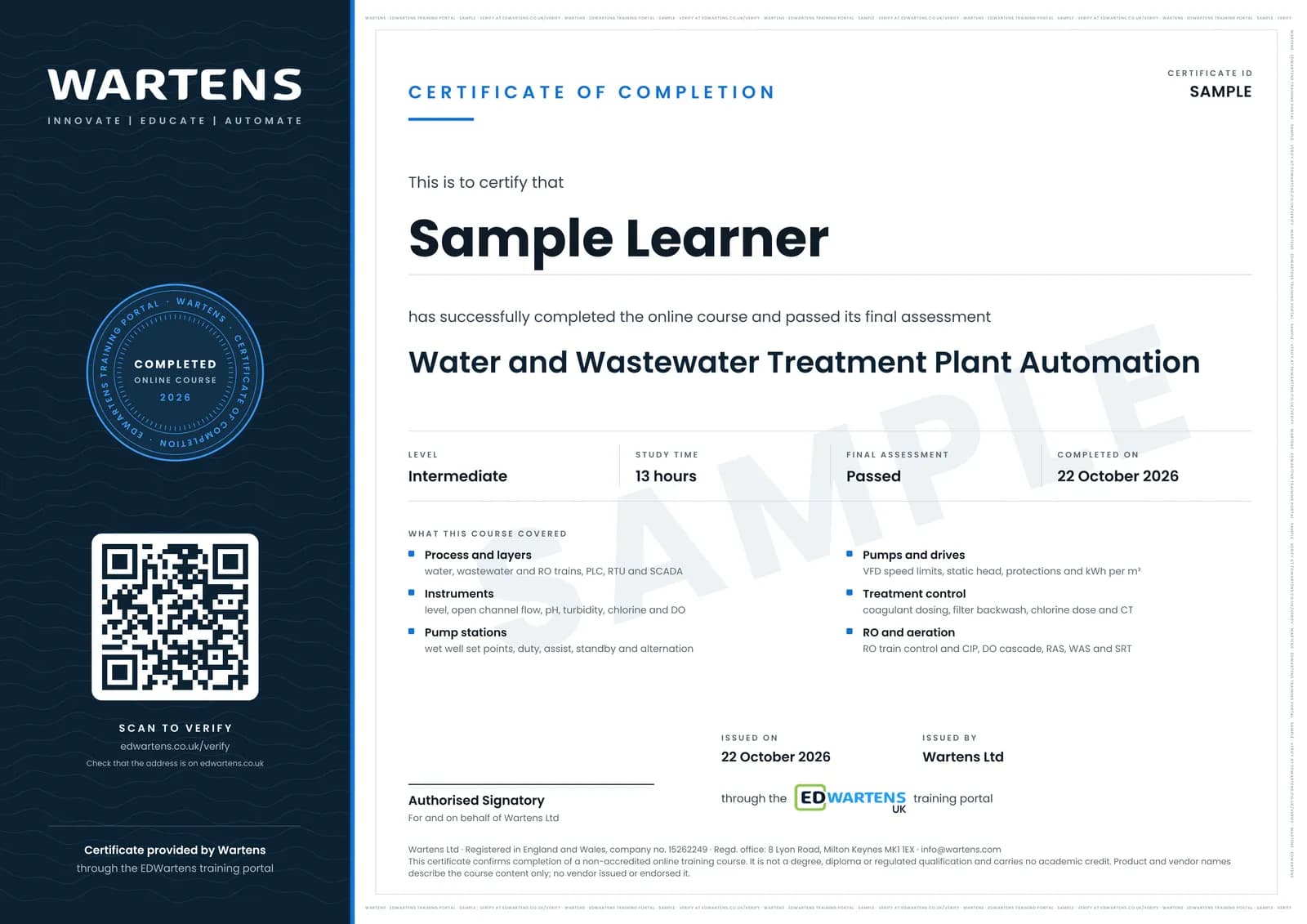
Sample certificate. Optional, issued when you pass the final exam.
- Level
- Intermediate
- Modules
- 14
- Video
- 22 hours
- Price
- Free
Outcome
What you will be able to do
Draw the process train of a drinking water plant, a wastewater plant and an RO desalination plant and name the instruments and control loops on each; scale level and flow signals and convert weir heads to flow; choose and calibrate pH, turbidity, chlorine and dissolved oxygen analysers and work out sample lag; set wet well levels, size the effective volume and write duty, standby, assist and alternation logic; apply the affinity laws, static head and pump protections to VFD-driven pumps; size flow-paced coagulant and chlorine dosing and check CT; write a filter backwash sequence with its permissives and turbidity triggers; control an RO train and decide when to clean from normalized data; control dissolved oxygen with a cascade and most-open-valve logic and set RAS and WAS from SRT; design telemetry, alarms and secure remote access; and write a control narrative, I/O list and test plan for a pump station.
- Draw water, wastewater and RO process trains with their instruments and control loops
- Choose level, open channel flow and water quality instruments, scale signals and allow for sample lag
- Set wet well levels and write duty, assist, standby, alternation and fail-over logic
- Apply affinity laws, static head, VFD limits and pump protections, and track kWh per m³
- Size flow-paced coagulant and chlorine dosing, check CT and write a filter backwash sequence
- Control an RO train and decide when to clean from normalized data
- Control dissolved oxygen with a cascade and most-open-valve logic, and set RAS and WAS from SRT
- Design telemetry, alarms and secure remote access, and write a control narrative, I/O list and SAT
Software
None is required. A spreadsheet (LibreOffice Calc is free) is used for the calculations, and any PLC or SCADA software you already use (for example Ignition Maker Edition or CODESYS) can be used to try the pump station logic, but every exercise can be done on paper.
Hardware
None. Any laptop that runs a spreadsheet is enough.
Syllabus
14 modules
Each module has video lessons, notes and a short quiz. The final exam closes the course.
- Water and wastewater plants: process trains and the automation layers4 lessons
- Level, flow and pressure measurement in water plants4 lessonsLab
- Water quality analysers: pH, turbidity, chlorine and dissolved oxygen6 lessons
- Pump stations: wet wells, set points and duty, standby and alternation5 lessonsLab
- Pump drives, protection and energy4 lessons
- Coagulation, clarification and chemical dosing control5 lessons
- Filtration: filter control and the backwash sequence6 lessons
- Disinfection: chlorine dosing, residual control, CT and UV5 lessons
- Membranes and RO desalination: train control and cleaning5 lessons
- Activated sludge: dissolved oxygen, blowers, RAS and WAS6 lessons
- SCADA, telemetry and alarm management for utilities5 lessonsLab
- Cybersecurity, data and compliance reporting4 lessonsLab
- Capstone: pump station control narrative, I/O list and testing2 lessons
- Final assessment1 lesson
How it works
How this course works
- Watch the video lessonsOne module at a time, at your own pace.
- Take the module quizA short quiz at the end of each module shows what stuck.
- Keep your notesWrite in My notes beside each module and ask the trainer if you are stuck.
- Practise in the labOptionalTry a task from the module in the EDWartens Lab, in your browser.
- Sit the final examPass it once you have been through the modules.
- Certificate, if you want oneOptionalPaid, and only after you pass. Anyone can check it online.
EDWartens Lab
Practise this in the EDWartens Lab
Run a tank and pump process in the Lab, read the trends and check alarms the way an operator screen would show them.
Works alongside Water and Wastewater Treatment Plant Automation. The Lab is process control practice in your browser: no install, no hardware, free to use. Sign in as a learner and it opens with your account.
Levels to try with this course
PRC-02 · Process lab
Loop check
Open in the lab (opens in a new tab)PLC-08 · PLC lab
Duty and standby pumps
Open in the lab (opens in a new tab)PRC-06 · Process lab
Alarm rationalisation
Open in the lab (opens in a new tab)OTS-02 · OT security lab
Zones and conduits: split a flat network
Open in the lab (opens in a new tab)
Optional. Skip it whenever you like: it never blocks your progress or your certificate.
Why practise in a lab
Technical work is judged on what you can do: wiring, commissioning, finding a fault. Doing a task yourself teaches more than watching it a second time, and a lab lets you try it safely before you meet real equipment. It does not replace working on real hardware.
- Practise safely, so a mistake costs nothing.
- The lab checks your work like a site test, so you know when it is right.
- Free, in your browser, with nothing to install.
Certificate
An optional certificate when you pass
Learning is free. Pass the final exam and you can have a certificate for £19, including VAT, with a number employers can check online. It records that you completed a free online course; it is not a regulated qualification or a CPD certificate.
- Your name, the course, its study time and your final exam score
- A unique certificate number and a QR code to its verification page
- Issued by Wartens Ltd; add it to your LinkedIn profile in one click
- Pay now or after you pass: it is issued the moment you pass the final
Credits
Who made the lessons
The video lessons belong to their creators. EDWartens wrote the study plan, notes, quizzes and the final exam.
- The Wastewater Enthusiast
an operator's view of SCADA at a wastewater plant, flow and velocity arithmetic, pH and alkalinity, pump horsepower, operating cost and motor inspection, chlorine disinfection dosing and centrifugal blowers
- Wastewater Ace
open channel flow measurement pitfalls and how one DO set point drives the aeration power bill
- American Water College
coagulation chemistry, coagulation operation and jar testing, breakpoint chlorination, and wastewater data and records
- AmericanWaterWorks (AWWA)
the short Water Treatment Grade 2 lessons on instrumentation and control, pump starting and stopping, coagulation, jar testing, rapid sand filtration, backwash, the filter backwash recycle rule and chlorine safety
- Endress+Hauser
the measuring principles of pH, turbidity, chlorine and dissolved oxygen sensors
- Practical Engineering
the fluid effects that kill pumps, settling and clarification, why desalination is difficult, and building a sewage pump station
- Animagraffs
the animated tour of drinking water and wastewater treatment
- Concerning Reality
how a drinking water treatment plant works, unit by unit
- RealPars
SCADA applications in water treatment and what an RTU is
- Siemens Knowledge Hub
ultrasonic level measurement
- Advance Instruments
a Teledyne ISCO presentation on measuring flow in flumes, weirs, rivers and streams
- Neal Systems
the options for chlorine residual analysers in water and wastewater
- Water Engineering
the components of a pump station
- Smith Pump Company
the webinar on modern lift station controls
- The PLC Tech
a ladder logic walkthrough of lift station pump control with alternation
- Metropolitan Council
how a wastewater lift station works
- David Ladner
backwash of a granular media filter
- West Carolina Water Treatment
how a backwashing filter works
- Water Academy
rapid sand filters: working principle, components and design
- Operator Mindset
UV disinfection of wastewater and the art of wasting activated sludge
- Water Corporation
what happens at a seawater desalination plant
- Evoqua Water Technologies
reverse osmosis operations
- Endless Learning
RO membrane clean-in-place systems and procedure
- DuPont Water Solutions
preparing RO operating data for normalized performance analysis
- Blacoh Industries
the All Things Water course session on activated sludge
- Water Environment Federation
ammonia-based aeration control and cybersecurity threats to the water sector
- Aerzen USA
a blower maker's dissolved oxygen control system
- Tait Communications
how SCADA data is carried over radio
- Affinity Energy
SCADA alarm management best practices
- AVEVA Select California
the webinar on water and wastewater SCADA
- SANS ICS Security
building cybersecurity in the water and wastewater industry
- Mitsubishi Electric Iconics Digital Solutions
securing SCADA and OT for water and wastewater
- L&L Lunch and Learn
how to develop a control narrative for PLC and DCS projects
Questions
About this course
What is water and wastewater treatment plant automation?
Who is this water treatment automation course for?
Do I need software or a PLC to take the course?
Which standards and regulations does the course cover?
Is the course free to learn, and how long does it take?
What certificate do I get, and how is it verified?
What jobs does water treatment plant automation lead to?
Does the course teach SCADA software or PID tuning?
Want a live class and career support?
The Professional Module is five live days of Siemens PLC, HMI and SCADA with an instructor, then a resume session and a CPD certificate.