
Free course · Cybersecurity
SOC Analyst Level 2: Threat Hunting with Wazuh
Level 2 SOC skills in a free, open source lab: build a Wazuh 4.14 server, enrol Windows and Linux agents with Sysmon, write and tune detection rules, map them to MITRE ATT&CK, hunt persistence, credential access and lateral movement, handle incidents with NIST SP 800-61 Rev. 3, and measure your detections against an Atomic Red Team simulation in an isolated lab.
Free to learn. Verifiable certificate £19 when you pass the final exam (optional, VAT included).
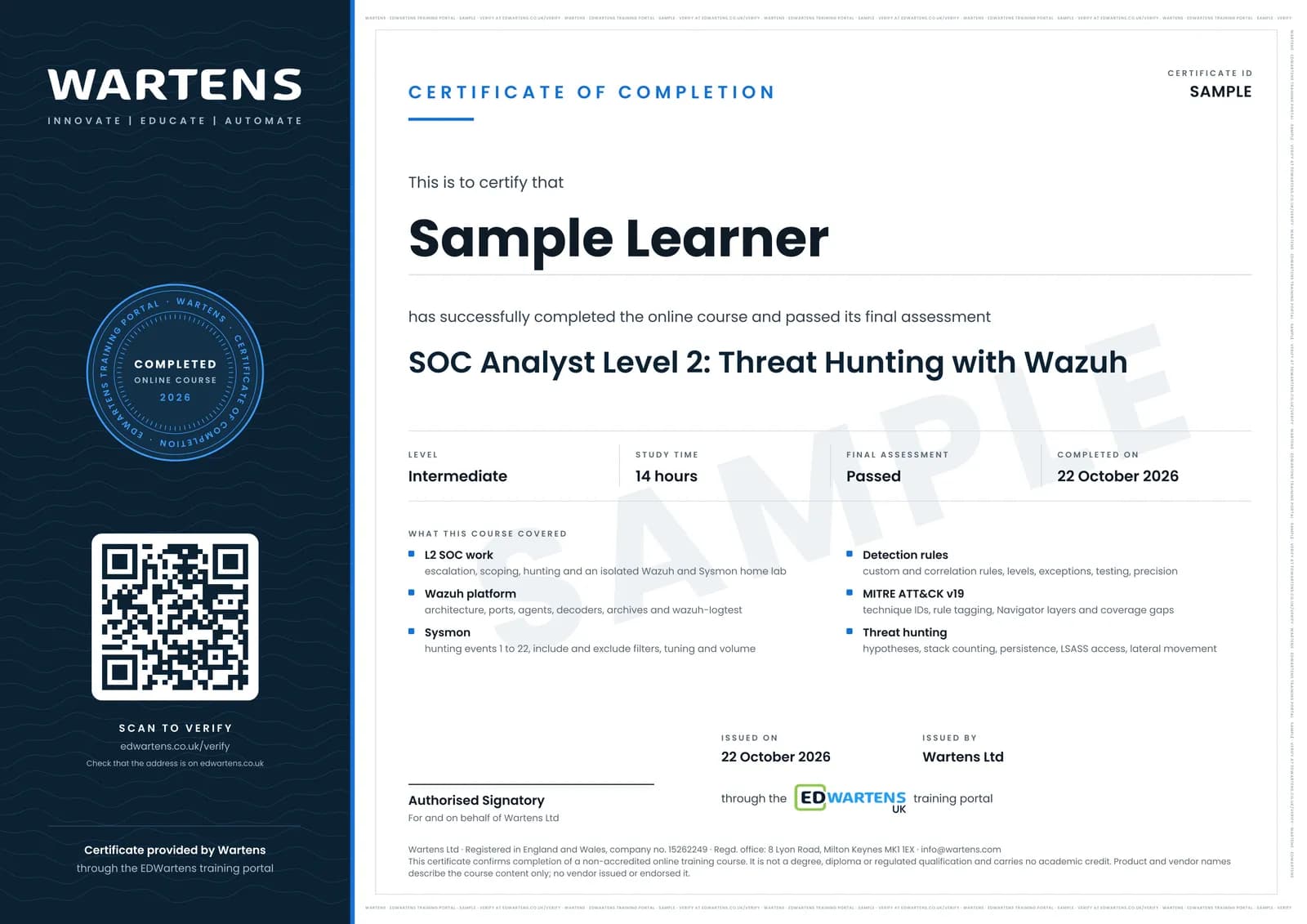
Sample certificate. Optional, issued when you pass the final exam.
- Level
- Intermediate
- Modules
- 14
- Video
- 20 hours
- Price
- Free
Outcome
What you will be able to do
Explain how Level 2 work differs from Level 1 triage; deploy a Wazuh server and enrol Windows and Linux agents; configure Sysmon for hunting; write custom decoders and test events with wazuh-logtest; write, test and tune Wazuh rules with sensible levels, correlation and narrow exceptions; tag detections with MITRE ATT&CK v19 and measure coverage; run and record hypothesis-driven hunts for persistence, LSASS access and lateral movement; use file integrity monitoring, vulnerability detection and active response safely; handle an incident on the NIST SP 800-61 Rev. 3 model and write the report; and score detection coverage with an Atomic Red Team simulation in your own isolated lab.
- Know what Level 2 SOC work adds to Level 1 triage, and build a safe, isolated hunting lab
- Install Wazuh 4.14, enrol Windows and Linux agents and troubleshoot them
- Configure and tune Sysmon for the events hunters rely on
- Write decoders and custom Wazuh rules with correlation, levels and narrow exceptions
- Tag detections with MITRE ATT&CK v19 and measure coverage in Navigator
- Run hypothesis-driven hunts for persistence, LSASS access and lateral movement
- Use file integrity monitoring, vulnerability detection and active response safely
- Handle and report incidents with NIST SP 800-61 Rev. 3, and score detections against an Atomic Red Team simulation
Software
Wazuh 4.14 (free and open source), Microsoft Sysmon (free), Atomic Red Team with Invoke-AtomicRedTeam (free, lab use only), MITRE ATT&CK Navigator (free, in the browser), a Windows 11 evaluation VM, Ubuntu Server, and VirtualBox or Docker.
Hardware
A computer with 16 GB of RAM and about 150 GB of free disk for the Wazuh server and two small VMs, or a free-tier cloud account kept private to you. The lab must stay isolated from any work or third-party network.
Syllabus
14 modules
Each module has video lessons, notes and a short quiz. The final exam closes the course.
- From L1 triage to L2 hunting: the job and the lab plan3 lessons
- Wazuh architecture and a working server2 lessons
- Enrolling Windows and Linux agents, with Sysmon2 lessons
- Sysmon configuration for hunting3 lessons
- Telemetry, decoders and reading events in Wazuh2 lessons
- Detection rules: writing, testing and tuning3 lessons
- MITRE ATT&CK for detection coverage3 lessons
- Hypothesis-driven threat hunting2 lessons
- Hunting persistence and credential access4 lessons
- Hunting lateral movement and account misuse3 lessons
- File integrity monitoring, vulnerability detection and active response3 lessons
- Incident handling with NIST SP 800-61r3, reports and metrics5 lessonsLab
- Capstone: hunt across an Atomic Red Team simulation3 lessons
- Final Assessment1 lesson
How it works
How this course works
- Watch the video lessonsOne module at a time, at your own pace.
- Take the module quizA short quiz at the end of each module shows what stuck.
- Keep your notesWrite in My notes beside each module and ask the trainer if you are stuck.
- Practise in the labOptionalTry a task from the module in the EDWartens Lab, in your browser.
- Sit the final examPass it once you have been through the modules.
- Certificate, if you want oneOptionalPaid, and only after you pass. Anyone can check it online.
EDWartens Lab
Practise this in the EDWartens Lab
Practise the incident handling decisions of a Level 2 analyst in the OT security lab: contain, keep evidence and recover in the right order. Wazuh and Sysmon are not part of the lab.
Works alongside SOC Analyst Level 2: Threat Hunting with Wazuh. The Lab is ot security practice in your browser: no install, no hardware, free to use. Sign in as a learner and it opens with your account.
Levels to try with this course
OTS-08 · OT security lab
Incident drill: a simulated note on an operator screen
Open in the lab (opens in a new tab)OTS-05 · OT security lab
Spot the intruder: the events that matter in a day's log
Open in the lab (opens in a new tab)
Optional. Skip it whenever you like: it never blocks your progress or your certificate.
Why practise in a lab
Technical work is judged on what you can do: wiring, commissioning, finding a fault. Doing a task yourself teaches more than watching it a second time, and a lab lets you try it safely before you meet real equipment. It does not replace working on real hardware.
- Practise safely, so a mistake costs nothing.
- The lab checks your work like a site test, so you know when it is right.
- Free, in your browser, with nothing to install.
Certificate
An optional certificate when you pass
Learning is free. Pass the final exam and you can have a certificate for £19, including VAT, with a number employers can check online. It records that you completed a free online course; it is not a regulated qualification or a CPD certificate.
- Your name, the course, its study time and your final exam score
- A unique certificate number and a QR code to its verification page
- Issued by Wartens Ltd; add it to your LinkedIn profile in one click
- Pay now or after you pass: it is issued the moment you pass the final
Credits
Who made the lessons
The video lessons belong to their creators. EDWartens wrote the study plan, notes, quizzes and the final exam.
- MyDFIR
Wazuh 101, the seven-part Build a SOC Lab with Wazuh series (server, agents and Sysmon, telemetry, dashboard, file integrity monitoring and rules, active response, the investigation), the Sysmon installation tutorial and a real account compromise investigation
- Wazuh
the project's own webinars on detection as code and on simulating attacks with Atomic Red Team and analysing them with Wazuh and Sysmon
- John Hammond
detection engineering with Wazuh and testing defences with Atomic Red Team
- Insane Cyber
writing Sysmon rules and hunting Run key persistence, malicious scheduled tasks, malicious account use and network share use in Windows logs
- Anvilogic
detection engineering with MITRE ATT&CK and lateral movement in Windows networks
- HackerSploit
mapping threat group techniques with MITRE ATT&CK Navigator
- Prabh Nair
practical threat hunting with Sysmon and MITRE ATT&CK
- Mohd Maaz
Sysmon event IDs 1, 3, 10, 17 and 18 for blue team detection
- Christian Lempa
deploying Wazuh with Docker in a home lab
- Taylor Walton
building custom Wazuh decoders
- Misk Samater
Wazuh vulnerability detection and configuration assessment
- Red Canary
what Atomic Red Team is and how security teams use it
- RJC
the differences between Tier 1, Tier 2 and Tier 3 SOC analysts
- Tech with Jono
the path from beginner to Level 3 SOC analyst
- SecGen
a Wazuh detection engineering lab writing SSH attack detection rules
- InfoSec Pandey
mapping detection rules to MITRE ATT&CK
- ANOMALI
hypothesis-led threat hunting
- p1p0
detecting credential dumping from Mimikatz to the SIEM
- HyperQube
credential dumping analysis, detection and prevention
- Karissa Ehman
cyber incident response and the updates in NIST SP 800-61 Rev. 3
- Security BSides London
Han O'Connor's talk on investigation note-taking and report writing for SOC analysts
Questions
About this course
What is a SOC Analyst Level 2 and what does this course teach?
Who is this Wazuh threat hunting course for, and what do I need first?
Is Wazuh free, and what software does the course use?
Is the lab safe and legal?
How long does the course take, and is it free to learn?
What certificate do I get, and how is it verified?
Which frameworks and standards does the course follow?
What jobs can this course lead to?
Want a live class and career support?
The Professional Module is five live days of Siemens PLC, HMI and SCADA with an instructor, then a resume session and a CPD certificate.