
Free course · Quality management
Six Sigma Green Belt Training for Manufacturing
Free Six Sigma Green Belt course for production and quality staff: run DMAIC with Gage R&R, Cpk, tests and control charts. The certificate is optional and paid.
Free to learn. Verifiable certificate £19 when you pass the final exam (optional, VAT included).
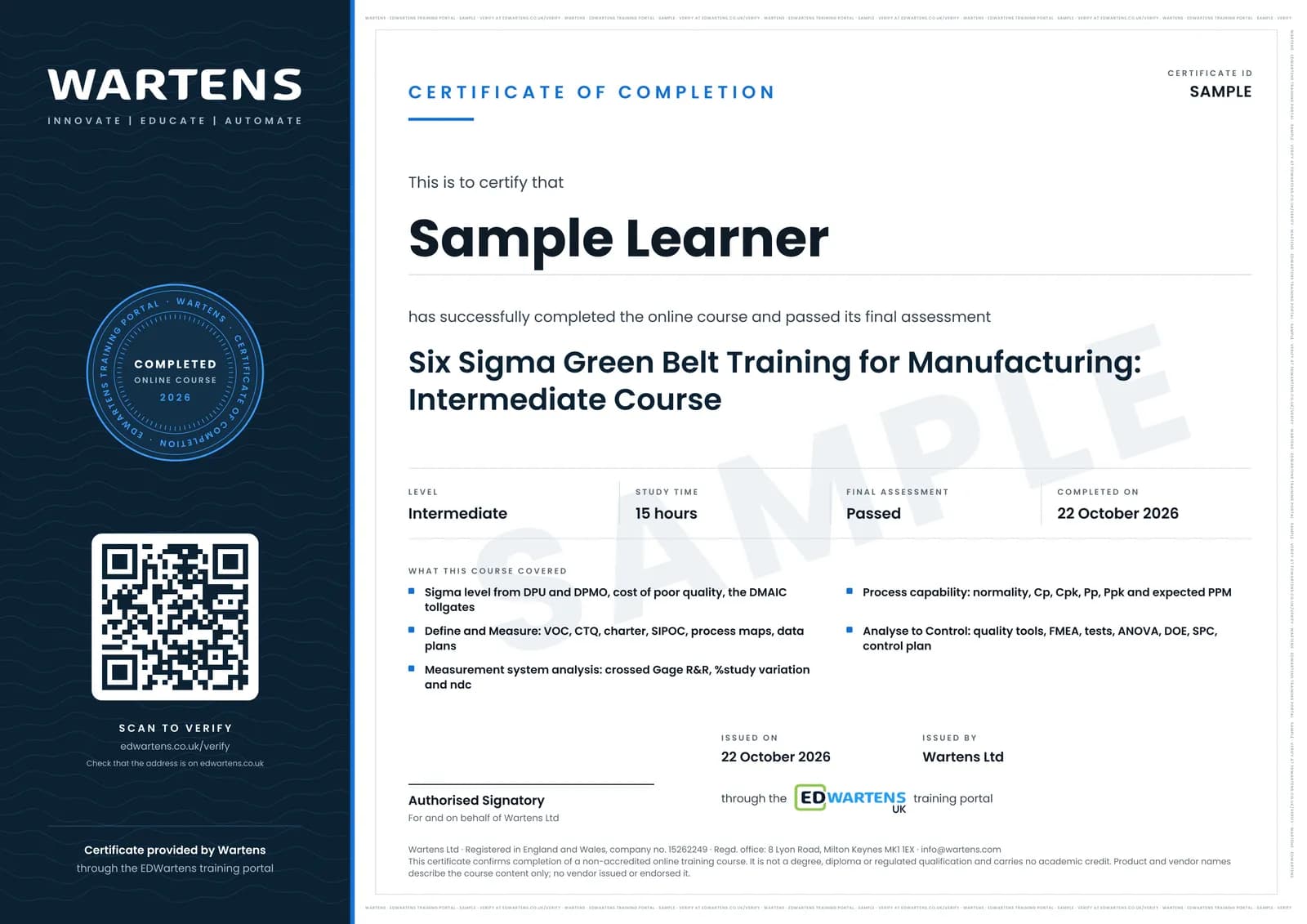
Sample certificate. Optional, issued when you pass the final exam.
- Level
- Intermediate
- Modules
- 15
- Video
- 19 hours
- Price
- Free
Outcome
What you will be able to do
Run a DMAIC project end to end on a real process. Convert reject data into DPU, DPMO and a sigma level, and cost the problem. Write a charter and a SIPOC that fix the scope, and turn customer complaints into CTQs with a unit, a target and limits. Build a data collection plan, then prove the gauge with a crossed Gage R&R before trusting a single reading. Compute Cp, Cpk, Pp and Ppk and convert them into expected PPM. Find root causes with the seven quality tools and FMEA. Decide whether a difference is real with one-sample and two-sample tests and ANOVA, fit and read a regression, and design a simple factorial experiment. Then hold the gain with X bar R and attribute control charts and a written control plan.
- Turn a month of reject data into DPU, DPMO and a sigma level, and cost the problem
- Fix a project with a one-page charter and a SIPOC, and write CTQs that carry a unit, a target and limits
- Run a crossed Gage R&R and judge the gauge by percent study variation and number of distinct categories
- Compute Cp, Cpk, Pp and Ppk from raw readings and convert an index into an expected parts per million
- Decide whether a difference is real with one-sample and two-sample tests, ANOVA and regression
- Hold the gain with X bar R and attribute control charts and a control plan production can follow without you
Software
None required. A spreadsheet such as MS Excel for the capability, control chart and hypothesis test arithmetic. Minitab is demonstrated in some lessons and is useful, but it is not needed to finish the course.
Hardware
None. An instrument and a few parts from your own workplace make the Gage R&R practice task real, if you have access to them.
Syllabus
15 modules
Each module has video lessons, notes and a short quiz. The final exam closes the course.
- Six Sigma, sigma level and the DMAIC roadmap4 lessons
- Quality, the cost of poor quality and lean beside Six Sigma3 lessons
- Define: the voice of the customer and critical-to-quality3 lessons
- Define: choosing the project, the charter and SIPOC3 lessons
- Measure: the process, the data and the scale it is on4 lessons
- Measurement system analysis and Gage R&R2 lessons
- Process capability: normality, Cp and Cpk3 lessons
- Capability in practice: centred and off-centred processes3 lessons
- Analyse: root cause, the seven quality tools and FMEA4 lessons
- Hypothesis testing: the logic and the one-sample test4 lessons
- Two-sample tests and analysis of variance3 lessons
- Correlation, regression and designed experiments3 lessons
- Control: statistical process control and control limits4 lessons
- Control charts in practice, and the control plan3 lessons
- Final assessment0 lessons
How it works
How this course works
- Watch the video lessonsOne module at a time, at your own pace.
- Take the module quizA short quiz at the end of each module shows what stuck.
- Keep your notesWrite in My notes beside each module and ask the trainer if you are stuck.
- Sit the final examPass it once you have been through the modules.
- Certificate, if you want oneOptionalPaid, and only after you pass. Anyone can check it online.
Certificate
An optional certificate when you pass
Learning is free. Pass the final exam and you can have a certificate for £19, including VAT, with a number employers can check online. It records that you completed a free online course; it is not a regulated qualification or a CPD certificate.
- Your name, the course, its study time and your final exam score
- A unique certificate number and a QR code to its verification page
- Issued by Wartens Ltd; add it to your LinkedIn profile in one click
- Pay now or after you pass: it is issued the moment you pass the final
Credits
Who made the lessons
The video lessons belong to their creators. EDWartens wrote the study plan, notes, quizzes and the final exam.
- NPTEL IIT Kharagpur
the lecture spine, from the NOC Jan 2019 Six Sigma course: quality management basics, voice of the customer, project identification and selection, process characteristics and analysis, measurement system fundamentals and the Gage R&R study, process capability concepts, measures and indices, hypothesis testing for single and two populations, correlation and regression, FMEA, the introduction to design of experiments, and statistical process control with control charts for variables
- Digital E-Learning
the short explainers that open each phase: what Six Sigma is, the DMAIC guide, DPU, DPMO and PPM, cost of quality against cost of poor quality, lean beside Six Sigma, the Define, Measure, Improve and Control phase videos, CTQ, the project charter, SIPOC, scales of measurement, the seven quality tools, five whys, the fishbone diagram, hypothesis testing, type I against type II error, ANOVA, common against special cause, control limits against specification limits, and defect against defective
- The Open Educator
the worked spreadsheet and Minitab sessions: the normality probability plot, centred and off-centred capability studies in MS Excel, Cp and Cpk against Pp and Ppk, the p value and the level of significance, the four-step two-sample t test, and choosing between p, np, c and u charts
- Simple Learning Pro
a lesson in "Measure: the process, the data and the scale it is on"
Questions
About this course
Can I get a Six Sigma Green Belt for free?
What is the ASQ Six Sigma Green Belt exam like?
What is the difference between a Six Sigma Green Belt and a Black Belt?
Is this the same as an ASQ or IASSC Green Belt certification?
What do I need to know before starting?
Do I need Minitab?
Do I need a factory to do the practice tasks?
Is the course really free?
What certificate do I get?
Who made the video lessons?
Will this help me move from production into quality or continuous improvement?
Want a live class and career support?
The Professional Module is five live days of Siemens PLC, HMI and SCADA with an instructor, then a resume session and a CPD certificate.