Free course · Process control
Process Simulation with DWSIM for Oil, Gas and Chemicals
This free course teaches steady-state process simulation in DWSIM, the free open-source simulator: compounds and property packages, streams and flash calculations, valves, pumps and compressors, separators, heat exchangers, shortcut and rigorous distillation, reactors, recycle loops and sensitivity studies. It suits UK chemical, process and mechanical engineering students and graduates, and engineers at oil, gas, chemical and energy sites. It helps with process engineer and process simulation roles. A 64-bit laptop with 4 GB of memory is enough.
Process Simulation with DWSIM for Oil, Gas and Chemicals is a free online intermediate Process control course with 13 modules, about 19 hours of video lessons. Learning is free; an optional verifiable certificate costs £19 including VAT when you pass the final exam. Last updated 28 October 2026.
Free to learn. Verifiable certificate £19 when you pass the final exam (optional, VAT included).
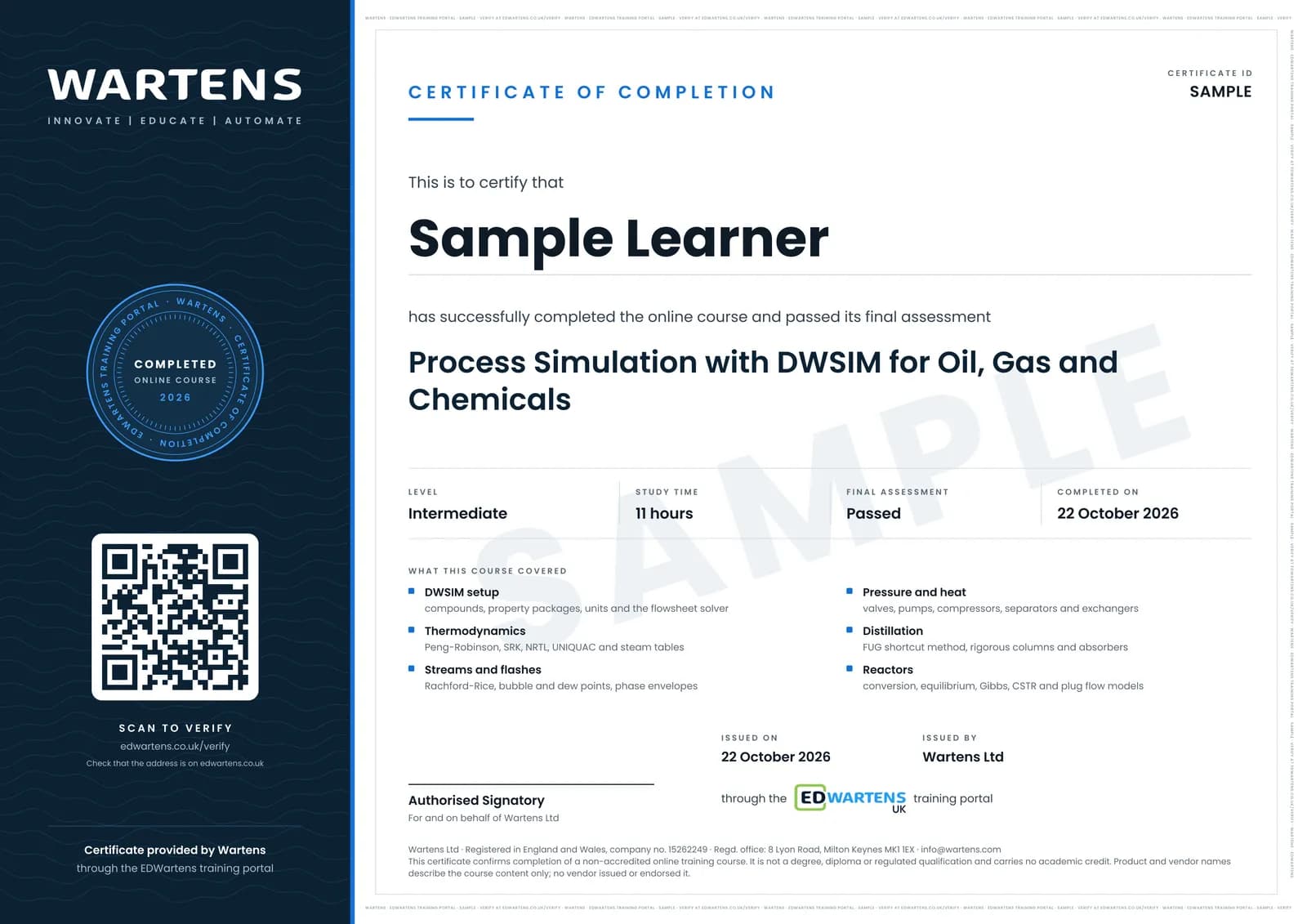
Sample certificate. Optional, issued when you pass the final exam.
- Level
- Intermediate
- Modules
- 13
- Video
- 19 hours
- Price
- Free
Video time only: reading the notes, the quizzes and the final exam take extra time, at your own pace.
Outcome
What you will be able to do
Set up a DWSIM simulation from compounds, property package and units to a solved flowsheet; choose and defend a property package (Peng-Robinson, SRK, NRTL, UNIQUAC, steam tables and the specialist packages); run TP, PH and vapour fraction flashes, bubble and dew points and phase envelopes, and solve a Rachford-Rice flash by hand; model mixers, splitters, valves, pumps, compressors, separators and heat exchangers and check their power, temperatures and areas; design a column with the Fenske, Underwood and Gilliland shortcut and converge a rigorous column or absorber; choose between conversion, equilibrium, Gibbs, CSTR and plug flow reactors and size a kinetic reactor; converge recycle loops and use adjust, sensitivity analysis and the optimizer; characterise a crude from an assay; and build, check and report a gas conditioning flowsheet.
- Set up DWSIM: compounds, property package, units, streams, unit operations and the solver
- Choose Peng-Robinson, SRK, NRTL, UNIQUAC or steam tables for a mixture and defend the choice
- Solve flashes, bubble and dew points by hand with Rachford-Rice and read phase envelopes
- Model valves, pumps, compressors, separators and heat exchangers and check them by hand
- Design a column with Fenske, Underwood and Gilliland, then converge a rigorous column or absorber
- Pick conversion, equilibrium, Gibbs, CSTR or PFR models and size a kinetic reactor
- Converge recycle loops and run adjust, sensitivity and optimisation studies
- Characterise a crude and build, check and report a gas conditioning flowsheet
Software
DWSIM, free and open source (GPL): download the current release from dwsim.org (Windows, Linux and macOS builds; the Classic interface is Windows only). The lessons were recorded on DWSIM 5 to 9; the workflow is the same in newer versions, though some menus have moved. A spreadsheet (LibreOffice Calc is free) for the hand checks. ChemSep LITE, a free CAPE-OPEN column add-on, is optional.
Hardware
Any 64-bit laptop with 4 GB of memory (8 GB recommended) and about 1 GB of free disk space; no graphics card is needed.
Syllabus
13 modules
Each module has video lessons, notes and a short quiz. The final exam closes the course.
- Process simulation and DWSIM: the workflow and your first flowsheet4 lessons
- Thermodynamics and choosing a property package4 lessons
- Material streams, flash calculations and phase envelopes5 lessons
- Pressure and flow: mixers, splitters, valves, pumps, compressors and pipes6 lessons
- Separators, flash drums and gas compression trains5 lessons
- Heat exchangers: heaters, coolers and shell and tube4 lessons
- Distillation design with the shortcut column (Fenske, Underwood, Gilliland)4 lessons
- Rigorous distillation, absorption and ChemSep columns5 lessons
- Reactors I: conversion, equilibrium and Gibbs reactors5 lessons
- Reactors II: kinetics, CSTR and plug flow reactors4 lessons
- Recycle, adjust, sensitivity analysis and optimisation5 lessons
- Oil and gas flowsheets: assays, gas treating, pipelines, dynamics and a capstone4 lessons
- Final assessment1 lesson
How it works
How this course works
- Watch the video lessonsOne module at a time, at your own pace.
- Take the module quizA short quiz at the end of each module shows what stuck.
- Keep your notesWrite in My notes beside each module and ask the trainer if you are stuck.
- Sit the final examPass it once you have been through the modules.
- Certificate, if you want oneOptionalPaid, and only after you pass. Anyone can check it online.
Certificate
An optional certificate when you pass
Learning is free. Pass the final exam and you can have a certificate for £19, including VAT, with a number employers can check online. It records that you completed a free online course; it is not a regulated qualification or a CPD certificate.
- Your name, the course, its study time and your final exam score
- A unique certificate number and a QR code to its verification page
- Issued by Wartens Ltd; add it to your LinkedIn profile in one click
- Pay now or after you pass: it is issued the moment you pass the final
Credits
Who made the lessons
The video lessons belong to their creators. EDWartens wrote the study plan, notes, quizzes and the final exam.
- Spoken-Tutorial IIT Bombay
the English DWSIM series by FOSSEE, IIT Bombay, licensed CC BY-SA 4.0: flowsheeting, material streams, bubble and dew points, binary phase envelopes, heat exchangers, shortcut, rigorous and ChemSep columns, absorption, conversion, equilibrium, Gibbs, CSTR, PFR and catalytic reactors, and sensitivity analysis with adjust
- DWSIM Simulator
the developer's own lessons: DWSIM's features, property packages and flash algorithms, the unit operations overview, the pipe network unit and the basic dynamic simulation tutorial
- Chemical Engineering Education
the DWSIM 9 lessons on Peng-Robinson against SRK, NRTL and UNIQUAC for azeotropes, bubble and dew points, mixers, splitters, pumps, pipes and valves, gas compression and LPG separation, heat exchangers, shortcut and benzene-toluene distillation, ammonia equilibrium, CSTRs and recycle
- The Chemical Engineer
the DWSIM introduction, the gas and liquid separator, and the recycle block in a complete flowsheet
- eduX
the water gas shift conversion reactor, pump selection with the adjust function, and building a petroleum assay
- Dr. Surendra Sasikumar Jampa (PhD,Chem Engg, IITB)
the DWSIM introduction and adiabatic compressor lecture with a hand calculation
- LearnChemE
the flash distillation examples, the Rachford-Rice procedure, the flash energy balance, binary distillation and the single reaction with recycle
- Vincent Stevenson
multicomponent distillation and the Fenske equation
- Christi Patton Luks
selecting property packages for simulations
- Kimray Inc
the TEG gas dehydration and glycol regeneration system, equipment by equipment
- Carver Pump Company
how amine sweetening works, absorption and stripping
Jobs
Jobs this course can lead to
The skills in this course are used in instrumentation and process control work, for example as a process engineer and a process simulation engineer. No course can promise a job, and employers also look for experience, so read what live adverts ask for.
Pay: Production and process engineers (SOC 2125, which includes control and instrumentation engineers) had a median of £48,700 a year, full-time, in April 2026. Source: ONS, Annual Survey of Hours and Earnings 2026 (provisional). Checked 28 Oct 2026.
Questions
About this course
Last reviewed 28 October 2026.
Is this enough to become a process engineer in the UK?
What computer do I need?
Are the results good enough for real design?
What does the Process Simulation with DWSIM for Oil, Gas and Chemicals course cover?
Where does Process Simulation with DWSIM for Oil, Gas and Chemicals start and where does it end?
How long is Process Simulation with DWSIM for Oil, Gas and Chemicals?
What is DWSIM?
Who is this process simulation course for?
Is DWSIM a free alternative to Aspen HYSYS?
Which DWSIM version does the course use?
Is the course free to learn, and how long does it take?
What certificate do I get, and how is it verified?
What jobs does process simulation lead to?
Does the course cover HAZOP or equipment mechanical design?
Want a live class and career support?
The Professional Module is five live days of Siemens PLC, HMI and SCADA with an instructor, then career sessions with our engineers and a CPD certificate.