
Free course · Electrical
Power Quality and Harmonics: G5/5, IEEE 519 and IEC 61000
Power quality for electrical engineers in plants, buildings, utilities and data centres: sags, swells, transients, flicker and unbalance; harmonics from drives, UPS, IT loads and inverters; THD, TDD, K-factor and resonance; the UK's ENA Engineering Recommendation G5/5 and IEEE 519-2022 limits at the point of common coupling, and the IEC 61000 family; Class A measurement and Python analysis; reactors, detuned capacitor banks, passive and active filters, active front ends and multipulse drives; and a harmonic study in the free OpenDSS simulator.
Free to learn. Verifiable certificate £19 when you pass the final exam (optional, VAT included).
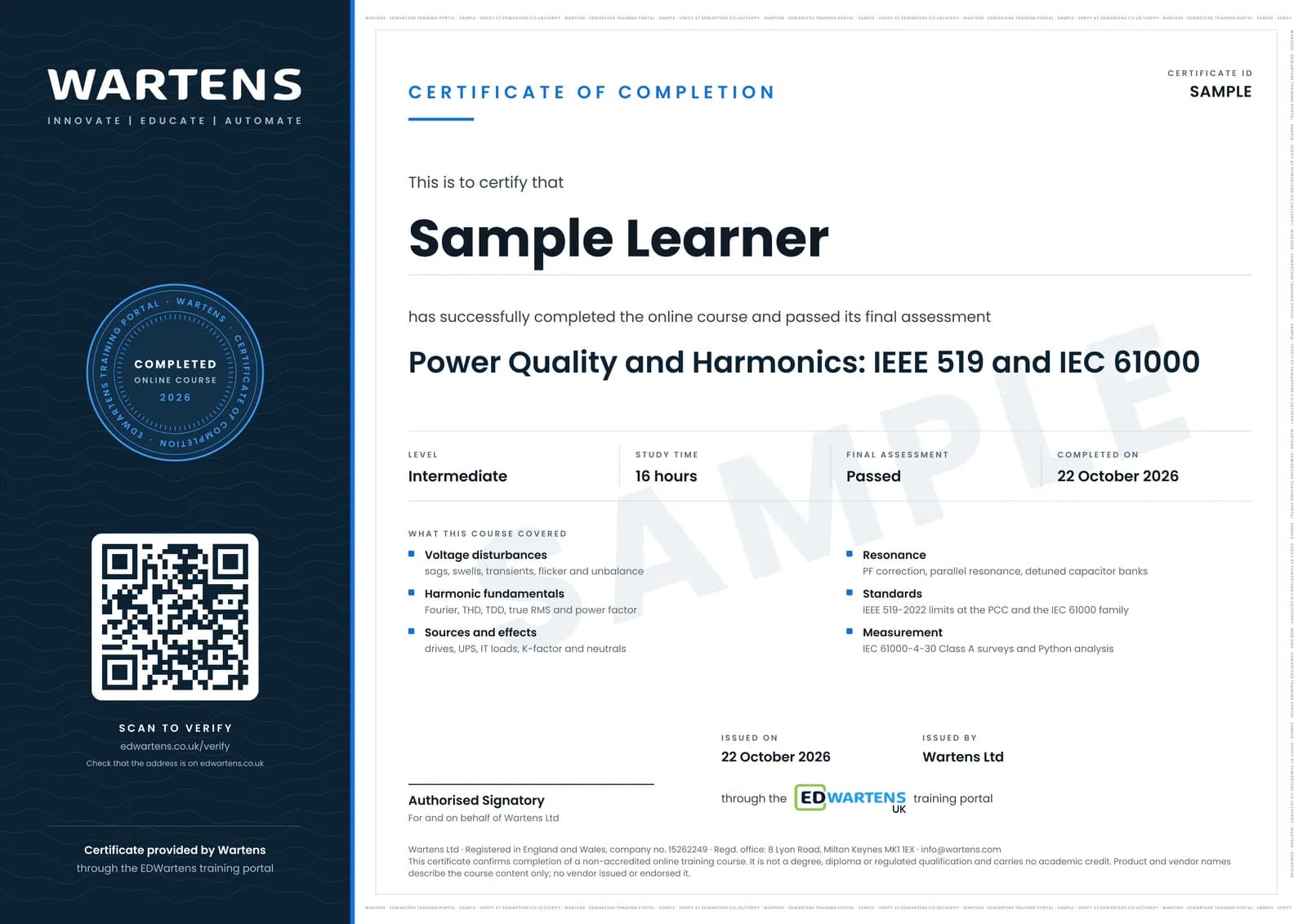
Sample certificate. Optional, issued when you pass the final exam.
- Level
- Intermediate
- Modules
- 15
- Video
- 24 hours
- Price
- Free
Outcome
What you will be able to do
Classify sags, swells, interruptions, transients, flicker and unbalance and judge equipment ride-through on the ITIC and SEMI F47 curves; calculate THD, TDD, true power factor, K-factor and neutral current from a spectrum; predict the harmonics of drives, UPS and IT loads; find parallel resonance and specify detuned capacitor banks; locate the PCC, calculate Isc/IL and test compliance with IEEE 519-2022 using its percentile rules; plan and run a Class A survey and analyse a week of data in Python; size reactors and active filters and compare multipulse, AFE and passive solutions; model a site in OpenDSS; and write a power quality report.
- Classify sags, swells, transients, flicker and unbalance and judge ride-through on ITIC and SEMI F47
- Calculate THD, TDD, true RMS, true power factor, K-factor and neutral current from a spectrum
- Predict the harmonics of six, twelve and eighteen pulse drives, UPS, IT loads and inverters
- Find parallel resonance and specify a detuned capacitor bank with the right capacitor voltage
- Locate the PCC, calculate Isc/IL and test compliance with IEEE 519-2022 percentile rules
- Plan an IEC 61000-4-30 Class A survey and analyse a week of data in Python
- Size reactors and active harmonic filters and compare multipulse, AFE and passive filters
- Model a site in OpenDSS and write a power quality report with ranked recommendations
Software
A spreadsheet for the calculations. Python 3 with numpy and pandas for the data analysis, and the free OpenDSS simulator from EPRI driven from Python through OpenDSSDirect.py; Google Colab runs both in a browser with nothing to install. Analyser vendor software and commercial study tools appear in some lessons but are not needed.
Hardware
None. Any laptop with a browser is enough. A three-phase power quality analyser is shown in the measurement lessons; using one on site needs a competent, authorised person.
Syllabus
15 modules
Each module has video lessons, notes and a short quiz. The final exam closes the course.
- What power quality is and why plants and data centres care4 lessons
- Voltage sags, swells and interruptions: causes, ride-through and tolerance curves4 lessons
- Transients, flicker and voltage unbalance7 lessons
- Harmonics fundamentals: Fourier, THD, TDD and true power factor10 lessons
- Sources of harmonics: drives, rectifiers, UPS, IT and LED loads, inverters11 lessons
- Effects of harmonics: transformers, K-factor, neutrals, cables, motors and generators12 lessons
- Resonance, power factor correction and detuned capacitor banks7 lessonsLab
- IEEE 519-2022 at the PCC, and the IEC 61000 limits9 lessons
- Measuring power quality: IEC 61000-4-30 Class A and analyser set-up8 lessons
- Reading the data: troubleshooting, percentiles and Python analysis10 lessons
- Mitigation 1: reactors, transformers, multipulse drives and passive filters15 lessons
- Mitigation 2: active harmonic filters, active front ends and choosing a solution9 lessons
- Harmonic studies: data, models, frequency scans and OpenDSS6 lessons
- Data centres, renewables and generators, and writing the power quality report7 lessons
- Final assessment1 lesson
How it works
How this course works
- Watch the video lessonsOne module at a time, at your own pace.
- Take the module quizA short quiz at the end of each module shows what stuck.
- Keep your notesWrite in My notes beside each module and ask the trainer if you are stuck.
- Practise in the labOptionalTry a task from the module in the EDWartens Lab, in your browser.
- Sit the final examPass it once you have been through the modules.
- Certificate, if you want oneOptionalPaid, and only after you pass. Anyone can check it online.
EDWartens Lab
Practise this in the EDWartens Lab
Read the single line diagram, then isolate, lock and tag a motor bucket in the Lab's substation and MCC room.
Works alongside Power Quality and Harmonics: G5/5, IEEE 519 and IEC 61000. The Lab is substation and mcc practice in your browser: no install, no hardware, free to use. Sign in as a learner and it opens with your account.
Levels to try with this course
MCC-07 · Substation and MCC lab
Correct the power factor
Open in the lab (opens in a new tab)
Optional. Skip it whenever you like: it never blocks your progress or your certificate.
Why practise in a lab
Technical work is judged on what you can do: wiring, commissioning, finding a fault. Doing a task yourself teaches more than watching it a second time, and a lab lets you try it safely before you meet real equipment. It does not replace working on real hardware.
- Practise safely, so a mistake costs nothing.
- The lab checks your work like a site test, so you know when it is right.
- Free, in your browser, with nothing to install.
Certificate
An optional certificate when you pass
Learning is free. Pass the final exam and you can have a certificate for £19, including VAT, with a number employers can check online. It records that you completed a free online course; it is not a regulated qualification or a CPD certificate.
- Your name, the course, its study time and your final exam score
- A unique certificate number and a QR code to its verification page
- Issued by Wartens Ltd; add it to your LinkedIn profile in one click
- Pay now or after you pass: it is issued the moment you pass the final
Credits
Who made the lessons
The video lessons belong to their creators. EDWartens wrote the study plan, notes, quizzes and the final exam.
- Eaton
the harmonics FAQ series: nonlinear loads, THD and TDD, sources and symptoms, transformers, neutrals and generators, resonance, IEEE 519 and its 2022 changes, the PCC, line reactors, phase-shifting and zig-zag transformers, 18 and 24 pulse drives, passive and active filters, and the power quality troubleshooting talk
- Gaurav J - TheElectricalGuy
the beginner's guide to power quality, voltage sags and interruptions, and the complete basics of harmonics
- Sunny Classroom
ten common power quality problems
- Circutor EN
how to interpret a recorded power quality event
- Dr. David Lubkeman
university lectures on power quality, the voltage sag model, harmonics in distribution systems, the OpenDSS overview and PV mitigation in OpenDSS
- Dr Hamdan UMP
power acceptability curves (CBEMA and ITIC)
- BESA Research
capacitor switching transients, voltage imbalance in motors, harmonics and neutral currents in transformers, and VFD harmonics damaging capacitors
- Transient Specialists
an overview of power line transients
- RLC Engineering
the impacts of voltage flicker and transient overvoltages
- Power Monitors, Inc.
understanding flicker measurement
- Ferguson HVAC Training, Service Group
voltage unbalance and its effect on motors
- w2aew
measuring THD with an FFT on an oscilloscope
- Rohde & Schwarz
understanding current harmonics from switch-mode and rectifier loads
- Maddox Transformer
how K-factor transformers handle harmonics
- WattsApp with Power
how to calculate K-factor
- Brainfiller | Jim Phillips, P.E.
third harmonics and neutral currents
- Skorpen Academy
why a capacitor bank can amplify harmonics
- Power Eng. By Afshin
how detuned filters work
- Comsys AB
what changed in IEEE 519-2022
- GalcoTV
a short introduction to IEEE 519
- TektronixSupport
IEC 61000-3-2 current harmonic measurement
- Levine Lectronics and Lectric
the webinar on power quality, harmonics and IEEE 519-2022
- SCIENTIA
how a Class A analyser records to IEC 61000-4-30 and how to verify an analyser installation
- Power Quality Analysers
setting up an analyser to record a power quality survey
- Hioki E.E. Corporation
analyser wiring and configuration
- Chauvin Arnoux UK
setting up a three-phase power quality analyser
- Fridays With Brandon
a walk-through of a three-phase power quality logger
- Fluke Corporation
running a harmonics test on a power quality analyser
- Signal Processing with Paul
plotting the Fourier transform in Python
- Python Power Electronics
performing a DFT with the numpy FFT
- ABB Drives
tackling harmonics with active front end drives
- Keentel Engineering
active harmonic filter sizing, and battery storage power quality in data centres
- U.S. Drives and Automation Training
harmonic mitigation compared: active front end against passive filter
- OpenDSS-G
a harmonics simulation in OpenDSS
- MICATU, Inc.
how harmonic disturbances cause data centre problems
- Data Center MEP System
power quality and harmonic performance in data centres
- Schneider Electric
how PV self-consumption affects power quality
Questions
About this course
Does it cover the UK harmonic rules?
What is this power quality and harmonics course?
Who is the power quality course for?
What do I need to know before starting?
Which standards does the course cover?
How long does the course take?
Is the course free, and what certificate do I get?
How do I check a site for IEEE 519 compliance?
What jobs does power quality lead to, and is it in demand?
Want a live class and career support?
The Professional Module is five live days of Siemens PLC, HMI and SCADA with an instructor, then a resume session and a CPD certificate.