
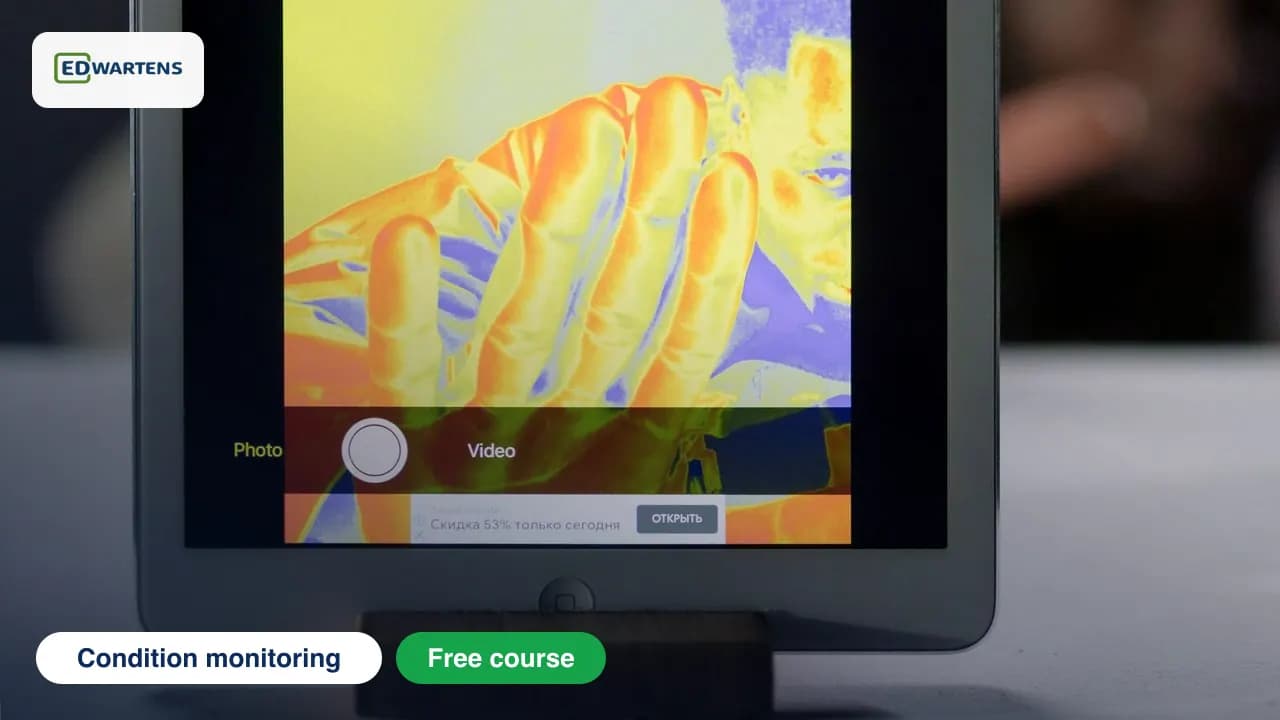
Free course · Condition monitoring
Infrared Thermography Training
A short, practical foundation in thermal imaging for plant work: what the camera actually measures and what it never sees, emissivity and reflected apparent temperature, loaded electrical surveys and three-phase comparison, motors and bearings and couplings, building envelope and lagging and moisture, solar PV hot cells and substrings, and the route survey and written finding that turn a pretty picture into a work order.
Free to learn. Verifiable certificate £19 when you pass the final exam (optional, VAT included).
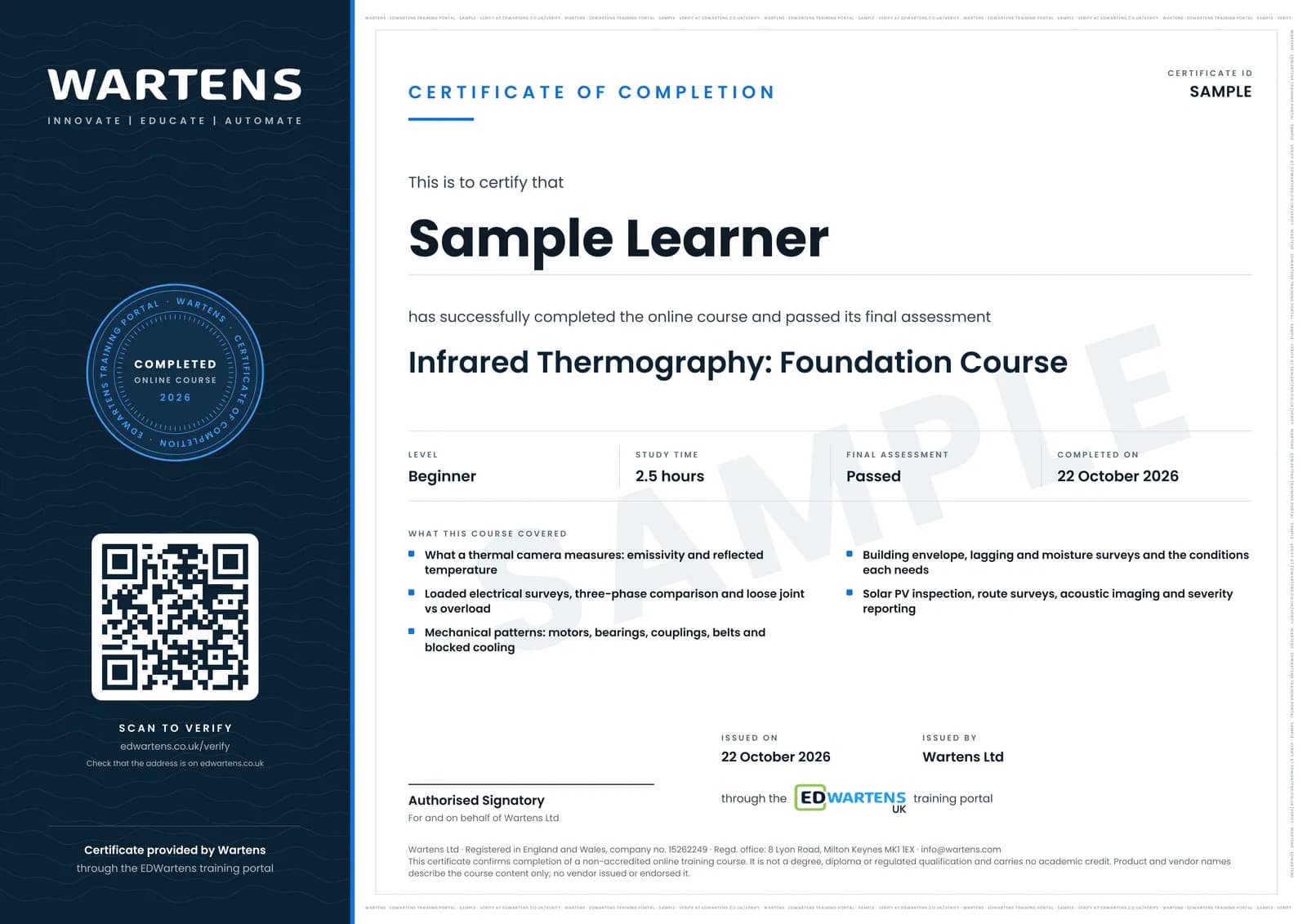
Sample certificate. Optional, issued when you pass the final exam.
- Level
- Beginner
- Modules
- 6
- Video
- 5 hours
- Price
- Free
Outcome
What you will be able to do
Set emissivity and reflected apparent temperature before trusting any reading, and say why a bright busbar reads wrong; plan and run a loaded electrical survey and classify a hot joint by comparing it with the same connection on the other phases; read motor, bearing housing, coupling and belt drive patterns and know which need vibration or ultrasound to confirm; choose the conditions a building, lagging or moisture survey needs; inspect a PV array and trace hot cell, bypass diode substring and whole module patterns back to their causes; build a route survey with baselines and repeat intervals; and write a finding that carries load, ambient, the comparison used, a severity and a re-inspection date.
- Set emissivity and reflected apparent temperature, and recognise when a shiny surface has made a reading worthless
- Plan a loaded electrical survey, record load and ambient with every image, and work safely with an authorised electrician
- Classify a hot joint by comparing it with the same connection on the other two phases
- Read motor, bearing, coupling and belt drive patterns, and say which finding needs vibration or ultrasound to confirm
- Choose the time of day and temperature difference a building, lagging or PV survey needs before you leave the office
- Write a finding a plant manager can act on: image pair, conditions, comparison, severity, action and re-inspection date
Software
None required. Camera makers' free report software is discussed in the notes, not needed to finish the course.
Hardware
None. A thermal camera, or a clip-on thermal module for a phone, makes every practice task real; each task also has a version you can do with a notebook.
Syllabus
6 modules
Each module has video lessons, notes and a short quiz. The final exam closes the course.
- What a thermal camera actually measures2 lessons
- Electrical and mechanical inspection4 lessons
- Building envelope, insulation and moisture1 lesson
- Solar PV inspection1 lesson
- Route surveys, and where infrared stops2 lessons
- Final assessment0 lessons
How it works
How this course works
- Watch the video lessonsOne module at a time, at your own pace.
- Take the module quizA short quiz at the end of each module shows what stuck.
- Keep your notesWrite in My notes beside each module and ask the trainer if you are stuck.
- Sit the final examPass it once you have been through the modules.
- Certificate, if you want oneOptionalPaid, and only after you pass. Anyone can check it online.
Certificate
An optional certificate when you pass
Learning is free. Pass the final exam and you can have a certificate for £19, including VAT, with a number employers can check online. It records that you completed a free online course; it is not a regulated qualification or a CPD certificate.
- Your name, the course, its study time and your final exam score
- A unique certificate number and a QR code to its verification page
- Issued by Wartens Ltd; add it to your LinkedIn profile in one click
- Pay now or after you pass: it is issued the moment you pass the final
Credits
Who made the lessons
The video lessons belong to their creators. EDWartens wrote the study plan, notes, quizzes and the final exam.
- Infrared Training Center
The Infrared Spectrum sessions on building thermography, PV inspection, shipboard route surveys and acoustic imaging
- Online Infrared Training Center
what thermal imaging is, the electrical inspection tutorials and the mechanical thermography walkthrough
- Pass Thermal
infrared thermography seen from the maintenance department rather than from a camera vendor
- GTI Predictive
how thermography sits alongside vibration analysis and balancing in one condition monitoring toolkit
Questions
About this course
Do I need a thermal camera?
What do I need before starting?
Is this the same as a Level 1 thermographer certification?
Which standards does it follow?
How long is the course?
Is the course really free?
What certificate do I get?
Who made the video lessons?
Want a live class and career support?
The Professional Module is five live days of Siemens PLC, HMI and SCADA with an instructor, then a resume session and a CPD certificate.