Free course · Food and drink manufacturing
Food and Drink Automation and Hygienic Design
This free course gives UK maintenance, electrical and automation engineers the food and drink context: HACCP awareness, hygiene zones and foreign body control, hygienic design and EHEDG principles, washdown-rated equipment and IP ratings, clean-in-place systems, packaging lines, OEE and changeovers. Food and drink is widely described as the UK's largest manufacturing sector, so many engineering roles sit in food plants. It is engineering awareness, not food hygiene training for food handlers.
Food and Drink Automation and Hygienic Design is a free online beginner Food and drink manufacturing course with 8 modules, self-paced video lessons. Learning is free; an optional verifiable certificate costs £19 including VAT when you pass the final exam. Last updated 28 October 2026.
Free to learn. Verifiable certificate £19 when you pass the final exam (optional, VAT included).
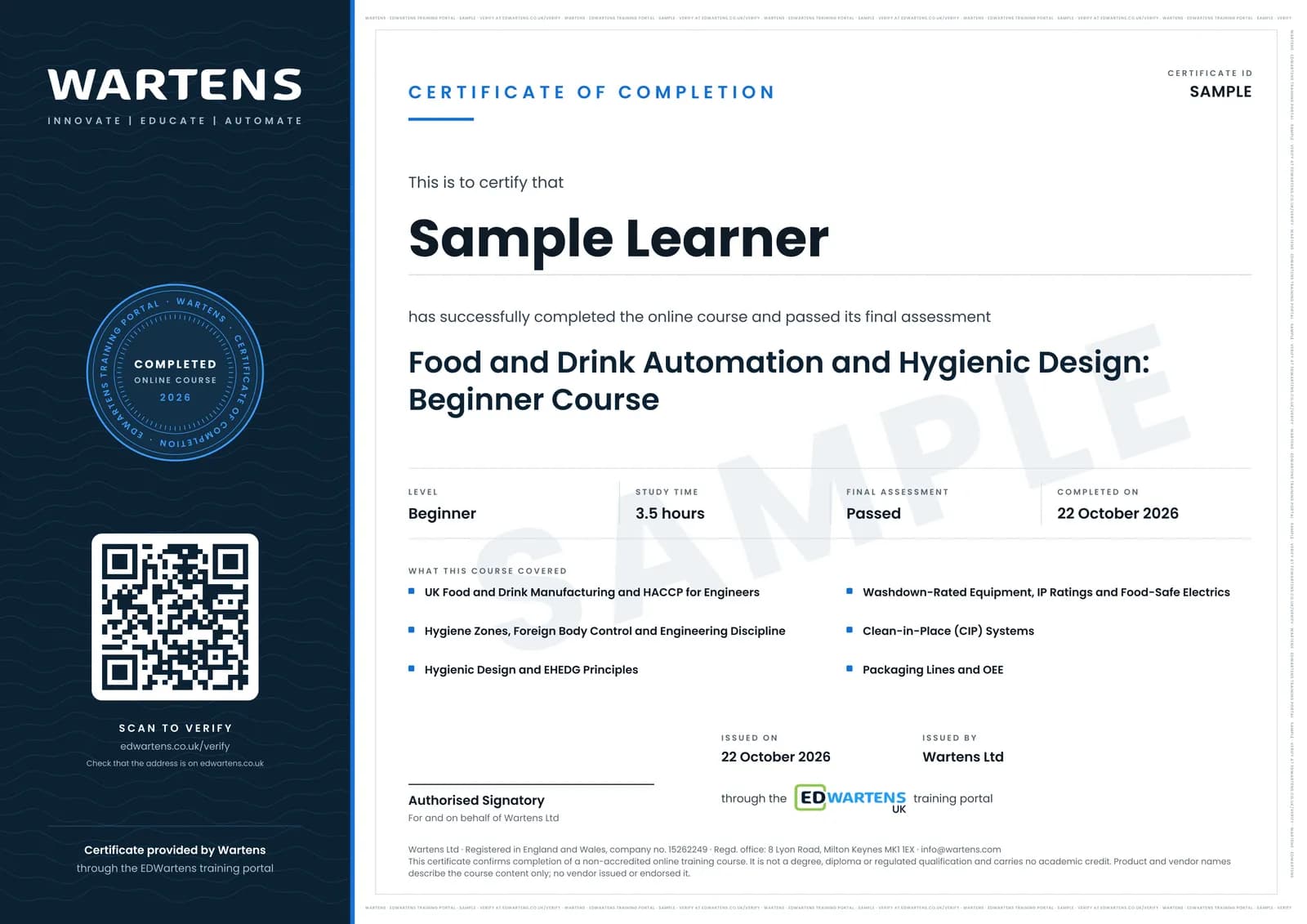
Sample certificate. Optional, issued when you pass the final exam.
- Level
- Beginner
- Modules
- 8
- Video
- Self-paced
- Price
- Free
Video time only: reading the notes, the quizzes and the final exam take extra time, at your own pace.
Outcome
What you will be able to do
Explain the engineer's role in HACCP and food safety, follow hygiene zone and foreign body rules, spot hygienic design faults using EHEDG principles, choose washdown-rated equipment, describe a CIP cycle and its sensors, calculate OEE for a packaging line, and plan a changeover that keeps allergen control.
- Explain how engineering work affects HACCP and food safety
- Follow tool control and post-maintenance hygiene clearance
- Spot hygienic design faults such as dead legs and crevices
- Choose IP65, IP66, IP67 or IP69K equipment for the area
- Describe a CIP cycle and the sensors that prove it
- Calculate OEE from availability, performance and quality
- Plan an allergen-safe changeover using SMED thinking
Software
None required. A spreadsheet is used for OEE calculations.
Hardware
None required.
Syllabus
8 modules
Each module has video lessons, notes and a short quiz. The final exam closes the course.
- UK Food and Drink Manufacturing and HACCP for Engineers3 lessons
- Hygiene Zones, Foreign Body Control and Engineering Discipline3 lessons
- Hygienic Design and EHEDG Principles3 lessons
- Washdown-Rated Equipment, IP Ratings and Food-Safe Electrics3 lessons
- Clean-in-Place (CIP) Systems3 lessonsLab
- Packaging Lines and OEE3 lessonsLab
- Changeovers, SMED and Allergen Control3 lessons
- Final Assessment1 lesson
How it works
How this course works
- Watch the video lessonsOne module at a time, at your own pace.
- Take the module quizA short quiz at the end of each module shows what stuck.
- Keep your notesWrite in My notes beside each module and ask the trainer if you are stuck.
- Practise in the labOptionalTry a task from the module in the EDWartens Lab, in your browser.
- Sit the final examPass it once you have been through the modules.
- Certificate, if you want oneOptionalPaid, and only after you pass. Anyone can check it online.
EDWartens Lab
Practise this in the EDWartens Lab
Build a clean-in-place rinse, wash and rinse sequence with timers in the Lab's process simulator.
Works alongside Food and Drink Automation and Hygienic Design. The Lab is process control practice in your browser: no install, no hardware, free to use. Sign in as a learner and it opens with your account.
Levels to try with this course
PRC-01 · Process lab
Read the P&ID
Open in the lab (opens in a new tab)PLC-06 · PLC lab
Pedestrian crossing
Open in the lab (opens in a new tab)PLC-04 · PLC lab
Batch counter on a packing line
Open in the lab (opens in a new tab)
Optional. Skip it whenever you like: it never blocks your progress or your certificate.
Why practise in a lab
Technical work is judged on what you can do: wiring, commissioning, finding a fault. Doing a task yourself teaches more than watching it a second time, and a lab lets you try it safely before you meet real equipment. It does not replace working on real hardware.
- Practise safely, so a mistake costs nothing.
- The lab checks your work like a site test, so you know when it is right.
- Free, in your browser, with nothing to install.
Certificate
An optional certificate when you pass
Learning is free. Pass the final exam and you can have a certificate for £19, including VAT, with a number employers can check online. It records that you completed a free online course; it is not a regulated qualification or a CPD certificate.
- Your name, the course, its study time and your final exam score
- A unique certificate number and a QR code to its verification page
- Issued by Wartens Ltd; add it to your LinkedIn profile in one click
- Pay now or after you pass: it is issued the moment you pass the final
Credits
Who made the lessons
The video lessons belong to their creators. EDWartens wrote the study plan, notes, quizzes and the final exam.
- Acasi Machinery
lessons in this course
- Burkert Australia
lessons in this course
- CQE Academy
lessons in this course
- Center for Dairy Research
lessons in this course
- Central States Industrial
lessons in this course
- DYW Dumfries&Galloway #DYWFlix
lessons in this course
- EHEDG Global
lessons in this course
- FlexLink
lessons in this course
- Food Safety Training School
lessons in this course
- Food Tech Explained
lessons in this course
- Gemba Academy
lessons in this course
- IFST
lessons in this course
- Just Recruitment
lessons in this course
- LeanVlog
lessons in this course
- QHSE & Food Safety | With Ali
lessons in this course
- Rittal ANZ
lessons in this course
- Telemecanique Sensors
lessons in this course
- campdenbri
lessons in this course
- ifm
lessons in this course
Jobs
Jobs this course can lead to
The skills in this course are used in PLC and industrial automation work, for example as a maintenance engineer, an automation technician and a PLC programmer. No course can promise a job, and employers also look for experience, so read what live adverts ask for.
Browse PLC and industrial automation jobs
456 jobs live on the UK board
Browse PLC programmer jobs
56 jobs live on the UK board
Pay: Advertised PLC engineer roles show a median of £60,000, with 147 permanent adverts in the six months to 27 October 2026 against 80 a year earlier. Source: ITJobsWatch (advert-based, an IT-category sample). Checked 27 Oct 2026.
Questions
About this course
Last reviewed 28 October 2026.
Is this food hygiene training for food handlers?
Will this help me work as an engineer in a food factory?
Is EHEDG training included?
What does the Food and Drink Automation and Hygienic Design course cover?
Where does Food and Drink Automation and Hygienic Design start and where does it end?
How long is Food and Drink Automation and Hygienic Design?
Can I practise Food and Drink Automation and Hygienic Design in the browser?
Why focus on food and drink manufacturing?
Does the course make me a food safety auditor?
Do I need a spreadsheet?
Who made the video lessons?
Want a live class and career support?
The Professional Module is five live days of Siemens PLC, HMI and SCADA with an instructor, then career sessions with our engineers and a CPD certificate.