
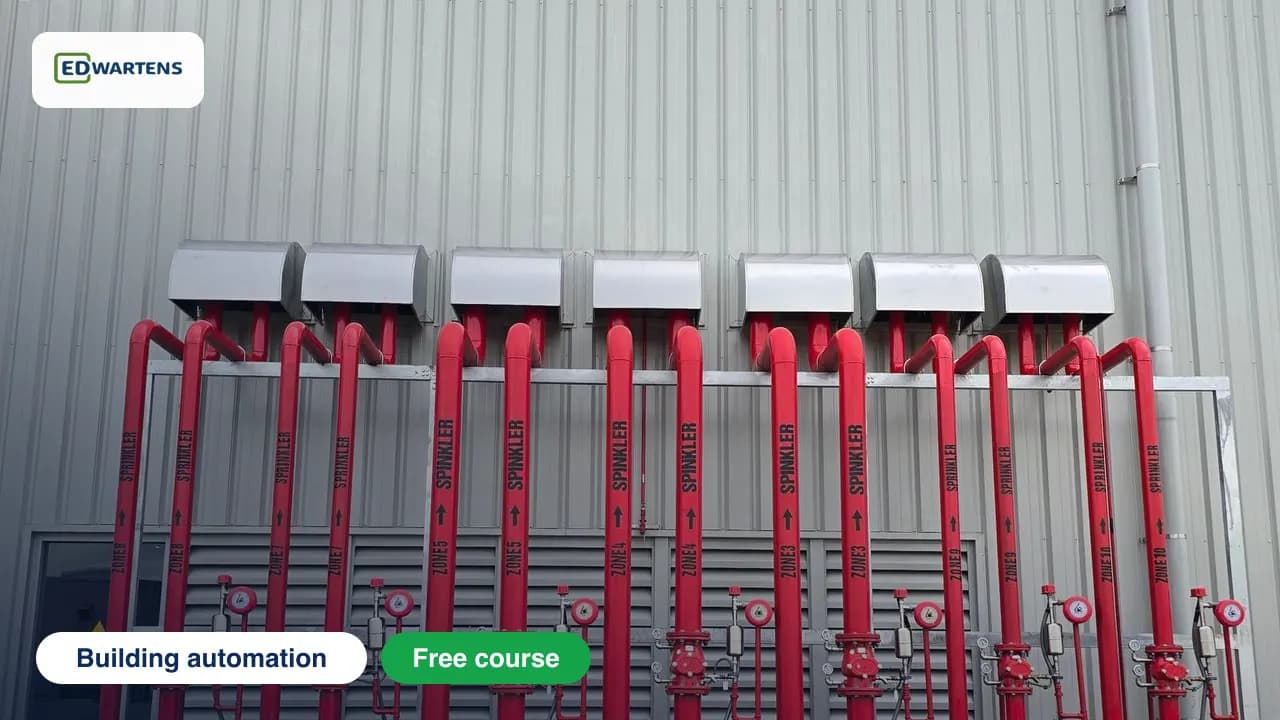
Free course · Building automation
Fire Fighting Design: Sprinklers, Fire Pumps and Hydrants
Design the water-based fire protection package that MEP consultants and contractors submit for approval: system types, hazard classification, sprinkler layout, hydraulic calculation by hand and in a spreadsheet, standpipes, hydrants and water supply, fire pump selection and the pump room, special systems, then testing, commissioning and maintenance.
Free to learn. Verifiable certificate £19 when you pass the final exam (optional, VAT included).
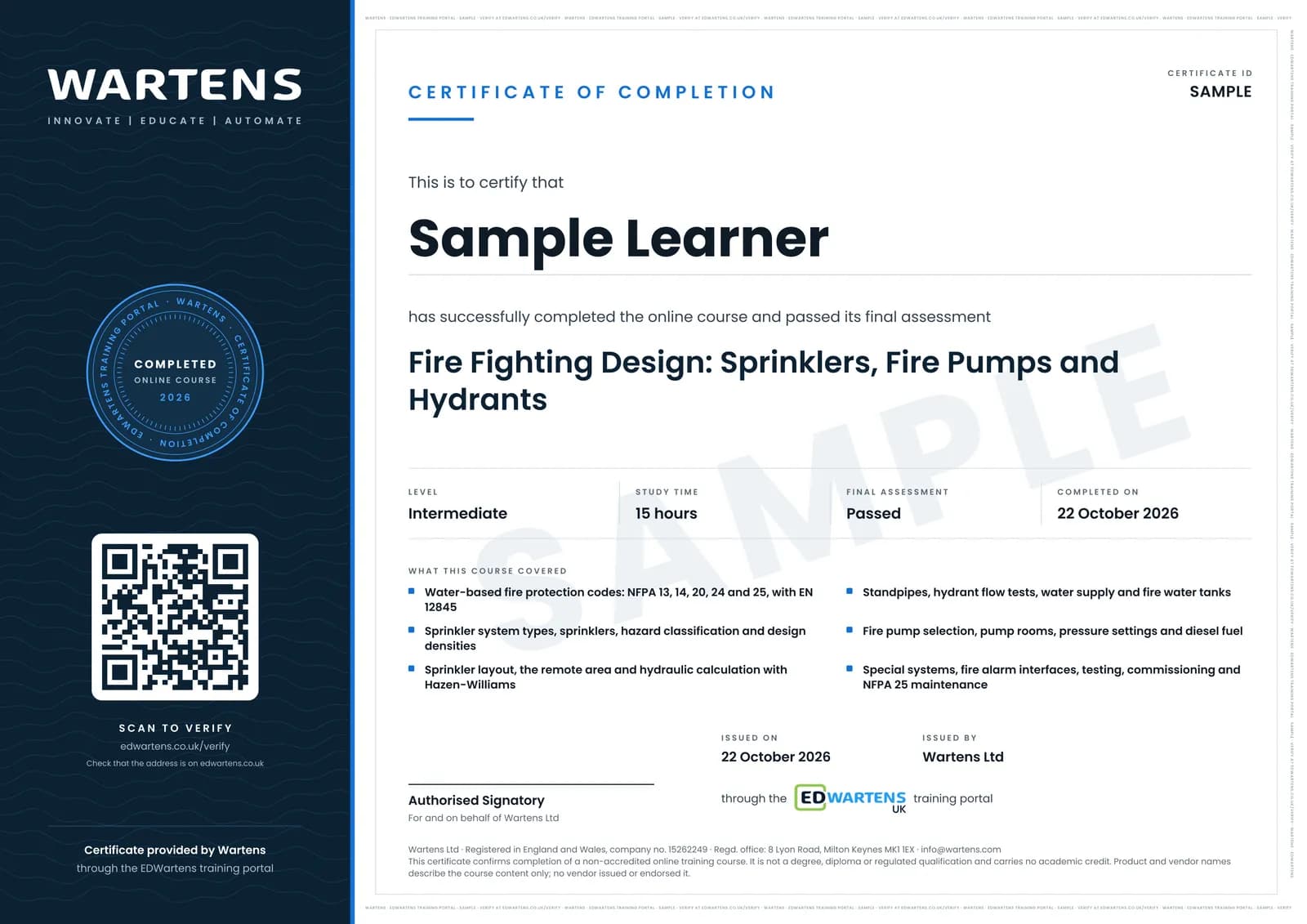
Sample certificate. Optional, issued when you pass the final exam.
- Level
- Intermediate
- Modules
- 15
- Video
- 23 hours
- Price
- Free
Outcome
What you will be able to do
Place a project in its code family (NFPA 13, 14, 20, 24 and 25, EN 12845 or a national code); choose wet, dry, preaction or deluge systems; classify hazards and read design densities; lay out sprinklers within spacing and coverage limits; select the remote area and calculate it node by node with Hazen-Williams, balancing branch lines and checking the demand against a water supply curve; design standpipes, hydrants and the fire water tank; select a fire pump against its NFPA 20 curve points and lay out the pump room with its pressure settings and fuel tank; size a clean agent system and list the signals sent to the fire alarm panel; and plan hydrostatic tests, acceptance tests, NFPA 25 maintenance and the design submittal.
- Explain what sprinklers, standpipes, hydrants and fire pumps do and how NFPA 13, 14, 20, 24 and 25 and EN 12845 divide the work
- Choose wet, dry, preaction or deluge systems and apply the design area adjustments that come with each
- Classify hazards, read design densities and work Q = K x sqrt(P) for any sprinkler
- Lay out sprinklers within the coverage, spacing, wall and obstruction limits
- Size the remote area and calculate it node by node with Hazen-Williams, balancing branch lines against a water supply curve
- Design Class I standpipes, run a hydrant flow test and size a fire water tank
- Select a fire pump against its NFPA 20 curve points, lay out the pump room and set the jockey and pump pressures
- Size a clean agent system, list the fire alarm signals, and plan hydrostatic tests, commissioning and NFPA 25 maintenance
Software
A spreadsheet (LibreOffice Calc is free) for the hydraulic calculator built in the course, and LibreCAD, AutoCAD or squared paper for the layouts. NFPA offers free read-only online access to its standards after a free account is made.
Hardware
None. Every exercise is done with a spreadsheet and a drawing tool or squared paper.
Syllabus
15 modules
Each module has video lessons, notes and a short quiz. The final exam closes the course.
- Water-based fire protection and the codes behind it3 lessons
- Sprinkler system types: wet, dry, preaction and deluge7 lessons
- Sprinklers and the K-factor4 lessons
- Hazard classification and design density4 lessons
- Sprinkler layout: spacing, walls and obstructions4 lessons
- Design approach: pipe schedule, density/area and the remote area6 lessons
- Hydraulic calculation 1: Hazen-Williams, fittings and elevation6 lessons
- Hydraulic calculation 2: balancing, the demand point and the worksheet7 lessons
- Standpipes, landing valves and hose reels4 lessons
- Hydrants, underground mains and the water supply4 lessons
- Fire pumps: types, performance curves and selection8 lessons
- The fire pump room: piping, controllers, settings and fuel6 lessons
- Special systems and the fire alarm interface5 lessons
- Testing, commissioning, maintenance and submittals8 lessons
- Final Assessment1 lesson
How it works
How this course works
- Watch the video lessonsOne module at a time, at your own pace.
- Take the module quizA short quiz at the end of each module shows what stuck.
- Keep your notesWrite in My notes beside each module and ask the trainer if you are stuck.
- Sit the final examPass it once you have been through the modules.
- Certificate, if you want oneOptionalPaid, and only after you pass. Anyone can check it online.
Certificate
An optional certificate when you pass
Learning is free. Pass the final exam and you can have a certificate for £19, including VAT, with a number employers can check online. It records that you completed a free online course; it is not a regulated qualification or a CPD certificate.
- Your name, the course, its study time and your final exam score
- A unique certificate number and a QR code to its verification page
- Issued by Wartens Ltd; add it to your LinkedIn profile in one click
- Pay now or after you pass: it is issued the moment you pass the final
Credits
Who made the lessons
The video lessons belong to their creators. EDWartens wrote the study plan, notes, quizzes and the final exam.
- Irfan CFPS
the NFPA 13, 14, 20 and 25 lessons: system types, sprinklers, hazards and commodities, layout, pipe sizing and hangers, the eleven-step hydraulic calculation series, standpipes, hydrant flow tests, tank capacity, fire pump types, curves, sizing, pump room design, settings and diesel tanks, clean agents and submittals
- NSVCad
the NFPA 13 series on the K-factor, flow and pressure, density, the five-part design area series, CMSA and ESFR sprinklers, the step-by-step hydraulic calculation, the detailed worksheet and the hose stream allowance
- John Novak TR2FD
the overview of sprinklers, standpipes and fire pumps that opens the course
- Project Fire
the Sprinkler Talk episode on obstruction rules
- FPE Learning with Alam
the comparison of standpipe system types
- TheHoseMonsterCompany
how a standpipe flow test is performed
- CalifDGS
the lecture on underground fire service mains and water supply
- MeyerFire
how a fire pump works
- Flameguard Fire Protection Philippines
the summary of NFPA 20 requirements for the pressure sensing line
- WAGNER Group GmbH
how inert gas extinguishing works
- Renewable Fuels Association
the training module on fire fighting foam principles
- Viking Group, Inc.
the activation of a high expansion foam deluge system
- FIRE PROTECTION GUY
a valve tamper switch signalling the fire alarm panel
- GPSTC Productions
the components of a wet sprinkler system, the main drain test and inspection
- McWane Ductile
how to conduct a hydrostatic test on ductile iron pipe
- Konken, Leann
an electric fire pump test
- National Fire Protection Association
what NFPA 25 requires for sprinkler inspections
- Louisiana State Fire Marshal
the shop drawing review process
- Jason Schroeder
how construction submittals are prepared and reviewed
Questions
About this course
Who is this fire fighting design course for?
Is the course free to learn?
Which codes and standards does it follow?
Does it cover the rules in my country?
Can I design a real sprinkler system after this course?
Which software do I need?
How long does the course take?
What certificate do I get?
Want a live class and career support?
The Professional Module is five live days of Siemens PLC, HMI and SCADA with an instructor, then a resume session and a CPD certificate.