
Free course · Building automation
Fire Alarm and ELV Systems Design: NFPA 72 and BS 5839
Design fire alarm and ELV systems the way MEP consultants and contractors submit them: system types and loops, detector and call point layouts to NFPA 72 and BS 5839-1, sounders and strobes, battery and voltage drop calculations, the cause and effect matrix and its interfaces, drawings, testing and commissioning, then CCTV, access control, PA/VA and structured cabling.
Free to learn. Verifiable certificate £19 when you pass the final exam (optional, VAT included).
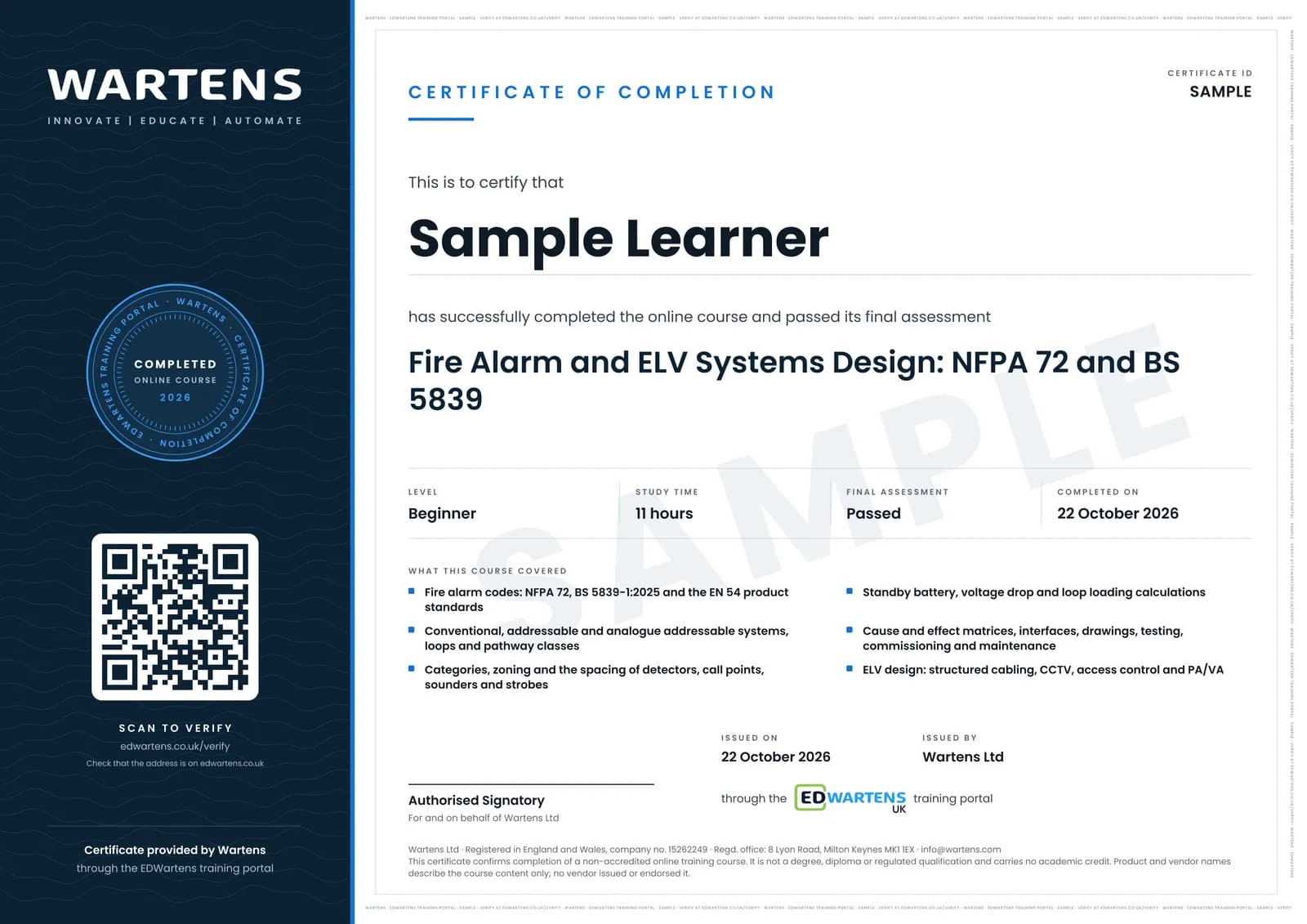
Sample certificate. Optional, issued when you pass the final exam.
- Level
- Beginner
- Modules
- 13
- Video
- 17 hours
- Price
- Free
Outcome
What you will be able to do
Explain what a fire alarm system must do and which code family governs a project; choose between conventional, addressable and analogue addressable systems; pick a BS 5839-1 category or NFPA 72 coverage and zone a building; space smoke, heat and beam detectors, call points, sounders and strobes; size standby batteries and check notification circuit voltage drop; write a cause and effect matrix and specify its interfaces to sprinklers, HVAC, lifts and doors; draw layouts, risers and loop diagrams; plan testing, commissioning and maintenance; and design the CCTV, access control, PA/VA and structured cabling of an ELV package.
- Explain what a fire alarm system must do and how NFPA 72, BS 5839-1 and the EN 54 product standards divide the work
- Choose conventional, addressable or analogue addressable, and plan loops, isolators and pathway classes
- Pick a BS 5839-1 category or NFPA 72 coverage and zone a building against the area and search limits
- Space smoke, heat and beam detectors, call points, sounders and strobes to both code families
- Size standby batteries both ways and check notification circuit voltage drop and loop loading
- Write a cause and effect matrix and specify the interfaces to sprinklers, HVAC, lifts and escape doors
- Produce layouts, risers, loop diagrams and a submittal, then plan testing, commissioning and maintenance
- Design CCTV by pixel density, access control with fail-safe escape doors, PA/VA and the structured cabling under them
Software
A spreadsheet (LibreOffice Calc is free) for the calculation sheets, and LibreCAD, AutoCAD or squared paper for the layouts. NFPA offers free read-only online access to NFPA 72 after registration.
Hardware
None. Every exercise is done with a spreadsheet and a drawing tool or squared paper.
Syllabus
13 modules
Each module has video lessons, notes and a short quiz. The final exam closes the course.
- Fire alarm systems and the codes that govern them3 lessons
- System types: conventional, addressable and analogue addressable4 lessons
- Coverage and categories: deciding where detection goes3 lessons
- Smoke detectors: types, siting and spacing6 lessons
- Heat, beam, aspirating, flame and duct detectors6 lessons
- Manual call points and notification appliances5 lessons
- Calculations: standby batteries, voltage drop and loop loading4 lessons
- Cause and effect matrices and interfaces to other systems4 lessons
- Drawings and submittals: layouts, risers and loop diagrams4 lessons
- Cables, installation, testing, commissioning and maintenance3 lessons
- ELV systems, structured cabling and CCTV design4 lessons
- Access control, intercom and PA/VA3 lessons
- Final Assessment1 lesson
How it works
How this course works
- Watch the video lessonsOne module at a time, at your own pace.
- Take the module quizA short quiz at the end of each module shows what stuck.
- Keep your notesWrite in My notes beside each module and ask the trainer if you are stuck.
- Sit the final examPass it once you have been through the modules.
- Certificate, if you want oneOptionalPaid, and only after you pass. Anyone can check it online.
Certificate
An optional certificate when you pass
Learning is free. Pass the final exam and you can have a certificate for £19, including VAT, with a number employers can check online. It records that you completed a free online course; it is not a regulated qualification or a CPD certificate.
- Your name, the course, its study time and your final exam score
- A unique certificate number and a QR code to its verification page
- Issued by Wartens Ltd; add it to your LinkedIn profile in one click
- Pay now or after you pass: it is issued the moment you pass the final
Credits
Who made the lessons
The video lessons belong to their creators. EDWartens wrote the study plan, notes, quizzes and the final exam.
- Irfan CFPS
the NFPA 72 lessons on the code, signals and circuits, schematic diagrams, smoke and heat detector spacing, beam detectors, pull stations, horns, strobes and battery calculations
- The Platform - Fire Engineering
the fire alarm training course lectures on components, the panel and power supply, smoke detectors on flat, sloped and beamed ceilings, heat, beam and aspirating detectors, call points, notification devices, special areas and interfacing
- RealPars
the introduction to what a fire alarm system is and does, in the first module and as the recap in the final
- Fire Alarms and Such
the difference between conventional and addressable fire alarm panels
- Daryll Fisher
the BS 5839-1:2025 system categories
- eFIXX
choosing between the life protection and property protection categories
- Dans the Engineer
the electrician's introduction to fire alarms and BS 5839-1
- Global Fire Strategies
why BS 5839-1 detector spacing is what it is
- All about Fire Protection
the battery and notification appliance voltage drop calculations, and inspection, testing and maintenance to NFPA 72
- The Fire Alarm Expert
device spacing and circuit length basics, and how to test and inspect a fire alarm system
- Wiring Diagram
what control and relay modules do in a fire alarm system
- Syracuse Time and Alarm
the elevator recall interface
- Serendib Training Qatar
the webinar on cause and effect matrices to NFPA 72
- The Prudent Engineer
fire alarm layouts in AutoCAD: spacing rules, heat detectors, the panel and the SLC loop drawing
- ORR Protection
fire alarm inspection and testing best practice
- Learn CCTV
the basics of a CCTV system
- JVSG (video surveillance design apps)
camera height, lens and pixel density in CCTV design
- Infinite Storm
estimating and designing an IP CCTV network for an ELV package
- NM Cabling Solutions
what structured cabling is and how it is organised
- Kantech
the basics of access control
- Schlage
wired communication between readers, controllers and locks
- L&P Renewable System Integrator
PAVA design basics: zones, amplifiers, speakers and wiring
Questions
About this course
Who is this fire alarm and ELV design course for?
Is the course free to learn?
Which codes and standards does it follow?
Does it cover the rules in my country?
Can I design a real fire alarm system after this course?
Which software do I need?
How long does the course take?
What certificate do I get?
Want a live class and career support?
The Professional Module is five live days of Siemens PLC, HMI and SCADA with an instructor, then a resume session and a CPD certificate.