
Free course · DCS
Emerson DeltaV DCS
The DCS in refineries, pharma and chemicals: architecture, controllers and CHARMs I/O, commissioning, Control Studio programming, analog and PID, advanced control, sequences, DeltaV Operate, alarms, history and full plant projects.
Free to learn. Verifiable certificate £19 when you pass the final exam (optional, VAT included).
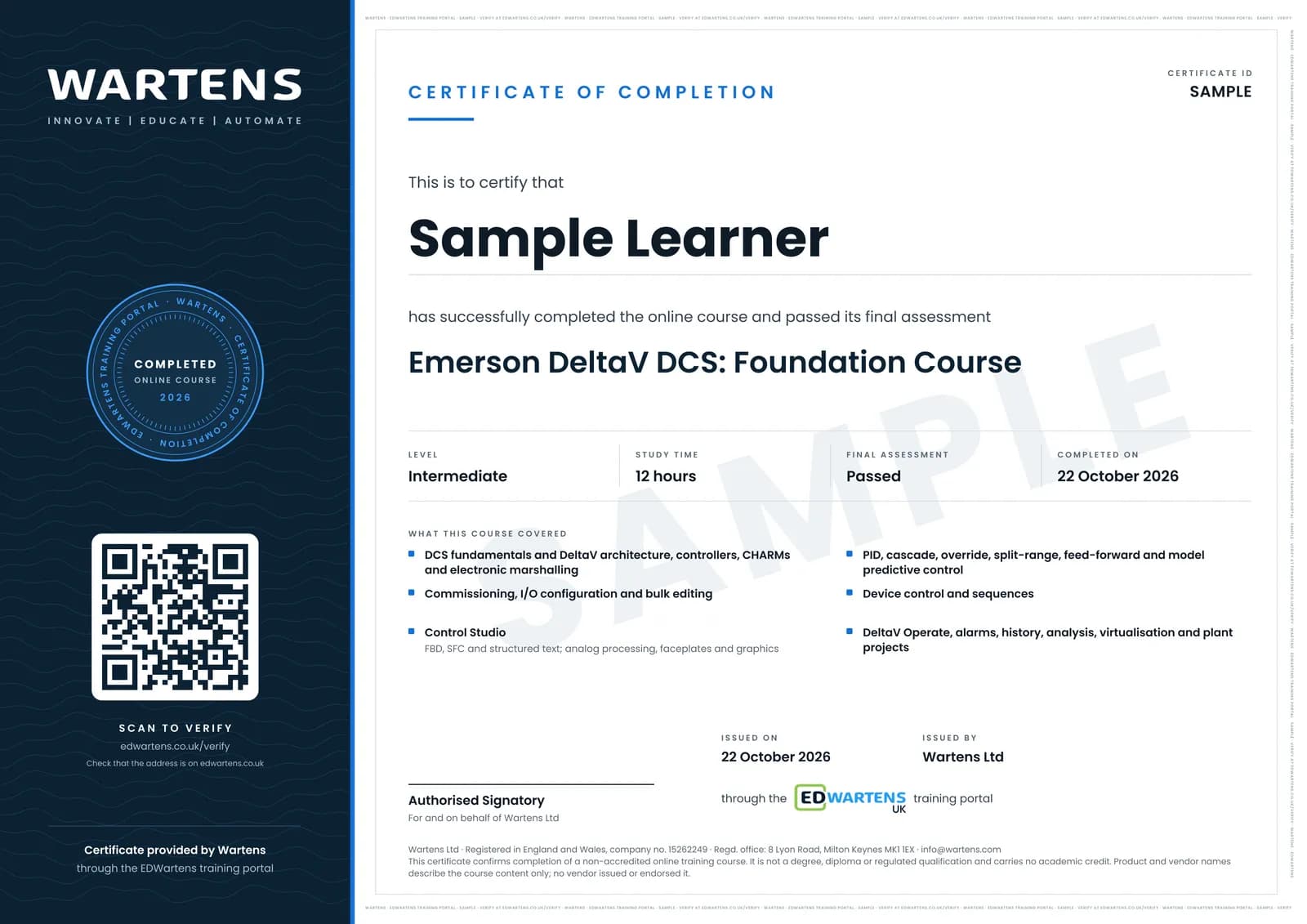
Sample certificate. Optional, issued when you pass the final exam.
- Level
- Intermediate
- Modules
- 13
- Video
- 19 hours
- Price
- Free
Outcome
What you will be able to do
Explain what a DCS is and how DeltaV is built, know its controllers, I/O and CHARMs, commission a controller and configure I/O, build modules in Control Studio, process analog signals with faceplates and graphics, configure and tune PID with cascade, override, split-range, feed-forward and MPC, program device control and sequences, operate DeltaV Operate with alarms and history, and follow a plant project end to end.
- Explain DCS versus PLC and SCADA and draw the DeltaV architecture
- Know controllers, S-series and PK, CHARMs and electronic marshalling
- Commission a controller and configure I/O, including bulk edit
- Build modules in Control Studio with FBD, SFC and structured text
- Process analog signals with faceplates and graphics; use timers, counters and scripts
- Configure and tune PID, cascade, override, split-range, feed-forward and MPC
- Program device control and sequences
- Operate DeltaV Operate, manage alarms and history, and complete plant projects
Software
DeltaV (licensed; lessons use training systems and DeltaV Virtual Studio)
Hardware
None. Follow by watching and re-drawing; no DeltaV licence required.
Syllabus
13 modules
Each module has video lessons, notes and a short quiz. The final exam closes the course.
- What a DCS Is and How DeltaV Is Built4 lessons
- Architecture in Depth; Controllers, I/O and CHARMs10 lessons
- Commissioning a Controller and Configuring I/O5 lessons
- First Program: Explorer, Control Studio, FBD, SFC and ST4 lessons
- Analog Signals, Faceplates and Graphics4 lessonsLab
- Timers, Counters and Scripted Buttons3 lessonsLab
- PID: Setup, Modes, Tuning and Cascade8 lessonsLab
- Advanced Control: Totalisers, Calculations, Override, Split-range, MPC8 lessons
- Device Control and Sequences4 lessons
- DeltaV Operate: The Operator Interface11 lessonsLab
- Alarms, History, Analysis, Versions and Virtualisation9 lessonsLab
- Plant Projects5 lessonsLab
- Final Assessment1 lesson
How it works
How this course works
- Watch the video lessonsOne module at a time, at your own pace.
- Take the module quizA short quiz at the end of each module shows what stuck.
- Keep your notesWrite in My notes beside each module and ask the trainer if you are stuck.
- Practise in the labOptionalTry a task from the module in the EDWartens Lab, in your browser.
- Sit the final examPass it once you have been through the modules.
- Certificate, if you want oneOptionalPaid, and only after you pass. Anyone can check it online.
EDWartens Lab
Practise this in the EDWartens Lab
Run a tank and pump process in the Lab, read the trends and check alarms the way an operator screen would show them.
Works alongside Emerson DeltaV DCS. The Lab is process control practice in your browser: no install, no hardware, free to use. Sign in as a learner and it opens with your account.
Levels to try with this course
PRC-02 · Process lab
Loop check
Open in the lab (opens in a new tab)PRC-04 · Process lab
Tune the level loop
Open in the lab (opens in a new tab)PRC-06 · Process lab
Alarm rationalisation
Open in the lab (opens in a new tab)PRC-07 · Process lab
Build an operator screen
Open in the lab (opens in a new tab)
Optional. Skip it whenever you like: it never blocks your progress or your certificate.
Why practise in a lab
Technical work is judged on what you can do: wiring, commissioning, finding a fault. Doing a task yourself teaches more than watching it a second time, and a lab lets you try it safely before you meet real equipment. It does not replace working on real hardware.
- Practise safely, so a mistake costs nothing.
- The lab checks your work like a site test, so you know when it is right.
- Free, in your browser, with nothing to install.
Certificate
An optional certificate when you pass
Learning is free. Pass the final exam and you can have a certificate for £19, including VAT, with a number employers can check online. It records that you completed a free online course; it is not a regulated qualification or a CPD certificate.
- Your name, the course, its study time and your final exam score
- A unique certificate number and a QR code to its verification page
- Issued by Wartens Ltd; add it to your LinkedIn profile in one click
- Pay now or after you pass: it is issued the moment you pass the final
Credits
Who made the lessons
The video lessons belong to their creators. EDWartens wrote the study plan, notes, quizzes and the final exam.
- PLC Tutor
the Emerson DeltaV programming and project series
- Aaron Mckee
a curated DeltaV playlist (lessons from several channels)
- Yaser Afaneh
a curated DeltaV playlist (lessons from several channels)
- Carson Merkwan
the DeltaV operator training series
- Keith Hunter
a curated DeltaV basics playlist (lessons from several channels)
- IT and Automation Academy
the DeltaV DCS tutorials
Questions
About this course
Can I practise without DeltaV?
Is this an operator or an engineer course?
Which lessons were left out?
Is the course really free?
What certificate do I get, and is it an Emerson qualification?
Who made the video lessons?
How long does the course take?
Want a live class and career support?
The Professional Module is five live days of Siemens PLC, HMI and SCADA with an instructor, then a resume session and a CPD certificate.