

Free course · Quality management
Automotive Core Tools: FMEA (AIAG-VDA 1st Edition)
The core tool an automotive customer audits hardest, taught to the 2019 AIAG-VDA handbook: the seven-step method, the five T's, the three-level structure tree, functions written so the failures fall out of them, effect against mode against cause, prevention against detection controls, the severity, occurrence and detection tables, the Action Priority table that replaced RPN, optimisation with owners and dates, results documentation, a reverse FMEA pass on the shop floor and the supplemental FMEA-MSR.
Free to learn. Verifiable certificate £19 when you pass the final exam (optional, VAT included).
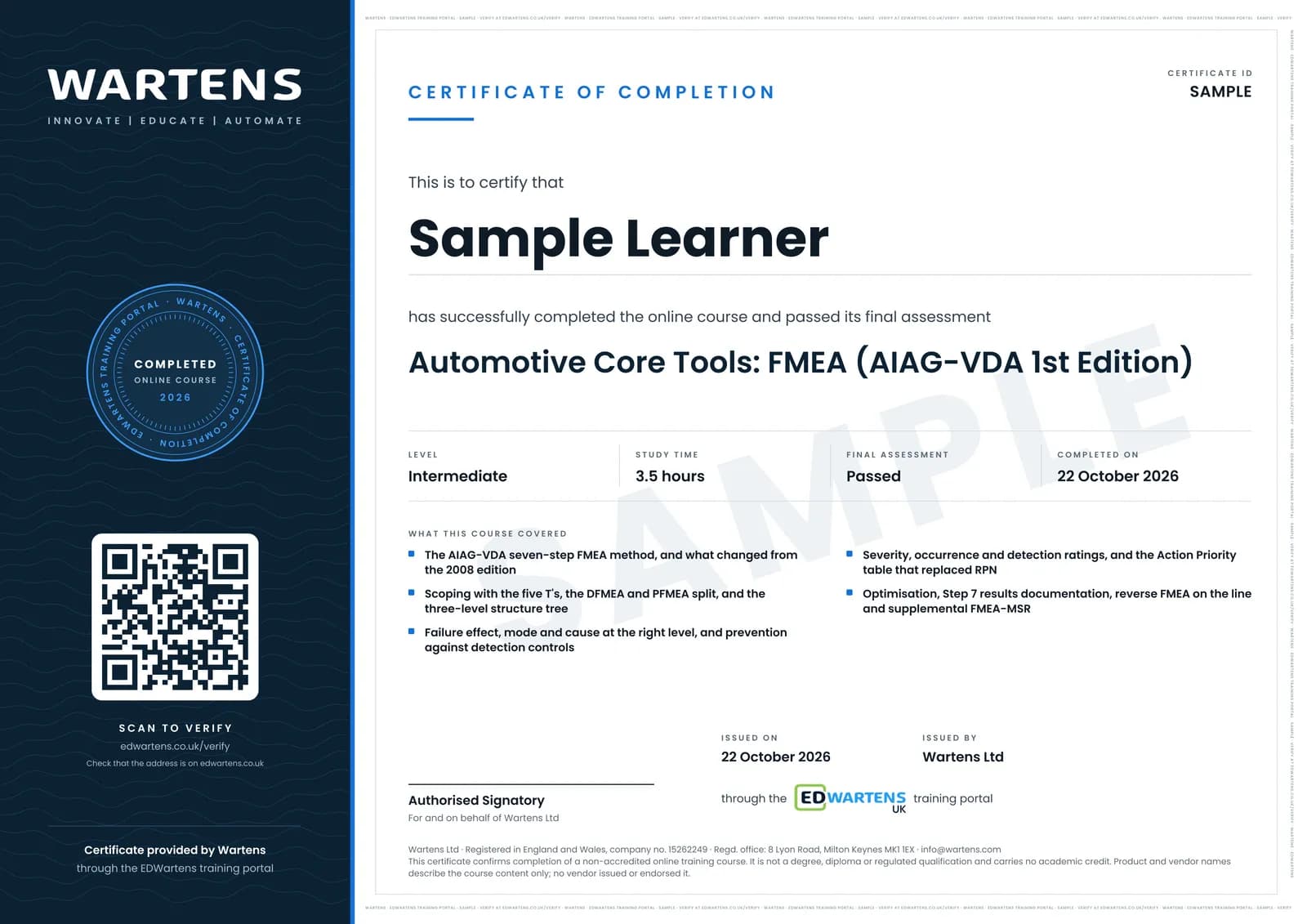
Sample certificate. Optional, issued when you pass the final exam.
- Level
- Intermediate
- Modules
- 8
- Video
- 6 hours
- Price
- Free
Outcome
What you will be able to do
Raise a PFMEA to the AIAG-VDA seven-step method. Scope it with the five T's and decide whether a problem belongs in a DFMEA or a PFMEA. Build the three-level structure tree and write a function for every box. Separate failure effect, failure mode and failure cause and place each at the right level. Mark every existing control as prevention or detection and say what each one moves. Rate severity, occurrence and detection against the handbook tables, then read Action Priority instead of chasing an RPN threshold. Write optimisation actions with an owner, a date and a re-rating. Assemble the Step 7 results documentation, verify the document against the line with a reverse FMEA pass, and say when a supplemental FMEA-MSR is needed.
- Scope a PFMEA with the five T's and set a boundary you can defend to a customer
- Build the three-level structure tree and write every function as verb, noun and requirement
- Place failure effect, mode and cause at the right level so the argument about which is which stops
- Mark every control on your line as prevention or detection, and say which rating each one moves
- Rate severity, occurrence and detection against the handbook tables and read Action Priority instead of an RPN threshold
- Write optimisation actions with owner, date and re-rating, then check them on the line with a reverse FMEA pass
Software
None required. A spreadsheet is enough for the structure tree, the rating sheet and the action list.
Hardware
None.
Syllabus
8 modules
Each module has video lessons, notes and a short quiz. The final exam closes the course.
- The seven-step method, and what changed in 20192 lessons
- Choosing the FMEA and scoping it before the form opens3 lessons
- Structure analysis and function analysis2 lessons
- Failure analysis, and the two kinds of control2 lessons
- Risk analysis: severity, occurrence, detection and Action Priority3 lessons
- Optimisation, results documentation and checking it on the floor3 lessons
- Supplemental FMEA-MSR, and why FMEAs go dead in real plants2 lessons
- Final assessment0 lessons
How it works
How this course works
- Watch the video lessonsOne module at a time, at your own pace.
- Take the module quizA short quiz at the end of each module shows what stuck.
- Keep your notesWrite in My notes beside each module and ask the trainer if you are stuck.
- Sit the final examPass it once you have been through the modules.
- Certificate, if you want oneOptionalPaid, and only after you pass. Anyone can check it online.
Certificate
An optional certificate when you pass
Learning is free. Pass the final exam and you can have a certificate for £19, including VAT, with a number employers can check online. It records that you completed a free online course; it is not a regulated qualification or a CPD certificate.
- Your name, the course, its study time and your final exam score
- A unique certificate number and a QR code to its verification page
- Issued by Wartens Ltd; add it to your LinkedIn profile in one click
- Pay now or after you pass: it is issued the moment you pass the final
Credits
Who made the lessons
The video lessons belong to their creators. EDWartens wrote the study plan, notes, quizzes and the final exam.
- Bhavya Mangla
the whole FMEA 1st Edition (2019 AIAG-VDA) series in English: the seven steps and what changed from 2008, planning and preparation, DFMEA against PFMEA, structure and function analysis, failure mode against cause against effect, prevention against detection controls, severity, occurrence and detection, RPN against Action Priority, optimisation, Step 7 results documentation, reverse FMEA, the supplemental FMEA-MSR and the 3G shop-floor habit
Questions
About this course
The page mentions APQP and PPAP. Are they taught here?
Do I need any software or a licence?
What should I know before starting?
Is this the same as an AIAG, IATF or ASQ certification?
Is the course really free?
What certificate do I get?
Who made the video lessons?
Will this help me move from production into quality?
Want a live class and career support?
The Professional Module is five live days of Siemens PLC, HMI and SCADA with an instructor, then a resume session and a CPD certificate.