
Free maintenance engineer training does exist online in the UK: EDWartens runs a free Multi-Skilled Maintenance Engineer course with eight modules, 21 videos and a final exam, covering permits to work, fault finding, motors and starters, sensors, pneumatics, PLC basics and shift handovers. Free learning gives you the knowledge and something to show an employer. It is not a regulated qualification, a site card or hands-on isolation practice, and it does not promise a job. This guide explains what is in the course, how to practise, what free cannot give you and the routes that can.
What does free maintenance engineer training usually mean?
Read the small print, because "free" is used in three different ways.
- A free certificate on a paid course. You pay for the course and the certificate costs nothing extra.
- Free to start, paid to finish. The first lesson is free and the rest sits behind a payment.
- Free learning. The course content is free to study, and any certificate is optional.
Ours is the third kind. The course is free to study, the quizzes and final exam are free, and an optional certificate of completion costs £19 including VAT once you pass the final. You pay nothing to learn, and nothing to try the browser simulators.
What should a maintenance engineer learn first?
The National Careers Service profile for an engineering maintenance technician says you can enter through an apprenticeship, college, or by starting as an operative and training on the job. Whatever the route, employers want the same foundation: work safely, find faults methodically, understand electrical and mechanical basics and keep records others can use.
Safe working comes first. The Health and Safety Executive says a written permit to work may need to be used for high-risk jobs such as hot work, vessel entry and work that requires electrical or mechanical isolation, and that "the issue of a permit does not, by itself, make a job safe". That is why our first module covers permits, isolation and knowing your limits before any fault finding.
What is in the free course, module by module?
The Multi-Skilled Maintenance Engineer (UK) course is built for apprentices, technicians and operators moving into maintenance. It uses short videos from other creators' channels, with our own notes, practice tasks and assessments. The estimated study time across the eight modules is about 450 minutes, with about 183 minutes of video.
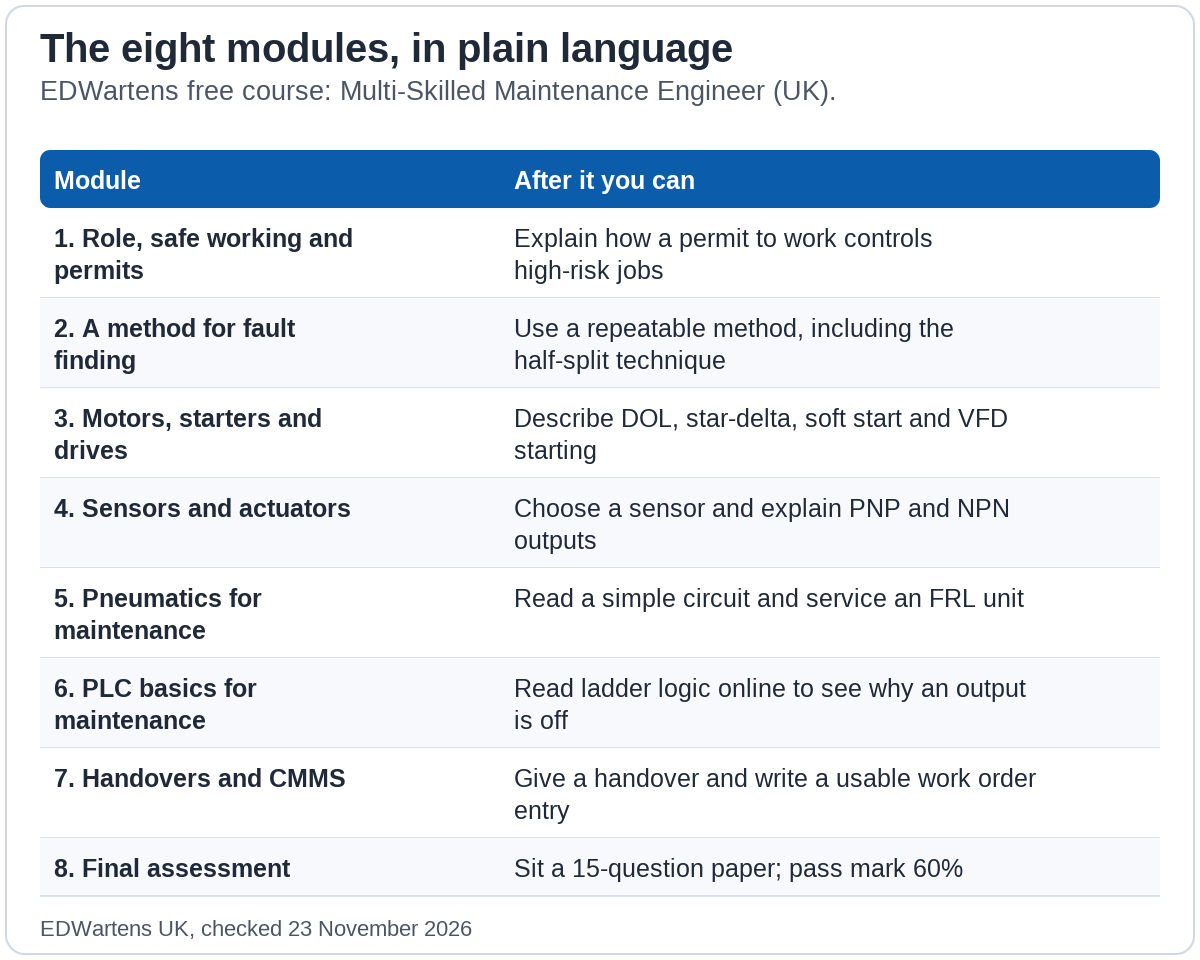
The final assessment has 15 questions drawn from every module, a pass mark of 60% and a limit of three attempts with a 24 hour wait between them. The optional £19 certificate is issued after you finish every module and pass the final. Anyone can check a certificate on our verification page.
If you want more depth on one area, these free courses go further: Electrical Fundamentals for Technicians, Mechanical Maintenance Fundamentals, PLC Electrical Troubleshooting and Maintenance and Maintenance Planning, Scheduling and CMMS. The maintenance engineer learning path lists them in order.
How long does it take, and how do you fit it in?
The course page plans it as a four week course. The study time estimates add up to about 450 minutes, or 7.5 hours, so a plan of a few evenings a week works. Here is one way to split it:
| Week | Modules | Estimated study time |
|---|---|---|
| 1 | Role, safe working and permits; a method for fault finding | 100 minutes |
| 2 | Motors, starters and drives; sensors and actuators | 120 minutes |
| 3 | Pneumatics; PLC basics for maintenance | 125 minutes |
| 4 | Shift handovers and CMMS; the final assessment | 105 minutes |
These are estimates, and pausing to practise will take longer. Do the fault finding method on something real, such as a household appliance or a bike, before you move on.
How can you practise without a workshop?
Watching is not the same as doing, so pair the course with practice. The EDWartens Lab has free browser simulators for PLC logic, motor control, wiring and a multimeter, so you can try a start-stop circuit or read a ladder program with no equipment. Our maintenance engineer job simulation puts you through working days at a simulated UK company: clock in, a morning meeting, tickets, an end-of-day report. The first five days are free and need no card to start. You keep a work pack afterwards. A simulation is practice, not employment, and the colleagues are AI characters labelled as simulated.
The video below is one the course uses in its final module. It is a short interview in which a maintenance engineer at a UK factory explains why he chose engineering and how an apprenticeship started his career.
Credit: wienerberger UK on YouTube. It shows one person's view and is not a pay or hiring guide. For what interviews ask, read our maintenance engineer interview questions.
What can free training not give you?
Be clear about the limits so you spend your effort well.
| Free training can give you | It cannot give you |
|---|---|
| The knowledge to understand a fault, a starter or a permit | Hands-on practice isolating real equipment safely |
| A certificate of completion that anyone can check | A regulated qualification or an ECS or site safety card |
| Practice in browser simulators and job simulations | Paid work experience or an interview |
| Evidence you finished and passed an assessment | A job offer or promised pay |
If you want a regulated route, an apprenticeship is the clearest. Our guide to engineering apprenticeships for adults explains funding and pay. For electricians, our ECS card guide covers cards and assessments.
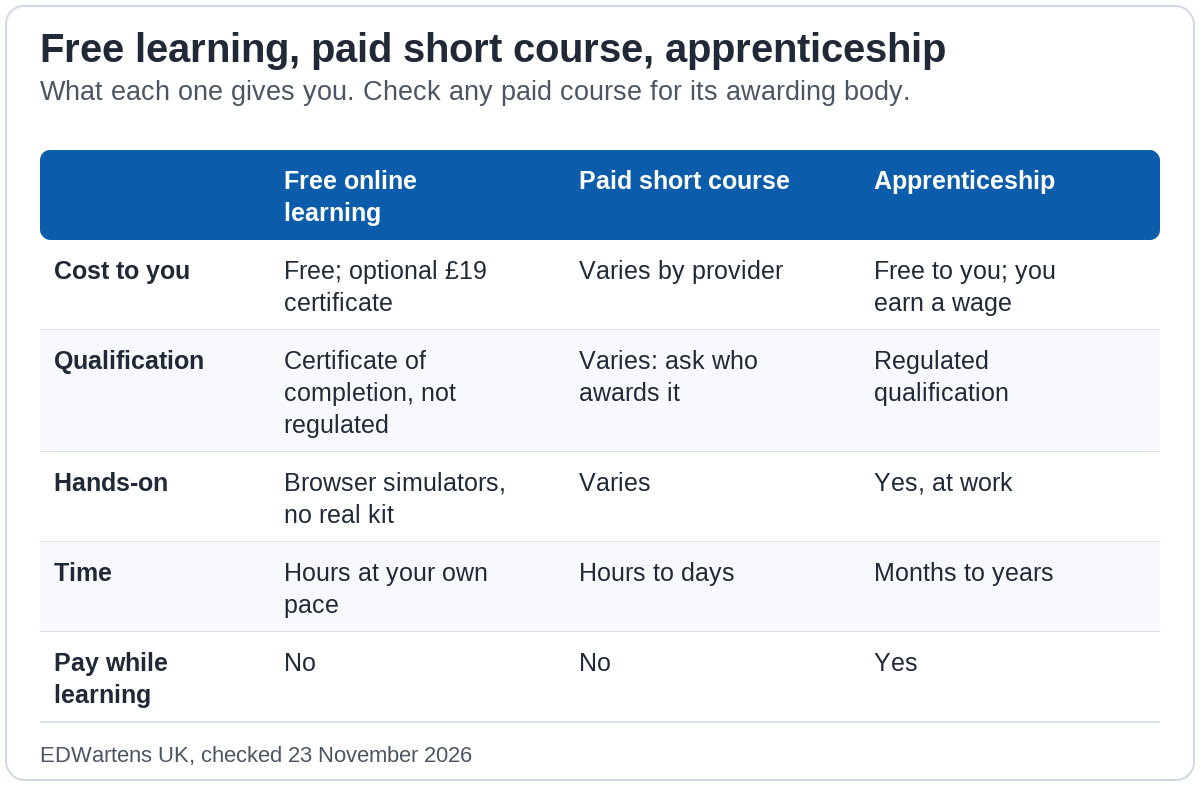
What should you ask before paying for a maintenance course?
Paid courses can be worth it, so ask five questions before you pay:
- Who awards the qualification, and is it a regulated award or only a certificate from the provider?
- How many hours of teaching or assessment are included, and what is assessed?
- What do you do hands-on, and where?
- What do employers in your area ask for, and do they name this course?
- What is the refund policy, and what happens if you do not pass?
If a provider cannot answer these, a free course plus a trainee job or an apprenticeship probably serves you better. We would say the same about our own paid training modules, which are for PLC and automation and not for general maintenance entry.
How do you show an employer what you have learned?
Keep the evidence short and honest. A one page CV should say what you finished, not claim a qualification you do not hold.
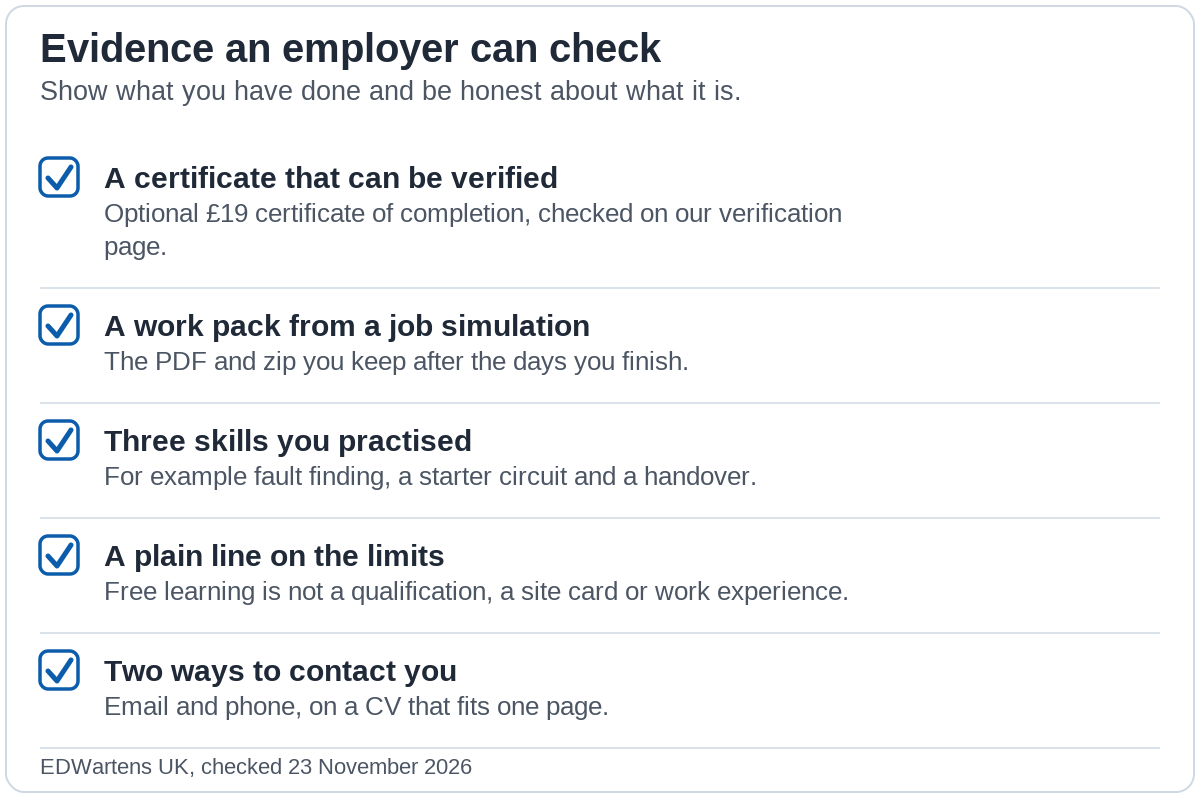
A certificate does not give you an interview or a job, and we do not promise either. It does show an employer you can finish a course and pass an assessment. Employers are free to ask you about any module, so make sure you can talk through a fault finding example. Our guide to free virtual work experience for engineering and the article on whether job simulations count as work experience explain how to describe simulations honestly.
How do you match the course to real adverts?
Open ten adverts on our entry-level jobs page and our maintenance jobs, and write down the skills each asks for: isolation, PLC fault finding, hydraulics, a driving licence, shift work. Tick off the ones the modules cover and note the gaps. If six adverts ask for pneumatics, spend an extra evening on module five and the FRL practice task. The point is to learn what the market in your area asks for, not to collect certificates. An employer reading your CV will care more about one specific example, such as how you found a fault with the half-split method, than about a long list of course titles.
What comes after the free course?
Three sensible next steps, depending on your situation. Apply for entry-level jobs while you finish, because trainee and junior adverts often say what they will teach. Ask local employers about apprenticeships or trainee roles. And if you want to move towards controls, our multi-skilled maintenance engineer guide and the free PLC options in our guide to free PLC courses in the UK show where to go next. The page on career changers explains funded adult courses, which have eligibility rules and an application.
Start free
Open the free course, try a Lab simulator and browse all free courses.