

An EV charger installer is, in practice, a qualified electrician who has added training on electric vehicle charging, joined the right scheme and, if the customer wants a grant, become authorised by the Office for Zero Emission Vehicles (OZEV). The short City & Guilds 2921 awards are aimed at qualified electricians, installers and engineers; they are an add-on to an electrical qualification, not a way into the trade on their own. This guide sets out the order of steps, what each qualification and scheme does, what the rules say about notifying work and where to learn the theory free first.
What does an EV charger installer do?
Installers fit charge points at homes, workplaces and larger sites such as depots and car parks. The work includes surveying the supply, choosing a charger and cable route, installing a dedicated circuit with the right protection, testing and certifying the installation, and explaining it to the customer. Larger sites add load management, network connections and commissioning. It is electrical installation work, with all the safety duties that come with it, so the starting point is electrical competence.
gov.uk's list of eligible occupations shows how the work is classed for immigration purposes: electric vehicle charging point installers sit under code 5241, electricians and electrical fitters. That is a classification, not a qualification route, and our Skilled Worker 2027 guide explains why sponsorship rules for that code are under review.
Do you have to be an electrician first?
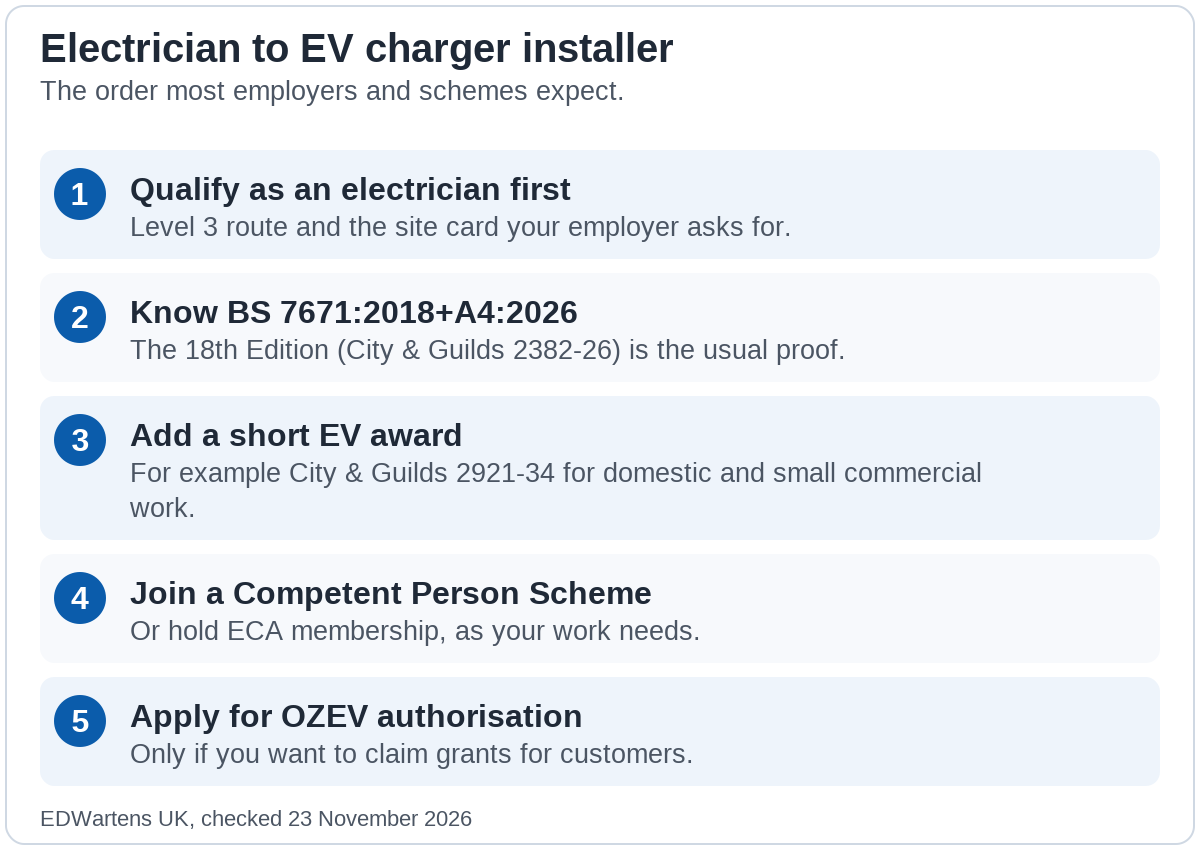
In practice yes. City & Guilds describes its 2921 suite as aimed at "qualified electricians, installers and engineers wishing to upskill" to install and maintain EV charging points. The domestic and small commercial award, 2921-34, is a Level 3 Award in requirements for design and installation. Taking it without an electrical background would leave you with knowledge of the rules and none of the installation skills or site experience.
The usual order is below. If you are early in your career, our ECS card guide explains the cards and assessments around electrical qualifications.
What are the City & Guilds 2921 awards?
The City & Guilds page lists four awards in the 2921 Electric Vehicle Charging suite:
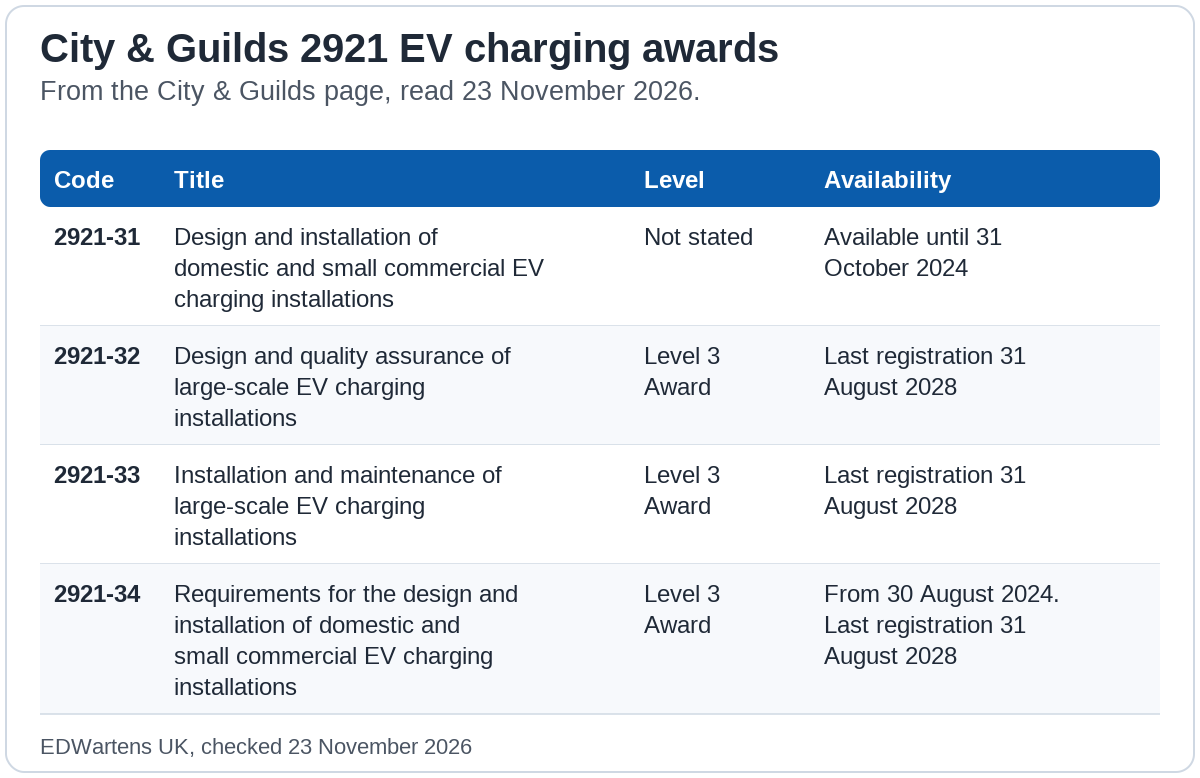
Providers and websites quote different codes, usually 2921-31 or 2921-34, for the domestic award. The City & Guilds page explains why: 2921-31 was available until 31 October 2024 and 2921-34 is the current domestic and small commercial award, available from 30 August 2024. Check which code a course teaches, and that it is current, before you book. The page does not list formal entry requirements; it states the audience.
Is 2921 compulsory? The gov.uk page for becoming an authorised installer asks for competent person scheme or Electrical Contracting Association details and does not name a 2921 award. Schemes and employers set their own requirements, so ask your scheme and your employer what they expect.
Which regulations apply?
| Item | What it covers | Source |
|---|---|---|
| BS 7671:2018+A4:2026 | The wiring regulations; the previous version was to be withdrawn on 15 October 2026 | BSI |
| Notifying the work | Building control, or a competent person scheme that issues a compliance certificate | Planning Portal |
| OZEV authorisation | Claiming grants on a customer's behalf | gov.uk |
| City & Guilds 2921 | Optional awards for qualified electricians and installers | City & Guilds |
The wiring standard is BS 7671, now BS 7671:2018+A4:2026. BSI says Amendment 4 was published on 15 April 2026 and that the previous version (A2:2022+A3:2024) was to be withdrawn on 15 October 2026. BSI's summary lists new material on stationary batteries, functional earthing for ICT equipment, Power over Ethernet and a revised Section 710 for medical locations, and it does not list EV charging among the changes. Section 722 is the part of BS 7671 for electric vehicle charging installations. Our free EV Charging Infrastructure course summarises what it asks for, such as a dedicated circuit and RCD protection with DC fault detection, but read the regulations themselves for the exact wording. Our guides to BS 7671 Amendment 4 and the 18th Edition exam cover the update and the qualification.
On notifying work, the Planning Portal says building regulations approval is always required when installing an EV home charger, because the work is notifiable. It must be reported to the local building control body unless it is done by someone registered with a competent person scheme, who can give a compliance certificate instead. The page is undated, and Approved Document S on gov.uk applies to England, so check the rules for Scotland, Wales and Northern Ireland separately.
What is OZEV authorisation and why do employers care?
OZEV authorisation lets an installer claim grants on a customer's behalf. gov.uk's page on becoming an authorised installer (updated 1 April 2026) says you must give your Competent Person Scheme name and number or your ECA membership number, and that only authorised installers can claim the grant on the applicant's behalf. A representative, who subcontracts and claims for installers, must hold public liability insurance with a minimum £2 million indemnity.
| Installation completed | Workplace Charging Scheme grant per socket |
|---|---|
| Before 1 April 2026 | Up to £350 |
| On or after 1 April 2026 | Up to £500 (scheme runs until 31 March 2027) |
The Workplace Charging Scheme guidance for installers (also updated 1 April 2026) says installations completed on or after 1 April 2026 can claim up to £500 per socket, up from £350 before, that the scheme runs until 31 March 2027 and that you must be an OZEV-authorised installer to claim. Employers value authorisation because it lets them offer customers the grant. Grant schemes change, so check the current rules rather than relying on this page.
What does an EV charger installer earn?
We could not find a published UK rate that we can cite for EV charger installers. The figures online come from training providers and installer blogs and are not statistics, so we do not repeat them. Employed installers and self-employed installers are paid very differently, and the answer depends on region and workload. For pay in live adverts, see our electrical engineer jobs page and our salaries page, where pay is shown only if an advert states it.
Should you be employed or self-employed?
An employer usually handles scheme membership, insurance, test equipment, the customer relationship and grant claims, and you do the installations. Working for yourself means you take on all of that: scheme or ECA membership, public liability insurance, calibrated test equipment, certificates, quotes and chasing payments. gov.uk asks authorised installer representatives for public liability insurance of at least £2 million, which shows the scale that scheme bodies expect for grant work. Neither route is easier. A sensible plan for most electricians is to work for an installer for a time, learn the surveys, testing and paperwork on live jobs and then decide. Ask any employer whether it will pay for your EV award and how many installations you would do with a mentor before working alone.
How can you learn the theory free first?
Our free EV Charging Infrastructure for the UK course has nine modules and 25 videos from other creators' channels, with our own notes, quizzes and a final exam. It covers the grid to the battery, charger types and modes, inside an AC charger (Type 2, the control pilot and BS 7671 Section 722), DC chargers and CCS2, smart charging and OCPP, public charging rules, workplace and depot charging and the economics. It teaches the knowledge. It is not a City & Guilds award or a licence to work, and the optional £19 certificate of completion is not a regulated qualification.
Start with this short video from our course on what a charger does in the UK and Ireland.
Credit: Engineering Simplified on YouTube. Its description notes that chargers are quoted as 7 kW, 22 kW, 50 kW, 150 kW or even 350 kW, which is a quick way to see the range from a home charger to a high-power DC rapid charger. The 2921 suite likewise separates domestic and small commercial installations from large-scale ones. For practice, try the Solar PV and EV Charging Engineer job simulation, the free BS 7671 learning for Amendment 4 and the rooftop solar PV course. A simulation is practice, not employment. Our guides on renewable energy automation careers and UK net zero 2030 and automation engineer demand show where the demand comes from.
What should you check before you quote for a charger?
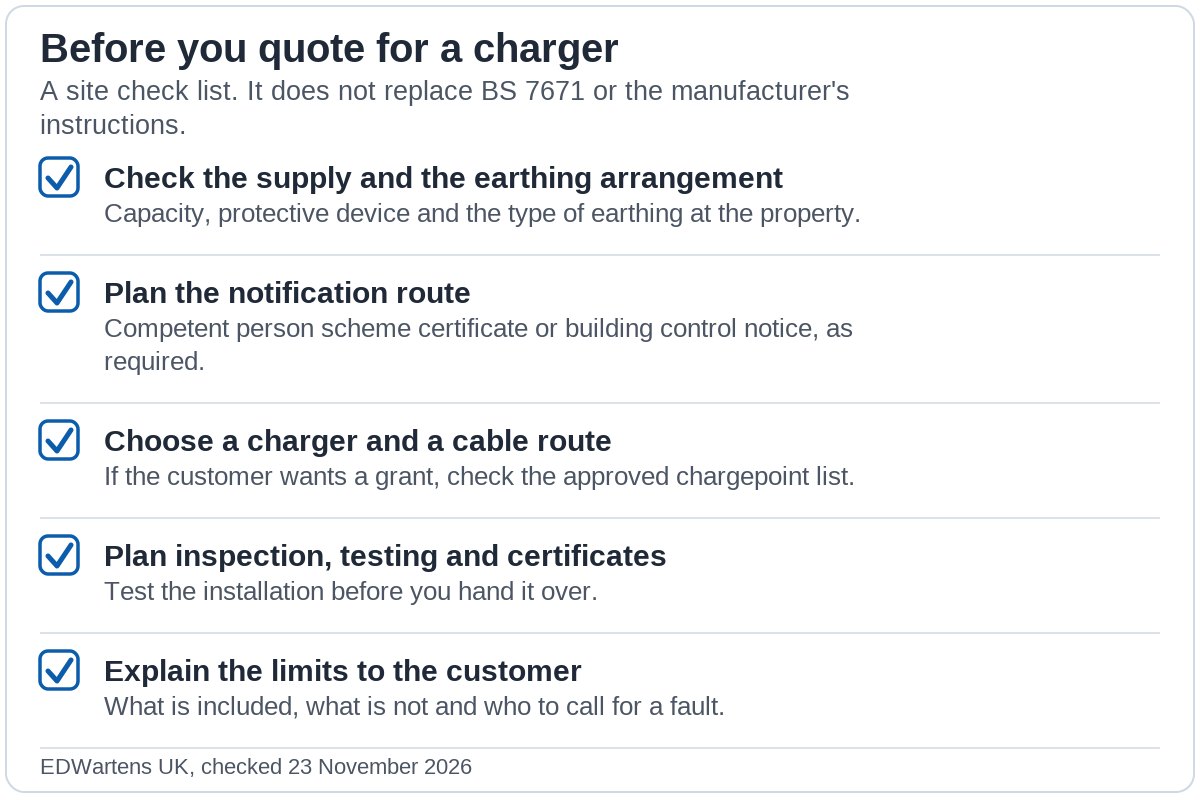
This is a prompt, not a substitute for BS 7671, the manufacturer's instructions or your scheme's rules.
Start free
Browse electrical free courses, then check live electrical jobs. Ask each employer which qualifications, scheme membership and authorisations it expects.