
A star delta vs DOL starter comparison comes down to one trade. A DOL (direct on line) starter connects the motor straight to the supply, so you get full starting torque and a large inrush current. A star-delta starter starts the windings in star, which ABB's control guide says cuts both starting current and starting torque to a third, then switches to delta to run.
Checked 28 October 2026. Starting figures and the switching sequence come from ABB's "Open Type Starters" control guide (document 1SBC009500R1002, star-delta page 1/5); safe working advice from the HSE pages named in the sources. This is a learning guide, not an installation procedure.
DOL starting in one minute (and why inrush current matters)
A DOL starter is one contactor, an overload relay and a start/stop control circuit. Press start, the contactor closes, and all three phases go straight onto the motor. It is the simplest, cheapest and most reliable arrangement, and it gives the motor its full torque from the first instant.
The cost is the starting current. ABB's control guide opens its star-delta page with the reason the method exists: on starting, the motor has to overcome the resistive torque and inertia of the driven machine, and during that phase the current "must remain within the limits acceptable by the mains". Its chart of star-delta starting plots the delta (direct) current curve starting near the top of a scale that runs to 7 times nominal current. We read that by eye, so treat it as "several times nominal", not as a figure for your motor. Your motor's real starting current is in the maker's data.
So DOL is fine where the supply can take the inrush and the machine can take the sudden torque. It becomes a problem on a weak supply, on a big motor, or where a belt, coupling or gearbox dislikes the jolt.
How does a star-delta starter work?
An induction motor has three windings. If the supply voltage is across each winding in turn from line to line, the windings are in delta. If one end of every winding is tied to a common point and the supply goes to the other ends, they are in star. In star each winding sees less voltage than in delta, so the motor draws less current and produces less torque.
ABB's technical data states it directly: on starting, "current inrush is reduced to a third of direct starting current" and "motor torque is reduced to a third of direct starting torque". It also warns that "high transient currents are commonly read during star-delta switching".
Two practical rules follow from the same ABB page:
- The motor must suit the mains in delta. The motor's nominal voltage in delta connection has to equal the mains voltage. ABB's example is a 380 V supply, which needs a motor designed for 380 V in delta (usually marked 380 V/660 V).
- It needs six terminals. The six winding ends are labelled U1 V1 W1 and U2 V2 W2. In delta, U1 joins W2, V1 joins U2 and W1 joins V2. In star, U2 V2 W2 are joined together.
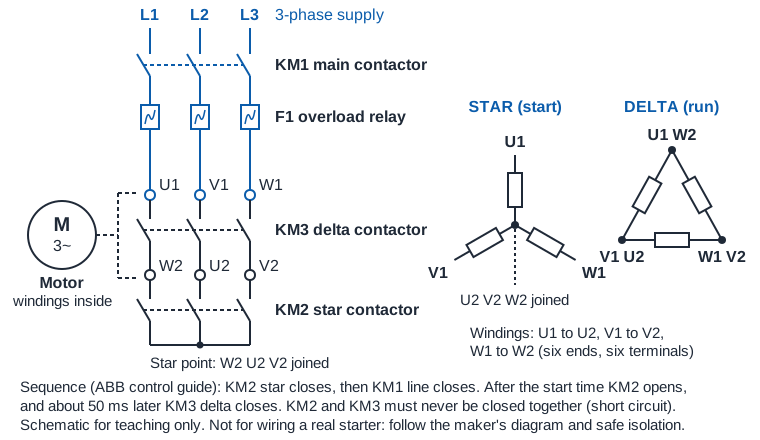
The diagram above is our own simplified drawing: the supply (L1 L2 L3) feeds terminals U1 V1 W1 through the main contactor KM1 and the overload relay F1. The delta contactor KM3 links U1 to W2, V1 to U2 and W1 to V2. The star contactor KM2 joins W2, U2 and V2 together. It uses the contactor names KM1, KM2 and KM3 that ABB uses on its page.
Star-delta vs DOL: a comparison table
The first two rows are ABB's figures. The rest is general description that you should check against the maker's data for a given starter.
| DOL | Star-delta | |
|---|---|---|
| Starting current | Full direct starting current | A third of direct (ABB) |
| Starting torque | Full direct starting torque | A third of direct (ABB) |
| Contactors | One main contactor | Three: line, star and delta |
| Motor terminals | Three or six, wired once | Six, all brought out |
| Switch to run | None | Star to delta after a set time (ABB: normally 6 to 10 s) |
| Suits | Loads that can take the torque jolt on a supply that can take the inrush | Light or no-load starts (ABB lists machine tools, centrifugal compressors and woodworking machines) |
| Weak point | Inrush current | Low starting torque, and a transient at the changeover |
The load rule matters most. ABB says that during the star phase the resistive torque of the driven machine "must remain, irrespective of speed, less than the star motor torque until star-delta switching occurs". A machine that is heavy to start, such as a loaded conveyor or a piston compressor under pressure, can stall in star or hang there until the switch, then draw a big current. ABB describes the method as ideal for machines with no-load starting and little inertia.
The power circuit and the control circuit, step by step
The power circuit is the one in the diagram: contactors, overload relay and motor. The control circuit is the low-current part that decides when each contactor closes: stop and start buttons, a timer and the contactor coils.
ABB describes starting as a three-stage process, and the order is what the control circuit must produce:
- Star. Press start. The KM2 star contactor closes, then the KM1 line contactor closes and the motor starts in star. The starting time then counts down (ABB: normally 6 to 10 seconds).
- Changeover. When the time is up, KM2 opens.
- Delta. After 50 ms, KM3 closes and the motor accelerates to its rated speed.
ABB's note on the 50 ms gap is the key safety point in the circuit: the pause between the star contactor opening and the delta contactor closing "prevents arc short-circuits". If star and delta were ever closed together, the three phases would be shorted through the contactors. That is why a well-built starter has an electrical interlock (and often a mechanical one) between KM2 and KM3, so each contactor's coil is fed through a normally closed contact of the other. ABB's catalogue lists starters "with mechanical interlock" as a separate range, which shows the maker treats the interlock as part of the design.
The overload relay (F1 in our diagram) sits in the supply to the motor and trips the control circuit if the motor draws too much for too long. The control circuit then drops out the contactors.
The changeover problem and why soft starters often replace it
The weak point of star-delta is the moment of switching. For a short time the motor is connected to nothing, then to the supply in delta. If it has slowed or has not reached a good speed, the delta connection acts like a second start. ABB's advice: to prevent an over high current peak, "at least 80% of nominal speed must be reached on star-delta switching". A starting time that is too short for the load gives a large current spike at the changeover, which defeats the purpose.
This is why many sites choose a different starter for new work. Two alternatives:
- Soft starter. It ramps the voltage to the motor electronically, with no open transition. It limits current and torque and needs only three motor leads.
- Variable frequency drive (VFD). It controls frequency and voltage, so it can start, run and stop the motor at any speed. It costs more but gives speed control. Our guide to VFD motor control explains it, and there is a free VFD course.
Those two bullets are general descriptions, not figures from the ABB guide, which we did not find covering soft starters. For a real choice, use the maker's selection data for the motor, load and supply. Star-delta is still everywhere in existing plant, so you will meet it in maintenance jobs even where nobody would specify it today.
Programming star-delta in a PLC (timer, interlock, overload)
In a PLC, the three contactors are three outputs, with the stop, start and overload as inputs. The logic follows ABB's sequence directly:
- A start input latches a "running" memory bit (a seal-in), unless the overload or stop input is open.
- The star output (KM2) and line output (KM1) come on, and an on-delay timer starts. Set it to a value the machine needs (ABB: normally 6 to 10 seconds).
- When the timer is done, the star output goes off.
- After a short delay (ABB's figure on the starter is 50 ms), the delta output (KM3) comes on.
- Each of KM2 and KM3 has the other's output in its rung as a normally closed condition. That software interlock is not enough on its own, so keep the hardware interlock.
- The overload and stop break the seal-in and drop all three outputs.
Learn the pattern in a simulator before touching real kit: our ladder logic tutorial for beginners covers the seal-in and timer instructions used above. A fuller walk-through is in the video below.
The first video is a short 3D walkthrough of a star-delta starter's wiring and PLC control, from the ControlByte Automation channel (uploaded 7 September 2026). The second is RealPars' older beginner video on the PLC program and wiring (2015). Check any figures in either against your own motor and starter data.
Common faults: welded contactor, wrong timing, one phase missing
These are well-known failure patterns. They are our general description, not ABB data, and you should confirm any of them with the maker's fault guide before acting.
- A welded or stuck contactor. If a contact welds, the interlock no longer proves the contactor opened. The worst case is a stuck star contactor when delta closes. Watch for the starter tripping the supply protection as soon as it changes over.
- Wrong timing. If the timer is too short, the motor has not reached the speed ABB specifies (at least 80%), and the changeover current is large. If it is too long, the motor sits in star longer than it should and may overheat if it cannot accelerate.
- A missing phase. If a supply fuse or one contactor pole has failed, the motor may hum or fail to start, and the overload may trip. A motor that starts in star but will not run in delta often points to a delta contactor or its wiring.
- A wrongly wired motor. Crossed U/V/W labels on the delta links give a motor that draws a high current or runs hot. This is why the six terminals are marked in a fixed order.
All fault-finding on a starter is electrical work. The HSE's guide *Electricity at work: safe working practices* (HSG85) is written for people who work on or near electrical equipment, and our guide does not replace it, training, a permit where required, safe isolation and a competent person. Do not test or adjust a live starter because you read this article. See HSE electrical safety.
Practise on the motor control simulator
You can practise the sequence without a panel. The free motor control simulator lets you build and run start-stop and starter circuits on screen. For the theory, the free industrial motor control course covers contactors, relays and starters. Motor starters and contactor panels are part of what maintenance teams look after, and you can see what UK employers currently ask for on our maintenance jobs page.
Start free
- Free industrial motor control course: contactors, overloads, DOL and star-delta starters.
- Motor control simulator: build and run starter circuits on screen.
- Maintenance Technician job simulation: practice, not employment, with tasks in the style of the work.
- UK maintenance jobs: read real adverts to see what is asked for.
None of these is a regulated qualification, and nothing here promises a job. They are a way to practise before you work on real equipment under proper supervision.