
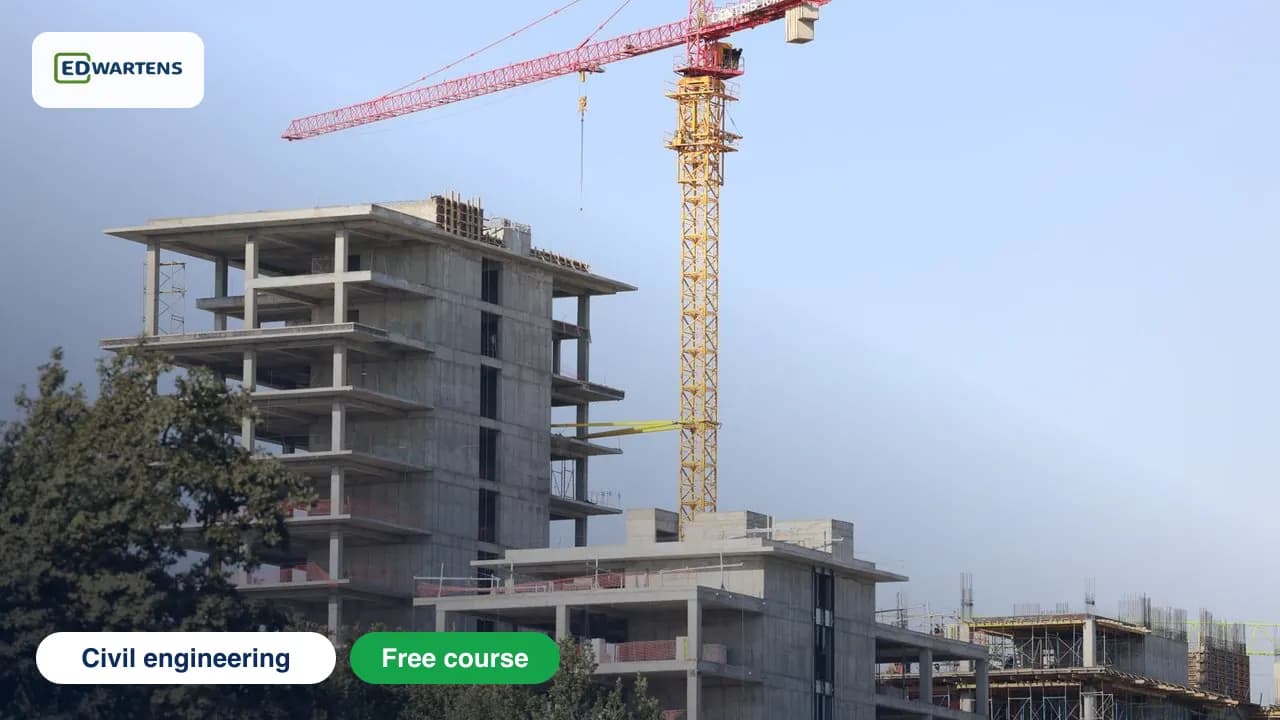
Free course · Civil engineering
ETABS and SAFE: Building Analysis and Design
This free course follows one reinforced concrete building through ETABS and SAFE. You set up grids and storeys, model frames, walls and slabs, apply gravity, wind and seismic loads, run modal and response spectrum analysis, check drift, design beams, columns and walls, then design slabs and footings in SAFE. The worked examples use ACI 318 and ASCE 7, and the steps carry over to Eurocode 2. It suits graduate structural engineers and technicians. A qualified engineer remains responsible for any real design.
Free to learn. Verifiable certificate £19 when you pass the final exam (optional, VAT included).
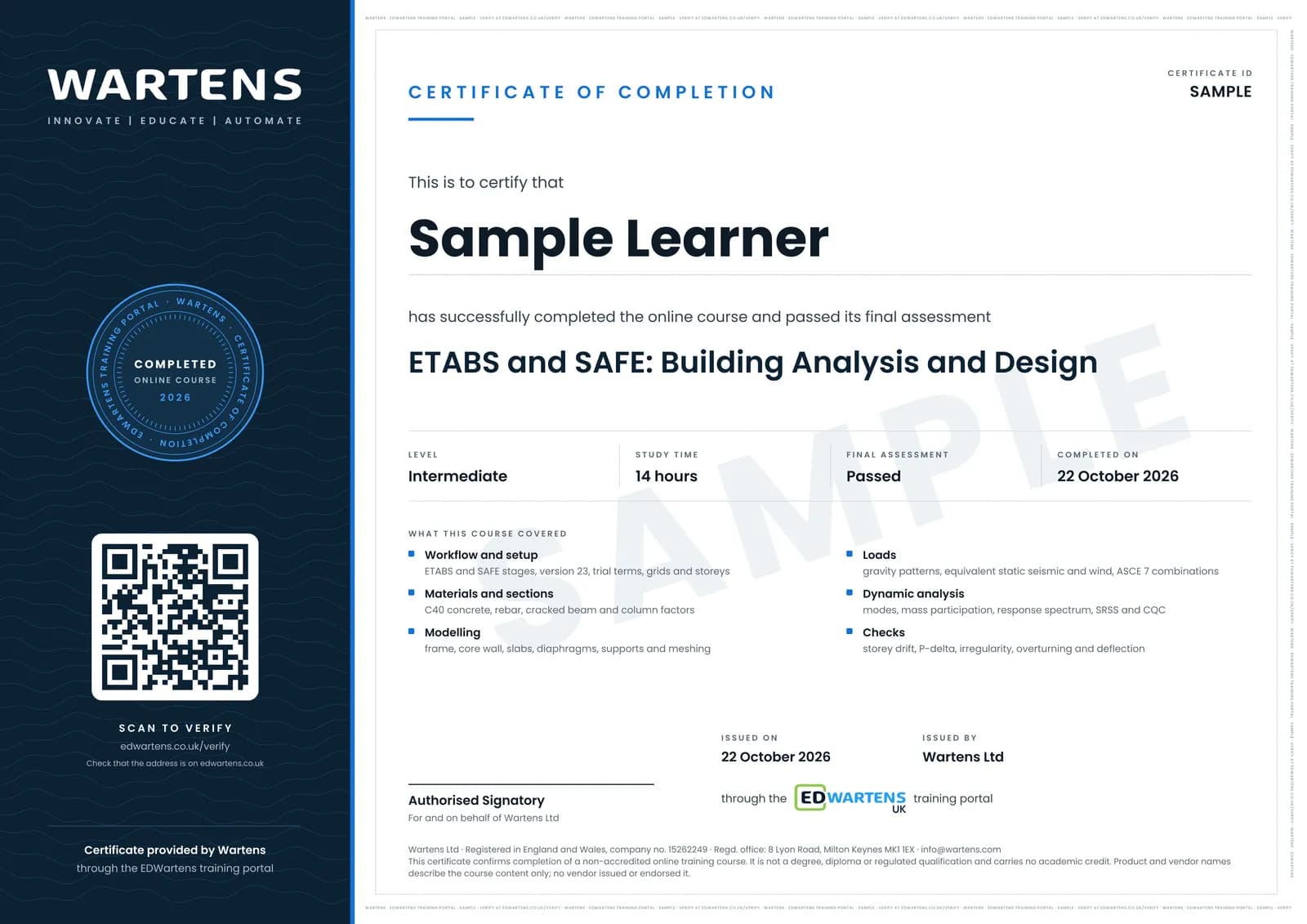
Sample certificate. Optional, issued when you pass the final exam.
- Level
- Intermediate
- Modules
- 15
- Video
- 21 hours
- Price
- Free
Outcome
What you will be able to do
Set up an ETABS model with grids, stories, materials and cracked-section modifiers; model frames, walls, slabs and diaphragms; define gravity, wind and seismic loads and the code load combinations; run modal and response spectrum analysis and judge mass participation; check storey drift, P-delta and irregularity; run concrete beam, column and shear wall design; check output by hand; then take the model into SAFE for slab strips, punching shear, deflection and foundations on soil springs. Software output is always checked, and real designs remain the responsibility of a qualified structural engineer under the local regulations.
- Set up an ETABS model with grids, storeys, concrete and cracked beam and column sections
- Model frames, core walls, slabs and diaphragms and assign base supports and meshes
- Define gravity, wind and equivalent static seismic loads and the ASCE 7 load combinations
- Run modal and response spectrum analysis and judge mass participation and SRSS or CQC
- Check storey drift, P-delta and irregularity against the code limits
- Run concrete beam, column and shear wall design and check them by hand
- Check slab design with the static moment split and write a checking note
- Take the floor into SAFE for punching shear and deflection, and size footings on soil springs
Software
CSI ETABS and CSI SAFE, current version 23 (Windows 10 or 11, 64-bit, Cloud Sign-in licence). CSI offers an evaluation trial on request for evaluation use only; check the trial terms on CSI's own page. A spreadsheet, or a few lines of Python or JavaScript, for the hand checks. The lessons use ACI 318-19 with ASCE 7-22 for every worked example, and the same steps apply with Eurocode 2 and EN 1998.
Hardware
A 64-bit Windows 10 or 11 computer. CSI lists 16 GB of RAM as the minimum and 64 GB as the recommended amount, about 6 GB of disk for the install and a discrete graphics card for large models. Small learning models run on a modest machine. The video lessons run on any device.
Syllabus
15 modules
Each module has video lessons, notes and a short quiz. The final exam closes the course.
- ETABS and the building-analysis workflow2 lessons
- Grids, storeys and starting a model3 lessons
- Materials, sections and cracked-section modifiers7 lessons
- Modelling the frame: columns, core, beams and replication5 lessons
- Slabs, walls, diaphragms, supports and meshing6 lessons
- Gravity load patterns and cases3 lessons
- Wind, equivalent static seismic load and mass source4 lessons
- Load combinations for strength and service2 lessons
- Modal analysis, mass participation and response spectrum5 lessons
- P-delta, storey drift and irregularity checks7 lessons
- Concrete beam, column and shear wall design5 lessons
- Slab design, reading output and detailing4 lessons
- SAFE: importing from ETABS, slab strips, punching shear and deflection6 lessons
- SAFE foundations: soil springs, mat and isolated footings5 lessons
- Final assessment0 lessons
How it works
How this course works
- Watch the video lessonsOne module at a time, at your own pace.
- Take the module quizA short quiz at the end of each module shows what stuck.
- Keep your notesWrite in My notes beside each module and ask the trainer if you are stuck.
- Sit the final examPass it once you have been through the modules.
- Certificate, if you want oneOptionalPaid, and only after you pass. Anyone can check it online.
Certificate
An optional certificate when you pass
Learning is free. Pass the final exam and you can have a certificate for £19, including VAT, with a number employers can check online. It records that you completed a free online course; it is not a regulated qualification or a CPD certificate.
- Your name, the course, its study time and your final exam score
- A unique certificate number and a QR code to its verification page
- Issued by Wartens Ltd; add it to your LinkedIn profile in one click
- Pay now or after you pass: it is issued the moment you pass the final
Credits
Who made the lessons
The video lessons belong to their creators. EDWartens wrote the study plan, notes, quizzes and the final exam.
- Computers and Structures, Inc.
the official Watch & Learn lessons on the ETABS overview, drawing tools, CAD import, the introductory concrete tutorial, response spectrum analysis, shear wall design, slab design and reports, and the SAFE tutorials on the introduction, import from CAD, pattern live loading, cracked sections and foundation uplift
- qLearnify (EN)
the 15-storey ETABS v22 lessons to ACI 318 and ASCE 7 on materials, sections, drawing the frame, loads, load combinations, mass source, diaphragms, supports, meshing, drift, P-delta, irregularity, beam and column design, slab design and the SAFE mat foundation
- Tarek Youssef
building the ASCE 7 design response spectrum
- Real civil
modal combination methods SRSS and CQC in a response spectrum analysis
- Dr Nafie - Structural Engineering
what a response spectrum analysis is and how it is used in seismic design
- Be Pro Engineer
a response spectrum case to ASCE 7-22 in ETABS 22, exporting an ETABS model to SAFE and soil subgrade modulus
- AF Math & Engineering
punching shear in SAFE with the practical theory
- Road to be an engineer
a mat footing on soil springs
- The Civil Bro - Civil Structural Design
isolated foundation design in SAFE
Jobs
Jobs this course can lead to
The skills in this course are used in quality and project engineering work, for example as a structural engineer, a graduate structural engineer and a structural design engineer. No course can promise a job, and employers also look for experience, so read what live adverts ask for.
Questions
About this course
Last reviewed 1 November 2026.
Does the course use Eurocodes?
Do I need to buy ETABS?
Can I design real buildings after this course?
What is the ETABS and SAFE course?
Which software and version does the course use?
Which design code does the course use?
Can I design a real building with what I learn here?
Is this a CSI certification?
How long does the course take, and is it free?
What certificate do I get?
Civil and structural engineer
Take it with
Want a live class and career support?
The Professional Module is five live days of Siemens PLC, HMI and SCADA with an instructor, then a resume session and a CPD certificate.