
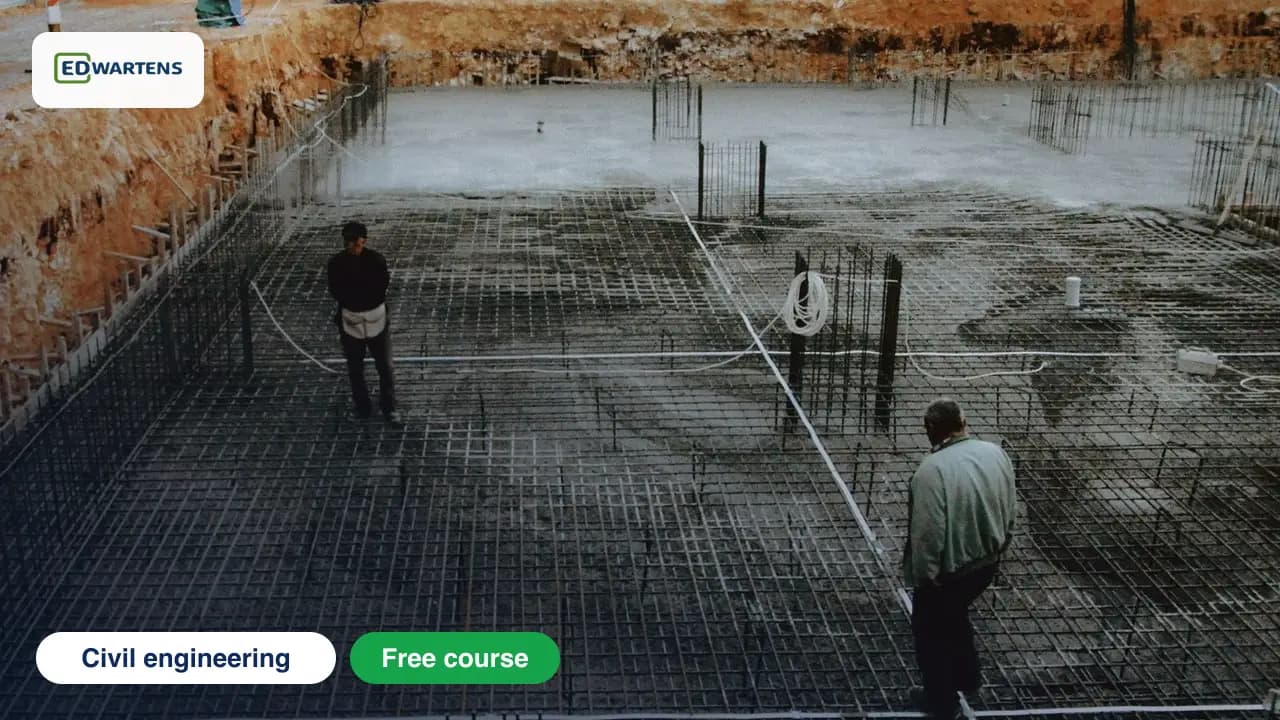
Free course · Civil engineering
Civil QA/QC Engineer: Concrete, Steel and Earthworks
This free course teaches site quality control on civil and building projects. You write a quality plan and inspection and test plans, review submittals, test fresh concrete and judge cube results with statistics, check reinforcement, formwork and steelwork, control earthworks with lab and field density tests, raise non-conformance reports and keep calibration records for handover. Test methods are named by family, such as BS EN and ASTM, and limits come from the project specification. It suits site engineers, inspectors and graduates moving into QA/QC.
Free to learn. Verifiable certificate £19 when you pass the final exam (optional, VAT included).
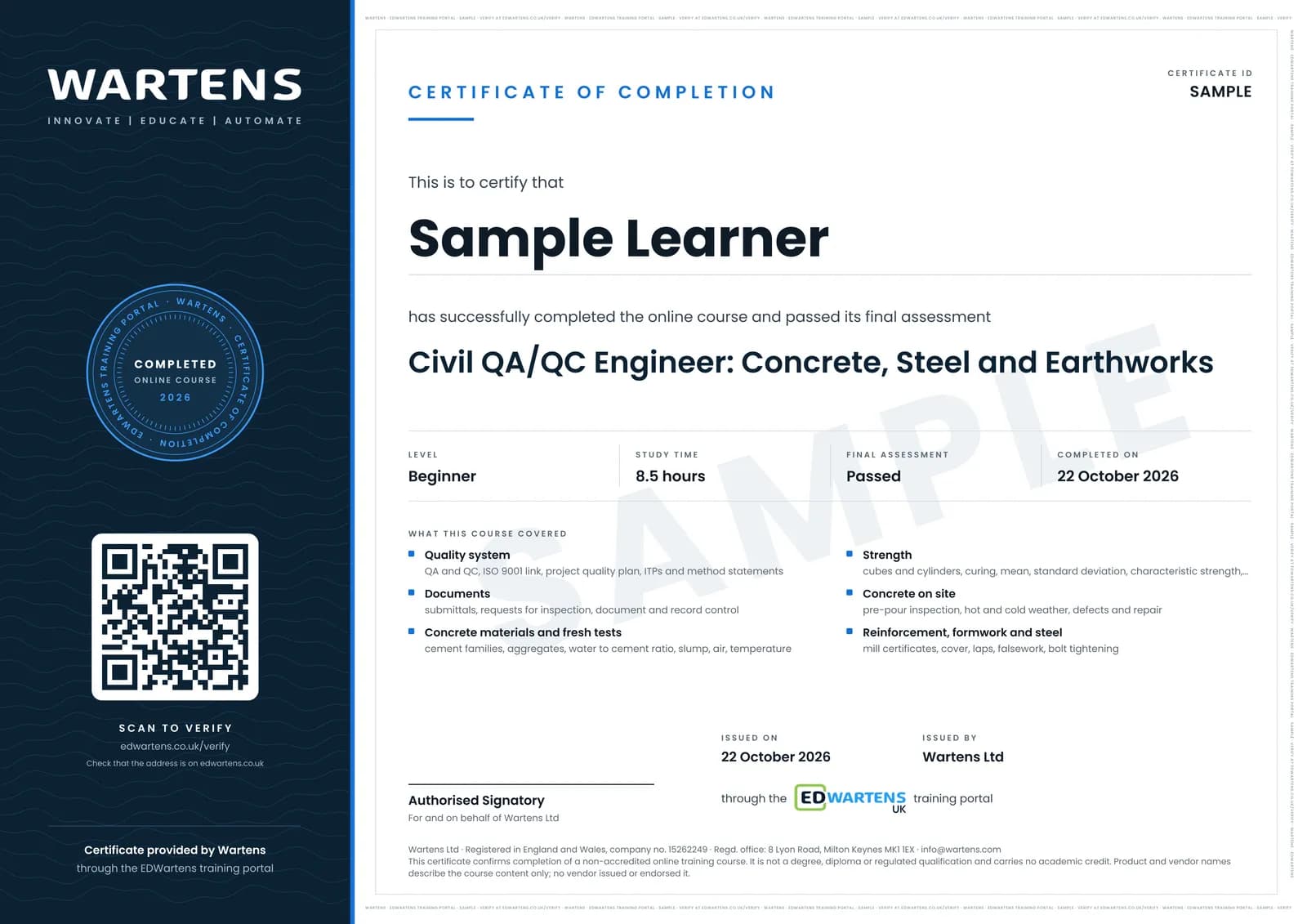
Sample certificate. Optional, issued when you pass the final exam.
- Level
- Beginner
- Modules
- 13
- Video
- 15 hours
- Price
- Free
Outcome
What you will be able to do
Explain the civil QA/QC role on the contractor and consultant side and how an ISO 9001 quality plan reaches the site; draft an inspection and test plan with hold, witness and review points and a method statement for a concrete pour; run material submittals, requests for inspection and document control; check concrete materials, a delivery ticket and a trial mix; carry out slump, temperature and air content tests and make and cure cubes or cylinders; calculate mean, standard deviation and characteristic strength and check a set of results against a specification rule; inspect reinforcement, formwork and structural steel erection; plan compaction and calculate percent compaction from sand cone data; inspect blockwork, plaster, waterproofing and run a flood test; and write a non-conformance report with root cause, corrective action, calibration and handover records.
- Explain the QA/QC role and trace an ISO 9001 quality system down to a site inspection
- Draft an inspection and test plan with hold, witness and review points and a method statement
- Run material submittals, requests for inspection and document control
- Check a concrete delivery ticket and run slump, temperature and air content tests
- Make and cure cubes or cylinders and work out mean, standard deviation and characteristic strength
- Inspect reinforcement, formwork and structural steel erection before release
- Read a proctor curve and calculate percent compaction from sand cone data
- Inspect blockwork, plaster and waterproofing, run a flood test and write an NCR with root cause
Software
A spreadsheet: Excel, Excel for the web or LibreOffice Calc (free), and node or any calculator for the worked checks. No site software is needed.
Hardware
None. The lessons show real test equipment in the videos; you do not need to own any.
Syllabus
13 modules
Each module has video lessons, notes and a short quiz. The final exam closes the course.
- The civil QA/QC engineer and the project quality plan4 lessons
- Inspection and test plans and method statements5 lessons
- Submittals, requests for inspection and document control7 lessons
- Concrete materials, mix design and fresh concrete tests13 lessons
- Cubes, cylinders, curing and strength acceptance9 lessons
- Concrete on site: placing, weather, defects and repair5 lessons
- Reinforcement inspection7 lessons
- Formwork, falsework and structural steel erection4 lessons
- Earthworks: soils, proctor and compaction control8 lessons
- Field density and bearing tests10 lessons
- Blockwork, plaster, waterproofing and finishes5 lessons
- Non-conformance, root cause, calibration and handover6 lessons
- Final Assessment1 lesson
How it works
How this course works
- Watch the video lessonsOne module at a time, at your own pace.
- Take the module quizA short quiz at the end of each module shows what stuck.
- Keep your notesWrite in My notes beside each module and ask the trainer if you are stuck.
- Sit the final examPass it once you have been through the modules.
- Certificate, if you want oneOptionalPaid, and only after you pass. Anyone can check it online.
Certificate
An optional certificate when you pass
Learning is free. Pass the final exam and you can have a certificate for £19, including VAT, with a number employers can check online. It records that you completed a free online course; it is not a regulated qualification or a CPD certificate.
- Your name, the course, its study time and your final exam score
- A unique certificate number and a QR code to its verification page
- Issued by Wartens Ltd; add it to your LinkedIn profile in one click
- Pay now or after you pass: it is issued the moment you pass the final
Credits
Who made the lessons
The video lessons belong to their creators. EDWartens wrote the study plan, notes, quizzes and the final exam.
- 2i Constructions
requests for inspection, QC logs and non-conformities
- CQE Academy
the seven quality control tools including the cause and effect diagram
- Civil Engineer At Site.
the ITP and the daily work of a civil quality engineer, method statement for RCC work, and compressive strength testing in practice
- Civil Engineering Clicks
the roles and responsibilities of a construction QA/QC engineer or inspector
- Construction Quality Management
a plain explanation of the hold point in an ITP
- Cttp Arkansas
short test-method demonstrations on concrete slump, temperature, density and air content, aggregate sieve and washing tests, proctor testing and the nuclear density gauge, calibration of measures and the pressure air meter, and compressive strength with unbonded caps
- Engr. DANISHWAR KHAN
concrete inspection before, during and after a pour, reinforcement checks, steel grade identification and bar weight, tensile test of steel, cement fineness and water to cement ratio, segregation, honeycombing and plate load testing
- Ezekiel Kalu
why concrete temperature should be measured
- Gilson Company Inc.
the pros and cons of sand cone, rubber balloon and nuclear density methods
- Hixtra Ltd
plate bearing and in-situ CBR testing
- Intact Knowledge
the QA/QC document series: project quality plan, quality manual, ITPs, method statements for concrete, reinforcement, formwork, structural steel, blockwork, plastering, waterproofing, tiling, painting, excavation and backfilling, material submittals and approval logs, document and record control, NCR and CAPA procedures
- Into The Box
field density by the sand replacement method
- Kevin Good
dynamic cone penetrometer soil testing
- Mattest Ireland
sampling fresh concrete, slump, flow table, air content, making cubes and curing cube samples
- NCTEL
a lecture on the compressive strength of cement concrete cubes
- NDDOT Materials Technical Certification Program
a state materials programme's sand cone demonstration
- Professional Civil Engineers
checking a flat slab, its steel and shuttering on site
- QualityEngineers Guide
the work inspection request procedure and a QA/QC engineer reacting to slump tests and a pour
- Quantum Build
checking steel reinforcement and formwork integrity
- Rigid Academy
rebar placement and support explained for site engineers
- Smart Civil Engineer
a step-by-step sand cone field density test
- The Merchant Construct-preneurs and Tutors
a steel reinforcement checklist for slabs, beams and columns
- UltraTech Cement
casting and testing concrete cubes in the field
Jobs
Jobs this course can lead to
The skills in this course are used in quality and project engineering work, for example as a qa/qc engineer, a site engineer and a quality inspector. No course can promise a job, and employers also look for experience, so read what live adverts ask for.
Questions
About this course
Last reviewed 1 November 2026.
Does it follow British Standards?
Will it qualify me as a site inspector?
Is the £19 certificate a recognised qualification?
What is the Civil QA/QC Engineer course?
Who is the course for?
Which test methods and standards does the course use?
Can I use this on a real site without supervision?
Do I need any equipment or software?
Is this a testing technician certification?
How long does the course take, and is it free?
What certificate do I get?
Civil and structural engineer
Take it with
Want a live class and career support?
The Professional Module is five live days of Siemens PLC, HMI and SCADA with an instructor, then a resume session and a CPD certificate.