Free course · Building automation
Building Management Systems (BMS): HVAC Control, BACnet and Building Automation
This free course teaches building management systems from the ground up: BMS architecture and field devices, I/O point lists, sequences of operation for AHUs, chillers, boilers and pumps, DDC panels, graphics, alarms, BACnet and commissioning. It suits UK engineers, electricians and technicians moving into buildings, and helps with BMS engineer, controls engineer and building services roles. Good controls also help buildings meet Part L energy requirements.
Building Management Systems (BMS): HVAC Control, BACnet and Building Automation is a free online beginner Building automation course with 13 modules, about 20 hours of video lessons. Learning is free; an optional verifiable certificate costs £19 including VAT when you pass the final exam. Last updated 28 October 2026.
Free to learn. Verifiable certificate £19 when you pass the final exam (optional, VAT included).
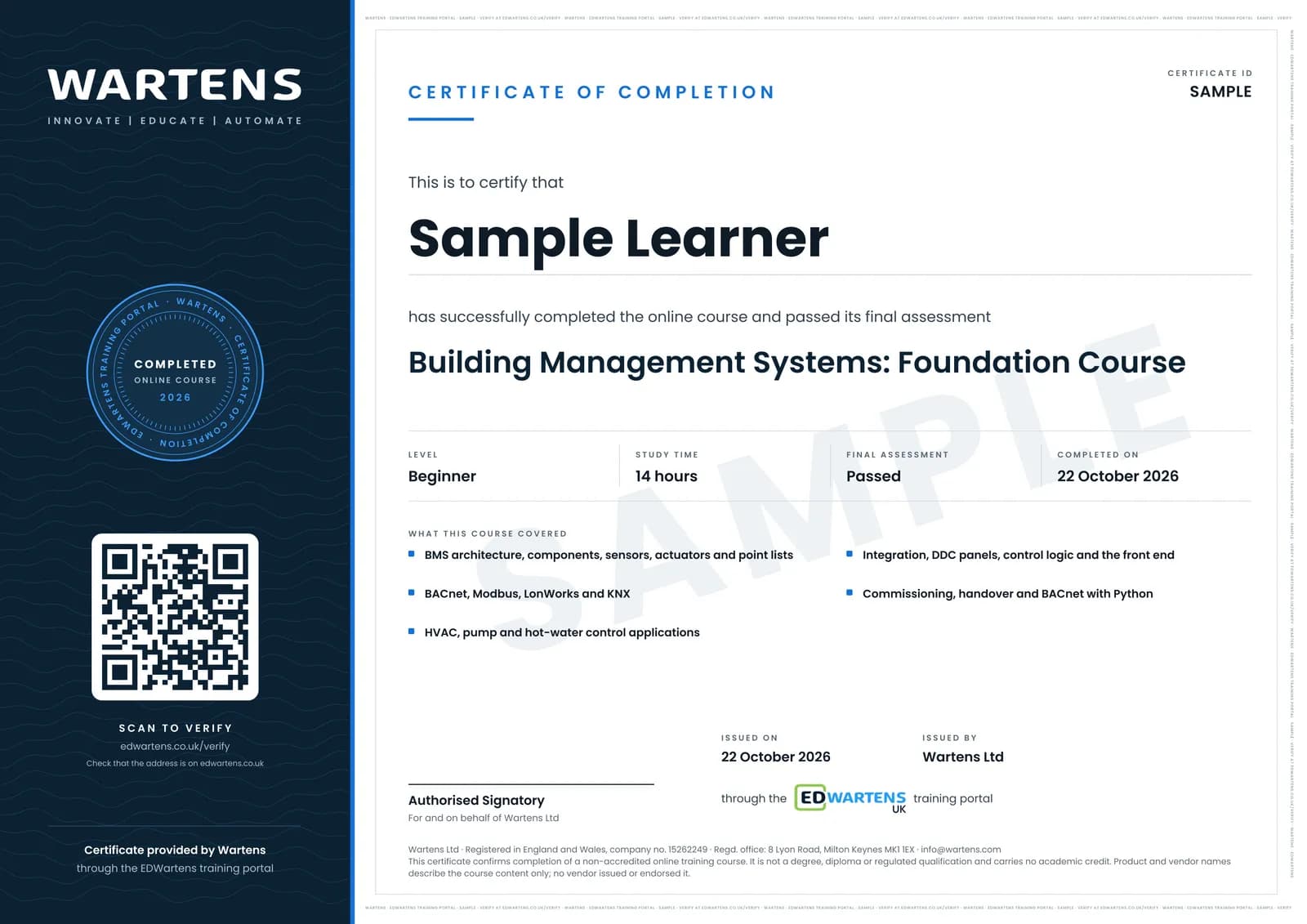
Sample certificate. Optional, issued when you pass the final exam.
- Level
- Beginner
- Modules
- 13
- Video
- 20 hours
- Price
- Free
Video time only: reading the notes, the quizzes and the final exam take extra time, at your own pace.
Outcome
What you will be able to do
Describe a BMS architecture from field devices to servers, choose sensors, actuators and controllers for HVAC, lighting, fire and security integration, read and design an I/O point list, explain BACnet, Modbus, LonWorks and KNX, write control sequences for AHUs, chillers, boilers and pumps, configure graphics, trends, schedules and alarms, plan testing, commissioning and handover, and read and write BACnet points with Python.
- Explain BMS architecture, components and field devices
- Design I/O point lists and choose protocols
- Write sequences of operation for AHUs, chillers, boilers and pumps
- Integrate lighting, security, fire and energy systems
- Design DDC panels, graphics, trends, schedules and alarms
- Commission a BMS and read and write BACnet with Python
Software
Python 3 with BAC0 for the BACnet modules (free); any BMS front end is optional.
Hardware
None required. A BACnet/IP simulator or a small DDC controller helps with the Python modules.
Syllabus
13 modules
Each module has video lessons, notes and a short quiz. The final exam closes the course.
- What a BMS Is: Overview, Components and Architecture4 lessons
- Sensors, Actuators, Controllers and Point Lists3 lessonsLab
- Communication Protocols and Networking2 lessonsLab
- HVAC Control Applications: AHU, VAV and FCU, Chiller, Cooling Tower and Boiler7 lessonsLab
- Pumps, Tanks and Hot Water Applications7 lessonsLab
- Lighting, Security, Fire, Energy and Water Integration5 lessons
- DDC Panels, Wiring and Control Logic3 lessonsLab
- The Front End: Graphics, Trends, Schedules, Alarms and Users4 lessonsLab
- Testing, Commissioning, Validation, Handover and Integration4 lessons
- BACnet with Python: Discovery, Read and Write8 lessons
- BACnet Logging, Edge Apps and BACnet Servers8 lessons
- Case Studies, Efficiency, Fault Detection and Careers5 lessons
- Final Assessment1 lesson
How it works
How this course works
- Watch the video lessonsOne module at a time, at your own pace.
- Take the module quizA short quiz at the end of each module shows what stuck.
- Keep your notesWrite in My notes beside each module and ask the trainer if you are stuck.
- Practise in the labOptionalTry a task from the module in the EDWartens Lab, in your browser.
- Sit the final examPass it once you have been through the modules.
- Certificate, if you want oneOptionalPaid, and only after you pass. Anyone can check it online.
EDWartens Lab
Practise this in the EDWartens Lab
Write and test the same ladder logic in the Lab's PLC simulator, go online and force inputs. The Lab uses a vendor-neutral editor, so brand software stays in the course.
Works alongside Building Management Systems (BMS): HVAC Control, BACnet and Building Automation. The Lab is plc programming practice in your browser: no install, no hardware, free to use. Sign in as a learner and it opens with your account.
Levels to try with this course
PLC-05 · PLC lab
Tank filling pump
Open in the lab (opens in a new tab)PLC-08 · PLC lab
Duty and standby pumps
Open in the lab (opens in a new tab)Electrical lab
Commission the 4-20 mA level loop
Open in the lab (opens in a new tab)PRC-07 · Process lab
Build an operator screen
Open in the lab (opens in a new tab)
Optional. Skip it whenever you like: it never blocks your progress or your certificate.
Why practise in a lab
Technical work is judged on what you can do: wiring, commissioning, finding a fault. Doing a task yourself teaches more than watching it a second time, and a lab lets you try it safely before you meet real equipment. It does not replace working on real hardware.
- Practise safely, so a mistake costs nothing.
- The lab checks your work like a site test, so you know when it is right.
- Free, in your browser, with nothing to install.
Certificate
An optional certificate when you pass
Learning is free. Pass the final exam and you can have a certificate for £19, including VAT, with a number employers can check online. It records that you completed a free online course; it is not a regulated qualification or a CPD certificate.
- Your name, the course, its study time and your final exam score
- A unique certificate number and a QR code to its verification page
- Issued by Wartens Ltd; add it to your LinkedIn profile in one click
- Pay now or after you pass: it is issued the moment you pass the final
Credits
Who made the lessons
The video lessons belong to their creators. EDWartens wrote the study plan, notes, quizzes and the final exam.
- Aayat Technical
the 30-day BMS study plan
- smart training center
the BMS control applications basic training
- TalkShopWithBen
BACnet with Python for building automation technicians
- MEP Academy
a lesson in "HVAC Control Applications: AHU, VAV and FCU, Chiller, Cooling Tower and Boiler"
Jobs
Jobs this course can lead to
The skills in this course are used in BMS and building controls work, for example as a BMS engineer, a controls engineer and a building services engineer. No course can promise a job, and employers also look for experience, so read what live adverts ask for.
Questions
About this course
Last reviewed 28 October 2026.
Do I need a BMS or BACnet controller?
Is this enough to get a job as a BMS engineer in the UK?
Do I need an HVAC background?
What does the Building Management Systems (BMS): HVAC Control, BACnet and Building Automation course cover?
Where does Building Management Systems (BMS): HVAC Control, BACnet and Building Automation start and where does it end?
How long is Building Management Systems (BMS): HVAC Control, BACnet and Building Automation?
Can I practise Building Management Systems (BMS): HVAC Control, BACnet and Building Automation in the browser?
What is BACnet?
What is KNX?
Which BMS brands does this cover?
Do I need to know Python?
Is HVAC knowledge required?
Is the course really free?
What certificate do I get, and is it a vendor qualification?
Who made the video lessons?
How long does the course take?
Building services engineer
Take it with
Want a live class and career support?
The Professional Module is five live days of Siemens PLC, HMI and SCADA with an instructor, then career sessions with our engineers and a CPD certificate.