Free course · Quality management
SPC and MSA: Control Charts, Capability and Gauge R&R
This free course teaches statistical process control and measurement system analysis with real numbers. You choose rational subgroups, build X-bar and R, individuals and attribute charts, apply run rules, write reaction plans, calculate Cp, Cpk, Pp and Ppk, and run gauge R&R studies by average and range and by ANOVA. The data is in the notes, so you can repeat every result in a spreadsheet. It suits quality, process and supplier quality engineers in automotive, aerospace and medical device supply chains.
Free to learn. Verifiable certificate £19 when you pass the final exam (optional, VAT included).
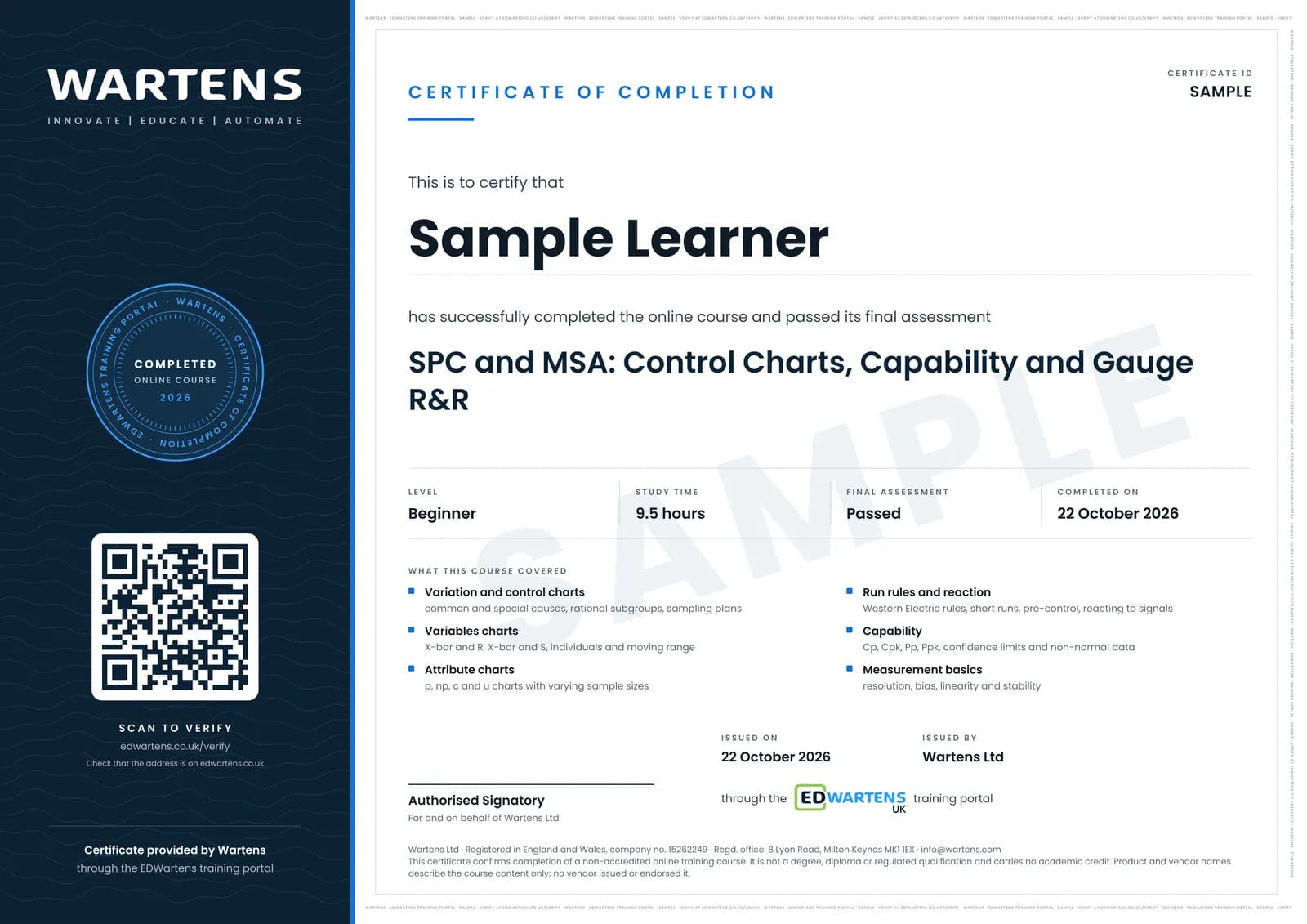
Sample certificate. Optional, issued when you pass the final exam.
- Level
- Beginner
- Modules
- 15
- Video
- 16 hours
- Price
- Free
Outcome
What you will be able to do
Explain variation and choose rational subgroups; build and read X-bar and R, X-bar and S, individuals and attribute control charts with the right constants; apply run rules and write a reaction plan; calculate Cp, Cpk, Pp and Ppk with confidence and handle skewed data; study a measurement system for resolution, bias, linearity and stability; run gauge R&R by the average and range method and by ANOVA and judge %GRR, percent of tolerance and distinct categories; run an attribute agreement study with kappa; and place SPC and MSA correctly in APQP, PPAP and IATF 16949.
- Explain variation and choose rational subgroups and sampling plans
- Build X-bar and R, X-bar and S, individuals and attribute control charts with the right constants
- Apply run rules and write a reaction plan for a signal
- Calculate Cp, Cpk, Pp and Ppk with confidence limits, and handle skewed data
- Check a gauge for resolution, bias, linearity and stability
- Run gauge R&R by the average and range method and by ANOVA and judge %GRR, percent of tolerance and ndc
- Run an attribute agreement study with effectiveness, miss rate, false alarm rate and kappa
- Place SPC and MSA correctly in APQP, PPAP and IATF 16949 and a control plan
Software
A spreadsheet (Excel or LibreOffice Calc) is all the course needs. JASP or R can repeat the ANOVA and capability steps; Minitab appears in some videos and is optional.
Hardware
None. A caliper and a gauge block make the measurement-system practice more real but are not required.
Syllabus
15 modules
Each module has video lessons, notes and a short quiz. The final exam closes the course.
- Variation, process thinking and the control chart idea2 lessons
- Rational subgroups, sample size and sampling frequency3 lessons
- Variables charts: X-bar and R, X-bar and S4 lessons
- Individuals and moving range charts2 lessons
- Attribute charts: p, np, c and u2 lessons
- Run rules and reacting to signals4 lessons
- Short runs, pre-control and SPC on the shop floor2 lessons
- Process capability: Cp and Cpk2 lessons
- Process performance: Pp, Ppk, non-normal data and confidence2 lessons
- MSA basics: resolution, bias, linearity and stability4 lessons
- Gauge R&R by the average and range method3 lessons
- Gauge R&R by ANOVA4 lessons
- Attribute agreement analysis4 lessons
- SPC and MSA in APQP, PPAP and IATF 16949, and the reaction plan2 lessons
- Final Assessment1 lesson
How it works
How this course works
- Watch the video lessonsOne module at a time, at your own pace.
- Take the module quizA short quiz at the end of each module shows what stuck.
- Keep your notesWrite in My notes beside each module and ask the trainer if you are stuck.
- Sit the final examPass it once you have been through the modules.
- Certificate, if you want oneOptionalPaid, and only after you pass. Anyone can check it online.
Certificate
An optional certificate when you pass
Learning is free. Pass the final exam and you can have a certificate for £19, including VAT, with a number employers can check online. It records that you completed a free online course; it is not a regulated qualification or a CPD certificate.
- Your name, the course, its study time and your final exam score
- A unique certificate number and a QR code to its verification page
- Issued by Wartens Ltd; add it to your LinkedIn profile in one click
- Pay now or after you pass: it is issued the moment you pass the final
Credits
Who made the lessons
The video lessons belong to their creators. EDWartens wrote the study plan, notes, quizzes and the final exam.
- Lean Six Sigma Training
the lesson series on SPC, patterns, R, S, X-bar, individuals, p, np, c and u charts
- numiqo
X-bar and R charts and process capability explained
- QualityGurus
rational subgrouping and control chart analysis with the Nelson rules
- SPC for Excel Software
rational subgrouping and gage R&R with SPC in software
- StatStuff
rational subgrouping
- CQE Academy
control chart basics, Cp, Cpk, Pp and Ppk, and rational subgrouping
- Olanab
a complete SPC training lesson used as a second worked example
- The Engineering Toolbox Channel
SPC control charting rules
- Statistics Basics
a short summary of the Nelson rules
- Mitutoyo America Corporation
SPC in three steps from a shop-floor measurement vendor
- Quality HUB India
statistical process control and chart types as an automotive core tool
- SIGMADESK
Cp, Cpk, Pp and Ppk and the full gage R&R tutorial with ANOVA interpretation
- Minitab
capability analysis in Minitab, shown as an optional software view
- GageRandR
what measurement system analysis is, with bias, linearity and stability
- Bhavya Mangla
the difference between bias and linearity
- Q Ultima Learning
bias, linearity, stability and gauge R&R in order
- Green Belt Academy
gauge R&R explained and the average and range method
- Insights unleashed
the MSA gauge R&R average and range method
- EngSuite
gauge R&R by ANOVA in a spreadsheet
- Problem Solving
step by step ANOVA calculations for gauge R&R
- Dr. Japan Trivedi
attribute data kappa analysis
- Knowledge Factory-Lean Six Sigma
how to perform an attribute agreement analysis
- Digital E-Learning
attribute gauge R&R and attribute agreement analysis
- Tom Mentink
kappa analysis with practical setup tips
- LEARN & APPLY : Lean and Six Sigma
a crossed gauge R&R study with examples
Jobs
Jobs this course can lead to
The skills in this course are used in quality and project engineering work, for example as a quality engineer, a supplier quality engineer and a process engineer. No course can promise a job, and employers also look for experience, so read what live adverts ask for.
Questions
About this course
Last reviewed 1 November 2026.
Does it follow the AIAG SPC and MSA manuals?
What software do I need?
Is the certificate an automotive qualification?
What is the SPC and MSA course?
Which AIAG manuals does the course follow?
Is this course an AIAG, IATF or ASQ credential?
How long is the course and is it free?
What certificate do I get?
Where do SPC and MSA fit in APQP, PPAP and IATF 16949?
Automotive quality engineer
Take it with

Want a live class and career support?
The Professional Module is five live days of Siemens PLC, HMI and SCADA with an instructor, then a resume session and a CPD certificate.