Free course · Quality management
APQP, Control Plan and PPAP
This free course follows a new part from the customer's request to production approval. You plan the five APQP phases with a timing plan, carry special characteristics into the process flow, PFMEA and Control Plan, run Safe Launch, validate with Ppk and run at rate, and build a PPAP submission with the PSW. It teaches the current AIAG editions in its own words. It suits supplier quality, quality and new product introduction engineers in UK automotive supply chains.
Free to learn. Verifiable certificate £19 when you pass the final exam (optional, VAT included).
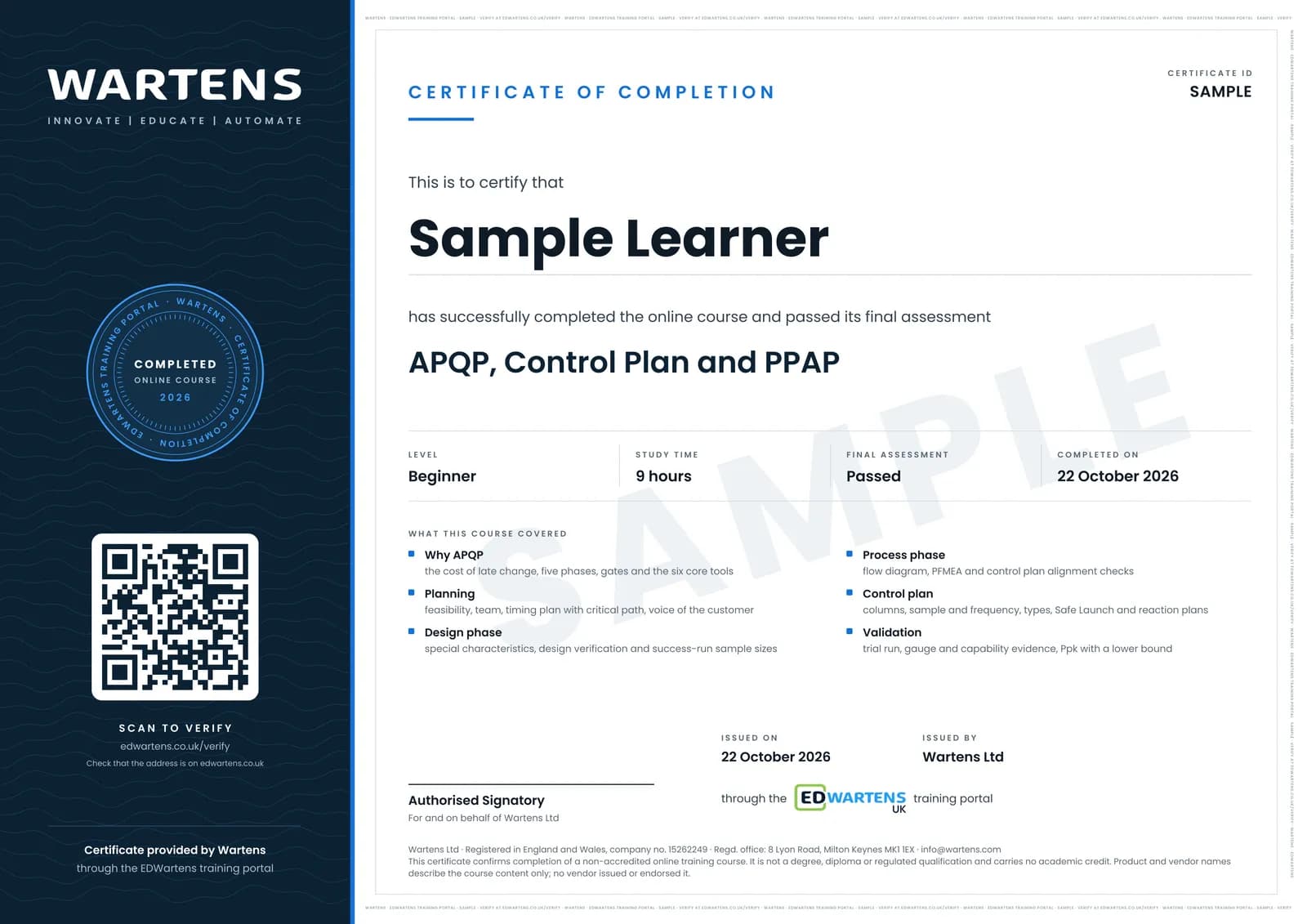
Sample certificate. Optional, issued when you pass the final exam.
- Level
- Beginner
- Modules
- 12
- Video
- 14 hours
- Price
- Free
Outcome
What you will be able to do
Explain why APQP exists and name its five phases, outputs and gates; build a timing plan from the start of production; turn customer requirements into special characteristics; align the process flow, PFMEA and Control Plan and find orphan rows; write prototype, pre-launch and production control plans with sample sizes, Safe Launch rules and reaction plans; list the 18 PPAP elements and choose a submission level; explain the part submission warrant, appearance approval, significant production run and run at rate; calculate required capacity; and handle interim approval, deviations, change notification and supplier APQP.
- Explain why APQP exists and name its five phases, outputs and gate reviews
- Build a launch timing plan backwards from the start of production and find its critical path
- Turn customer needs into measurable requirements and special characteristics
- Align the process flow, PFMEA and control plan and find missing controls and orphan rows
- Write prototype, pre-launch and production control plans with sampling, Safe Launch rules and reaction plans
- Judge gauge and capability evidence and calculate Ppk with a lower confidence bound
- List the 18 PPAP elements, choose a submission level and explain the part submission warrant
- Calculate required capacity and judge a run at rate
- Handle rejection, interim approval, deviations, change notification and supplier APQP
Software
A spreadsheet (Excel or LibreOffice Calc) for the timing plan, control plan, PPAP checklist and the capacity and Ppk calculations. No paid software is needed.
Hardware
None. A drawing and a real or imagined machined or moulded part make the practice more concrete.
Syllabus
12 modules
Each module has video lessons, notes and a short quiz. The final exam closes the course.
- Why APQP exists: the cost of late change and the five phases4 lessons
- Planning the programme: team, timing plan, feasibility and gates4 lessons
- Voice of the customer, special characteristics and product design4 lessons
- Process design: the flow diagram, PFMEA and the chain of documents4 lessons
- The Control Plan: purpose, columns and how to fill them3 lessons
- Control Plan types, Safe Launch and reaction plans3 lessons
- Phase 4: validation, MSA and SPC as PPAP evidence3 lessons
- PPAP: the 18 elements and five submission levels5 lessons
- Part submission warrant, appearance approval, significant production run and run at rate2 lessons
- When PPAP fails: rejection, interim approval, deviations and change notification3 lessons
- Phase 5, supplier APQP and early production containment6 lessons
- Final Assessment1 lesson
How it works
How this course works
- Watch the video lessonsOne module at a time, at your own pace.
- Take the module quizA short quiz at the end of each module shows what stuck.
- Keep your notesWrite in My notes beside each module and ask the trainer if you are stuck.
- Sit the final examPass it once you have been through the modules.
- Certificate, if you want oneOptionalPaid, and only after you pass. Anyone can check it online.
Certificate
An optional certificate when you pass
Learning is free. Pass the final exam and you can have a certificate for £19, including VAT, with a number employers can check online. It records that you completed a free online course; it is not a regulated qualification or a CPD certificate.
- Your name, the course, its study time and your final exam score
- A unique certificate number and a QR code to its verification page
- Issued by Wartens Ltd; add it to your LinkedIn profile in one click
- Pay now or after you pass: it is issued the moment you pass the final
Credits
Who made the lessons
The video lessons belong to their creators. EDWartens wrote the study plan, notes, quizzes and the final exam.
- Young Business Professionals International
the APQP phase series, the control plan, design and process verification plans and run at rate
- Bhavya Mangla
the APQP third edition by phase, the Control Plan first edition, control plan types, PPAP, change management and corrective action
- Excedify
voice of the customer, the five APQP phases, supplier control and gauge R&R as PPAP evidence
- Dhawal Thakkar
APQP as an automotive project management method, timing plans and gates
- THORS eLearning Solutions
a short introduction to the AIAG and VDA PFMEA
- LEARN & APPLY : Lean and Six Sigma
a worked FMEA on a practical example
- We Improve Consulting
a full APQP training run-through
- Quality Inspection
the APQP process explained end to end
- suppliersplatform
the PPAP masterclass for beginners
- Digital E-Learning
the 18 PPAP documents explained
- ASK Mechnology
a longer walk through the PPAP elements
- CAD Tutorials For Beginners To Advanced
PPAP explained as a core tool, including the production run
- PMC Videos
why advanced product quality planning is worth the effort
- Thota Krishna Hema
a complete guide to APQP
- High Skills
a short APQP walk-through in English
Jobs
Jobs this course can lead to
The skills in this course are used in quality and project engineering work, for example as a supplier quality engineer, a quality engineer and a new product introduction engineer. No course can promise a job, and employers also look for experience, so read what live adverts ask for.
Questions
About this course
Last reviewed 1 November 2026.
Which AIAG editions does it teach?
Is PPAP the same as APQP?
Is the £19 certificate an AIAG qualification?
What is the APQP, Control Plan and PPAP course?
Which AIAG manuals and editions does the course follow?
Is this course an AIAG, IATF or customer approval?
Do I need special software for the APQP and PPAP course?
How does this course relate to the FMEA and SPC courses?
How long is the course and is it free?
What certificate do I get?
Automotive quality engineer
Take it with

Want a live class and career support?
The Professional Module is five live days of Siemens PLC, HMI and SCADA with an instructor, then a resume session and a CPD certificate.