Free course · Quality management
Static Equipment Inspection: Pressure Vessels, Piping and Storage Tanks
This free course teaches in-service inspection of pressure vessels, process piping and storage tanks. You learn the main damage mechanisms, plan inspections and intervals, take ultrasonic thickness readings and calculate corrosion rate and remaining life. You then apply the checks to vessels, piping circuits and tank shells and floors, and write findings and reports. It suits mechanical graduates and technicians in process plants, where UK pressure systems rules expect a written scheme of examination by a competent person.
Static Equipment Inspection: Pressure Vessels, Piping and Storage Tanks is a free online intermediate Quality management course with 9 modules, about 4 hours of lessons and video. Learning is free; an optional verifiable certificate costs £19 including VAT when you pass the final exam. Last updated 28 November 2026.
Free to learn. Verifiable certificate £19 when you pass the final exam (optional, VAT included).
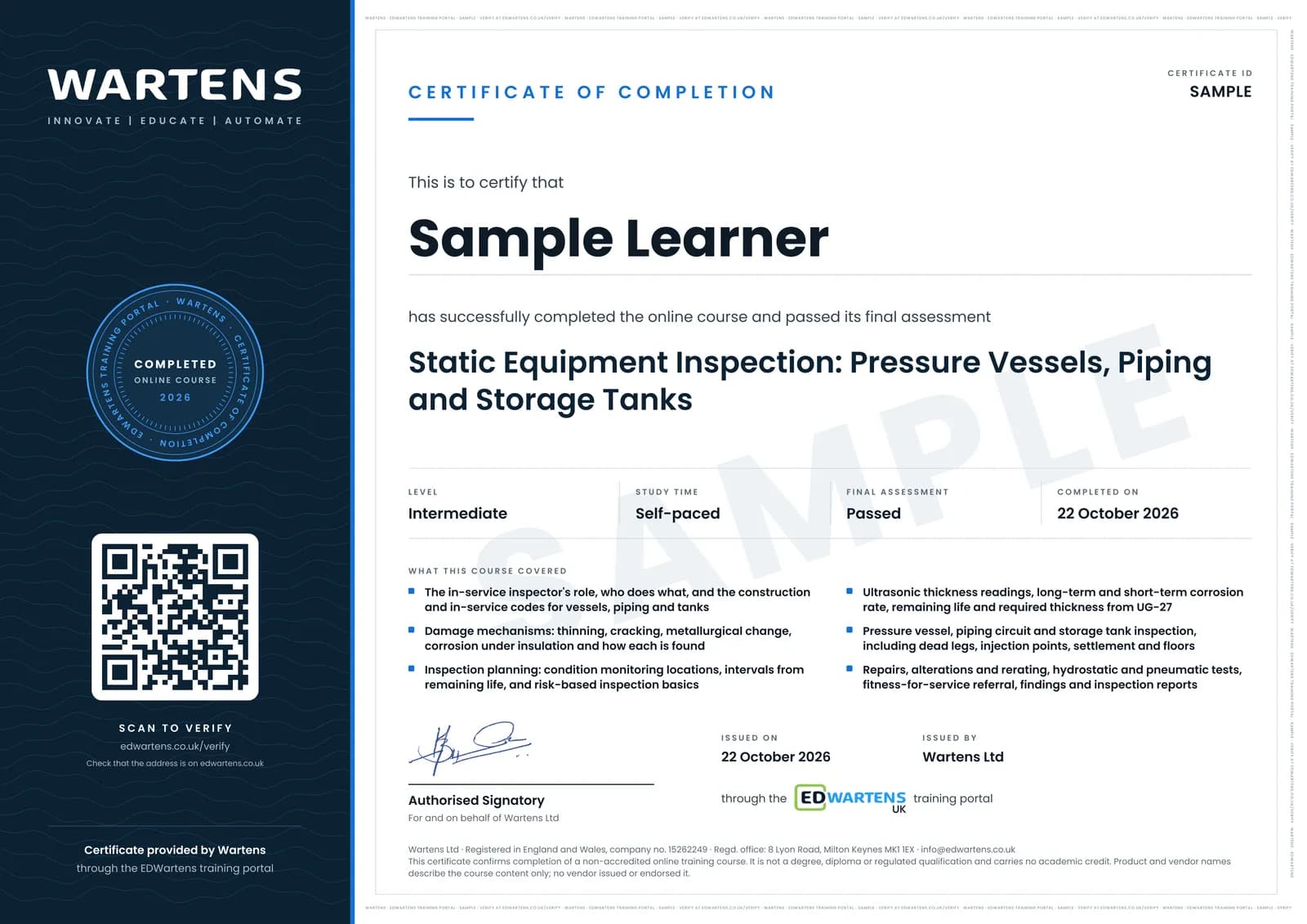
Sample certificate. Optional, issued when you pass the final exam.
- Level
- Intermediate
- Modules
- 9
- Length
- About 4 hours
- Price
- Free
Lessons and practice at your own pace. The video is optional extra.
Outcome
What you will be able to do
Explain what an in-service inspector checks and who decides what; tell a construction code from an in-service code and place API 510, API 570 and API 653 in their scope; match damage mechanisms to equipment and inspection methods; plan inspection with condition monitoring locations and intervals; judge an ultrasonic thickness reading; calculate corrosion rate, remaining life and the next inspection date; calculate required thickness for a cylindrical shell from UG-27 and a tank shell course by the one-foot method; inspect a vessel, a piping circuit and a storage tank; tell a repair from an alteration; choose a pressure test and judge a hold; write a finding and an inspection report. It covers the body of knowledge behind in-service inspection to the API 510, API 570 and API 653 codes and prepares you for junior in-service inspection roles. It is not an API certification, does not replace the API exams and does not authorise you to sign off equipment.
- Say what an in-service inspector checks, who decides what, and which code covers a vessel, a line and a tank
- Sort damage into thinning, cracking, metallurgical change and mechanical damage, and explain corrosion under insulation
- Write an inspection plan with condition monitoring locations and set dates from remaining life and the code maximums
- Judge an ultrasonic thickness reading and calculate corrosion rates, remaining life and the next inspection date
- Calculate the required thickness of a cylindrical shell from UG-27 and of a tank shell course by the one-foot method
- Inspect a pressure vessel externally and internally, assess pitting and link thickness to MAWP and the relief valve
- Inspect piping circuits, dead legs and injection points, and choose between UT, profile radiography and visual inspection
- Inspect storage tanks, tell a repair from an alteration, choose a pressure test and write findings and an inspection report
Software
A spreadsheet (LibreOffice Calc is free) for thickness histories, corrosion rates, remaining life and inspection dates. Nothing else is needed.
Hardware
None. If you can borrow an ultrasonic thickness gauge at work, the practice is better for it, but every task can be done on paper.
Syllabus
9 modules
Each module has video lessons, notes and a short quiz. The final exam closes the course.
- The in-service inspector and the codes1 lesson
- Damage mechanisms: how static equipment fails3 lessons
- Inspection planning: intervals, CMLs and risk-based inspection2 lessons
- Thickness measurement, corrosion rate and remaining life3 lessons
- Pressure vessel inspection2 lessons
- Piping inspection4 lessons
- Storage tank inspection4 lessons
- Repairs, pressure testing and the inspection report3 lessons
- Final Assessment0 lessons
How it works
How this course works
- Watch the video lessonsOne module at a time, at your own pace.
- Take the module quizA short quiz at the end of each module shows what stuck.
- Keep your notesWrite in My notes beside each module and ask the trainer if you are stuck.
- Sit the final examPass it once you have been through the modules.
- Certificate, if you want oneOptionalPaid, and only after you pass. Anyone can check it online.
Certificate
An optional certificate when you pass
Learning is free. Pass the final exam and you can have a certificate for £19, including VAT, with a number employers can check online. It records that you completed a free online course; it is not a regulated qualification or a CPD certificate.
- Your name, the course, its study time and your final exam score
- A unique certificate number and a QR code to its verification page
- Issued by Wartens Ltd; add it to your LinkedIn profile in one click
- Pay now or after you pass: it is issued the moment you pass the final
Credits
Who made the lessons
The video lessons belong to their creators. EDWartens wrote the study plan, notes, quizzes and the final exam.
- Arveng Training & Engineering
the roles and responsibilities of the inspector, the owner-user and others
- Corrosion Control and Inspections
what damage mechanisms are and how they are grouped
- Pressure Equipment Academy
walking an insulated line and the five places corrosion under insulation hides, remaining life, and hydrostatic and pneumatic testing
- I4I Academy
long-term and short-term corrosion rates, wet H2S damage, piping inspection and the tank shell minimum thickness calculation
- Ravi Refinery Academy
choosing and marking condition monitoring locations on a piping circuit
- URGS International
probability and consequence of failure in risk-based inspection
- Dakota NDT
how an ultrasonic thickness gauge works
- The Efficient Engineer
how pressure vessels work and why shells, heads and nozzles are shaped as they are
- Inspection & Corrosion
assessing pitting in a pressure vessel in a practical example
- Inspection Academy
dead legs and injection points in 3D animation
- Mr Eric
profile radiography finding pitting in a small line
- QUALITECH ENGINEERING
in-service external inspection of an aboveground tank and shell settlement evaluation
- Weld Maniac
magnetic flux leakage scanning of tank floors
- AABS Training
tank repair rules, patches, replacement plates and hold points
Jobs
Jobs this course can lead to
The skills in this course are used in maintenance engineer and technician work, for example as a static equipment inspector, an inspection engineer and an integrity technician. No course can promise a job, and employers also look for experience, so read what live adverts ask for.
Browse Electrical and maintenance technicians jobs
4,450 jobs live on the UK board
Browse Multi-skilled maintenance engineer jobs
720 jobs live on the UK board
Pay: Metal working production and maintenance fitters (SOC 5223, which includes automation maintenance technicians) had a median of £41,942 a year, full-time, in April 2026. Electrical service and maintenance mechanics (SOC 5246) had £44,785. Source: ONS, Annual Survey of Hours and Earnings 2026 (provisional). Checked 28 Oct 2026.
Questions
About this course
Last reviewed 28 November 2026.
Does this cover the Pressure Systems Safety Regulations?
Is this an API 510, 570 or 653 certification?
Is the £19 certificate a qualification?
What does the Static Equipment Inspection: Pressure Vessels, Piping and Storage Tanks course cover?
Where does Static Equipment Inspection: Pressure Vessels, Piping and Storage Tanks start and where does it end?
How long is Static Equipment Inspection: Pressure Vessels, Piping and Storage Tanks?
Who is this static equipment inspection course for?
Is the course free to learn?
Which standards does it use?
Does this course give an official API qualification?
What certificate do I get?
Will it let me sign off equipment on a plant?
How long does the course take?
What is the project?
Want a live class and career support?
The Professional Module is five live days of Siemens PLC, HMI and SCADA with an instructor, then career sessions with our engineers and a CPD certificate.