Free course · Renewable energy
Solar Farm O&M and QA/QC: Commissioning, IV Curves and Inspection
This free course teaches the quality and maintenance work on a utility-scale solar farm. You follow construction checks for piles, trackers, modules and cables, then run string commissioning tests to IEC 62446-1, including insulation resistance and I-V curves. You learn how inverters, monitoring, performance ratio and availability work, then plan cleaning, thermography and fault finding with safe DC working. It suits electricians, technicians and graduates targeting UK solar farm and battery site roles.
Solar Farm O&M and QA/QC: Commissioning, IV Curves and Inspection is a free online beginner Renewable energy course with 9 modules, about 5 hours of lessons and video. Learning is free; an optional verifiable certificate costs £19 including VAT when you pass the final exam. Last updated 28 November 2026.
Free to learn. Verifiable certificate £19 when you pass the final exam (optional, VAT included).
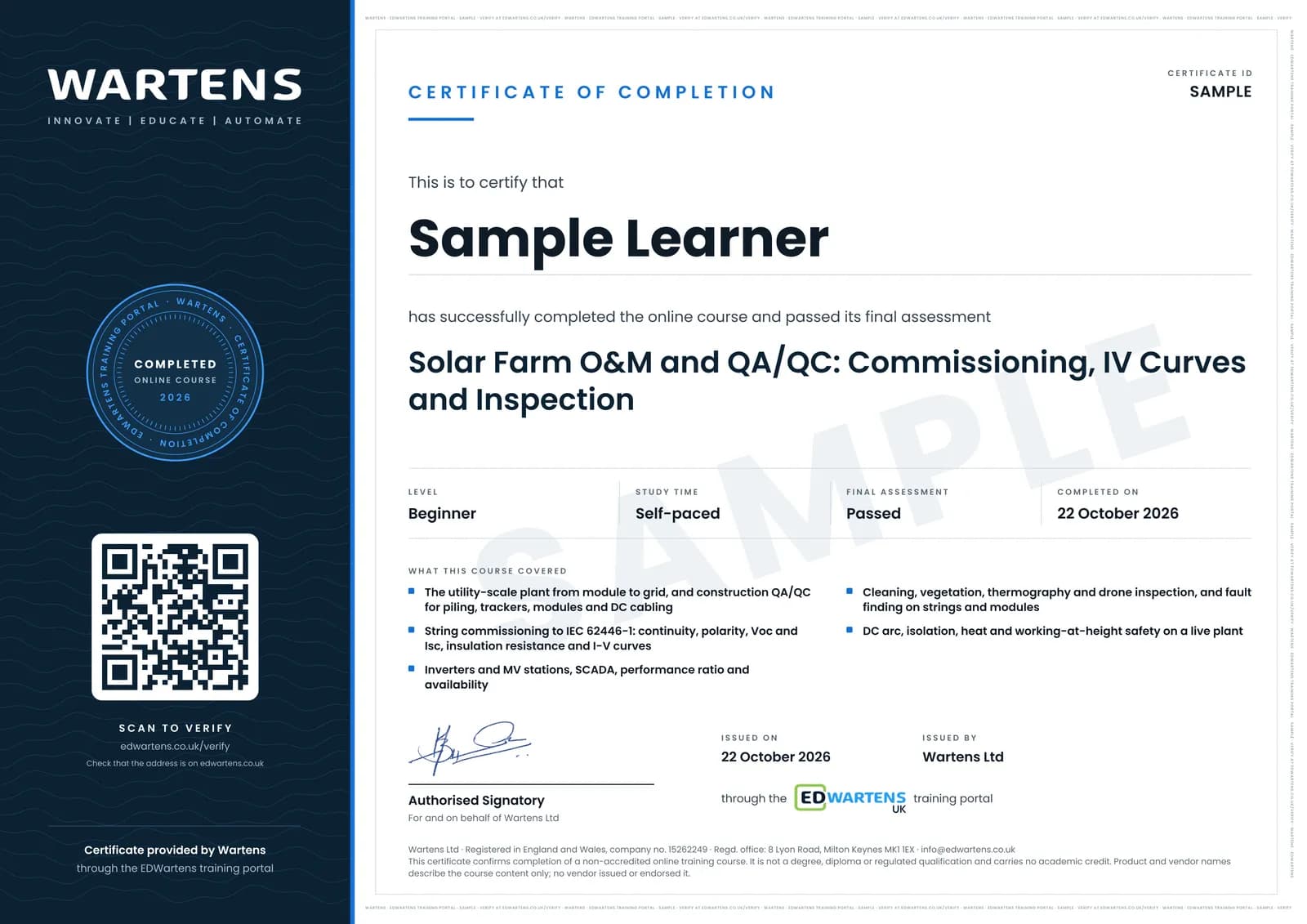
Sample certificate. Optional, issued when you pass the final exam.
- Level
- Beginner
- Modules
- 9
- Length
- About 5 hours
- Price
- Free
Lessons and practice at your own pace. The video is optional extra.
Outcome
What you will be able to do
Describe a utility-scale PV plant and the project stages from construction to O&M; set out the hold points for piling, structures, modules and DC cabling; predict and judge string Voc and Isc, insulation resistance and I-V curves to the IEC 62446-1 test sequence; start and check inverters and MV stations; calculate performance ratio and availability; plan cleaning, vegetation control, thermography and drone inspections; read I-V curve signatures and locate ground faults; and isolate, work in heat and at height safely. It prepares you for entry-level solar O&M and commissioning roles; it is not a solar certification or an electrical qualification.
- Trace power from a module to the grid, and count the strings and inverters of a plant from its size and DC/AC ratio
- Set out the hold points for piling, trackers, modules and DC cabling, and judge a pile load test
- Run the IEC 62446-1 test order, and predict and judge string Voc, Isc and insulation resistance
- Read an I-V curve for fill factor and fault signatures, and keep a commissioning record
- Check inverters, a transformer ratio and the energising order of an MV station
- Calculate performance ratio, temperature-corrected PR and availability, and read a loss tree
- Plan cleaning, vegetation control, thermography and drone inspections, and find hot spots, PID and ground faults
- Isolate a plant safely, and work in heat, at height and around DC arcs and trackers
Software
A spreadsheet (LibreOffice Calc is free) for the commissioning test sheet and the monthly O&M report. Nothing else is needed.
Hardware
None. Every task can be done on paper or in a spreadsheet. If you work on a plant, your own site's test sheets and procedures make the practice tasks better.
Syllabus
9 modules
Each module has video lessons, notes and a short quiz. The final exam closes the course.
- A utility-scale PV plant: blocks, power flow and who does what2 lessons
- Construction QA/QC: piles, trackers, modules and DC cabling1 lesson
- String testing and commissioning to IEC 62446-14 lessonsLab
- Inverters and the MV station2 lessons
- Monitoring, SCADA, performance ratio and availability2 lessons
- Preventive maintenance, cleaning, vegetation, thermography and drones4 lessons
- Fault finding and corrective maintenance4 lessons
- Safety: DC arcs, heat and working at height2 lessonsLab
- Final Assessment0 lessons
How it works
How this course works
- Watch the video lessonsOne module at a time, at your own pace.
- Take the module quizA short quiz at the end of each module shows what stuck.
- Keep your notesWrite in My notes beside each module and ask the trainer if you are stuck.
- Practise in the labOptionalTry a task from the module in the EDWartens Lab, in your browser.
- Sit the final examPass it once you have been through the modules.
- Certificate, if you want oneOptionalPaid, and only after you pass. Anyone can check it online.
Levels to try with this course
SEV-06 · Solar and EV lab
Commission the system: the safe energising order
Open in the lab (opens in a new tab)SEV-01 · Solar and EV lab
Site survey: name every part and every isolation point
Open in the lab (opens in a new tab)
Optional. Skip it whenever you like: it never blocks your progress or your certificate.
Why practise in a lab
Technical work is judged on what you can do: wiring, commissioning, finding a fault. Doing a task yourself teaches more than watching it a second time, and a lab lets you try it safely before you meet real equipment. It does not replace working on real hardware.
- Practise safely, so a mistake costs nothing.
- The lab checks your work like a site test, so you know when it is right.
- Free, in your browser, with nothing to install.
Certificate
An optional certificate when you pass
Learning is free. Pass the final exam and you can have a certificate for £19, including VAT, with a number employers can check online. It records that you completed a free online course; it is not a regulated qualification or a CPD certificate.
- Your name, the course, its study time and your final exam score
- A unique certificate number and a QR code to its verification page
- Issued by Wartens Ltd; add it to your LinkedIn profile in one click
- Pay now or after you pass: it is issued the moment you pass the final
Credits
Who made the lessons
The video lessons belong to their creators. EDWartens wrote the study plan, notes, quizzes and the final exam.
- HeatSpring
how electricity flows through a utility-scale solar site
- EltonDP
how a solar farm is constructed from start to finish
- Terracon
pile load testing on a solar site
- Keentel Engineering
the electrical tests used to commission a utility solar plant
- Metrel
testing a 1500 V PV installation to IEC 62446
- Transcat
an insulation test on a PV array
- Fluke Corporation
I-V curve tracing, I-V curve deviations and locating ground faults
- SolarAcademy
string inverters against central inverters in utility plants
- GoodWe Solar Academy
a medium voltage transformer station for a solar farm
- SCADA Support PH
SCADA systems for PV power plants
- Clearspot
specific yield against performance ratio
- LIGHTHIEF International
a short guide to solar farm operations and maintenance
- Ecoppia
soiling analysis and measurement
- Penn State Solar Center
infrared thermography of a PV system
- The Drone Life
how drone solar inspections work
- PADCON
potential induced degradation and how it can be reversed
- eFIXX
assembling MC4 solar connectors and testing crimp strength
- Tyndale Company
DC arc flash against AC arc flash
- NT WorkSafe
working safely in the heat
Jobs
Jobs this course can lead to
The skills in this course are used in power, renewable energy and data centre work, for example as a solar o&m technician, a solar commissioning technician and a solar qa/qc engineer. No course can promise a job, and employers also look for experience, so read what live adverts ask for.
Pay: Electrical engineers (SOC 2123) had a median of £63,136 a year, full-time, in April 2026. Source: ONS, Annual Survey of Hours and Earnings 2026 (provisional). Checked 28 Oct 2026.
Questions
About this course
Last reviewed 28 November 2026.
Does the course cover IEC 62446-1 tests?
Does it replace electrical competence or site authorisation?
Is the £19 certificate a qualification?
What does the Solar Farm O&M and QA/QC: Commissioning, IV Curves and Inspection course cover?
Where does Solar Farm O&M and QA/QC: Commissioning, IV Curves and Inspection start and where does it end?
How long is Solar Farm O&M and QA/QC: Commissioning, IV Curves and Inspection?
Can I practise Solar Farm O&M and QA/QC: Commissioning, IV Curves and Inspection in the browser?
Who is this solar farm O&M and QA/QC course for?
Is the course free to learn?
Is this a solar certification or an electrical qualification?
What certificate do I get?
How does it differ from your other solar courses?
How long does the course take?
What is the project?
Want a live class and career support?
The Professional Module is five live days of Siemens PLC, HMI and SCADA with an instructor, then career sessions with our engineers and a CPD certificate.