
Free course · Quality management
MEP QA/QC Engineer: HVAC, Plumbing, Fire and Electrical Site Inspection
This free course shows how quality control works on a building services project. You write inspection and test plans, run material and work inspection requests, witness duct leakage, pressure and flushing tests, check fire and electrical installations, and close snag lists and non-conformances into a handover pack. It suits building services graduates, site engineers and technicians moving into MEP quality roles, in the UK or on overseas projects that use the same site procedures.
MEP QA/QC Engineer: HVAC, Plumbing, Fire and Electrical Site Inspection is a free online beginner Quality management course with 9 modules, about 5 hours of lessons and video. Learning is free; an optional verifiable certificate costs £19 including VAT when you pass the final exam. Last updated 28 November 2026.
Free to learn. Verifiable certificate £19 when you pass the final exam (optional, VAT included).
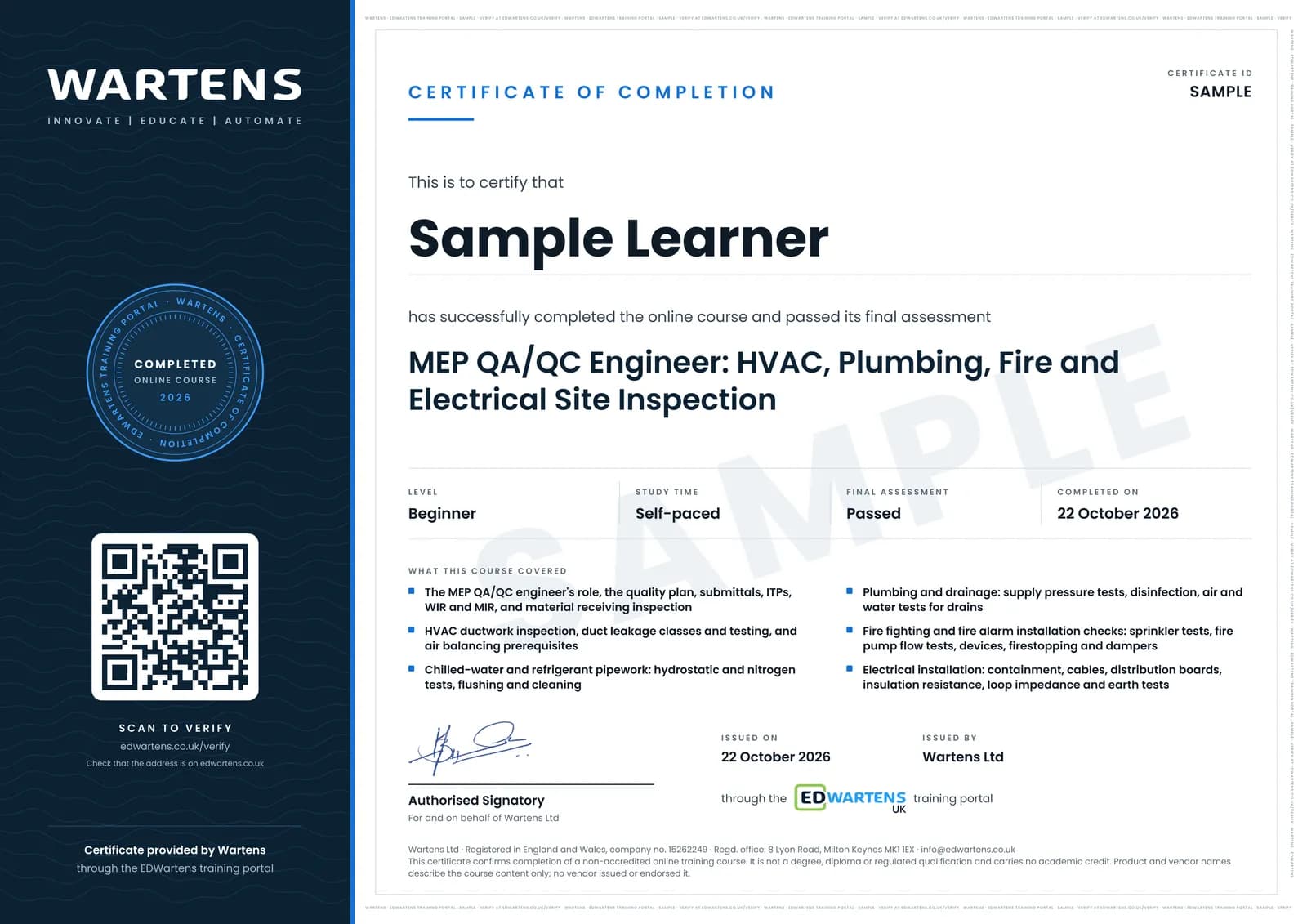
Sample certificate. Optional, issued when you pass the final exam.
- Level
- Beginner
- Modules
- 9
- Length
- About 5 hours
- Price
- Free
Lessons and practice at your own pace. The video is optional extra.
Outcome
What you will be able to do
Explain what an MEP QA/QC engineer checks and may decide; work from a quality plan, an ITP and approved submittals; raise and track WIRs and MIRs; inspect incoming material; check ductwork and run a duct leakage test; pressure test, flush and clean chilled-water pipework and test refrigerant pipework; test water supply and drainage; inspect sprinkler, fire pump, fire alarm and firestopping work; inspect containment, cables and distribution boards and run insulation resistance, loop impedance and earth tests; witness testing and commissioning, build a snag list, write an NCR and prepare handover records. It prepares you for MEP QA/QC engineer and inspector roles; it is not a certification from any inspection or engineering body.
- Say what an MEP QA/QC engineer checks, which documents control the work and what the role may not decide
- Follow the chain from submittal to ITP to WIR and MIR, and read the approval code that comes back
- Inspect incoming material against the approved submittal and decide to accept, quarantine or reject
- Inspect ductwork, work out allowable leakage by leakage class and judge a duct leakage test
- Plan and judge a hydrostatic test on chilled-water pipework, then flush it and test refrigerant pipework with nitrogen
- Test water supply and drainage by pressure, air and water methods and record the results
- Check sprinkler pipework, fire pump flow tests, fire alarm installation, firestopping and fire dampers
- Inspect containment, cables and boards, run insulation resistance, loop impedance and earth tests, then close out snags and NCRs
Software
A spreadsheet (LibreOffice Calc is free) for the ITP, the WIR and MIR logs, the test records, the snag list and the NCR log. Nothing else is needed.
Hardware
None. If you can borrow a pressure gauge, a multimeter or an insulation tester at work, the practice tasks are better for it, but every task can be done on paper.
Syllabus
9 modules
Each module has video lessons, notes and a short quiz. The final exam closes the course.
- The MEP QA/QC engineer, quality plan, ITPs, WIR and MIR3 lessons
- Material receiving inspection1 lesson
- HVAC ductwork inspection and duct leakage testing2 lessons
- Chilled-water and refrigerant pipework: testing and flushing3 lessons
- Plumbing and drainage inspection and testing1 lesson
- Fire fighting and fire alarm installation checks3 lessons
- Electrical installation checks: containment, cables, boards and tests3 lessons
- Testing and commissioning witness, snag lists, NCRs and handover3 lessons
- Final Assessment0 lessons
How it works
How this course works
- Watch the video lessonsOne module at a time, at your own pace.
- Take the module quizA short quiz at the end of each module shows what stuck.
- Keep your notesWrite in My notes beside each module and ask the trainer if you are stuck.
- Sit the final examPass it once you have been through the modules.
- Certificate, if you want oneOptionalPaid, and only after you pass. Anyone can check it online.
Certificate
An optional certificate when you pass
Learning is free. Pass the final exam and you can have a certificate for £19, including VAT, with a number employers can check online. It records that you completed a free online course; it is not a regulated qualification or a CPD certificate.
- Your name, the course, its study time and your final exam score
- A unique certificate number and a QR code to its verification page
- Issued by Wartens Ltd; add it to your LinkedIn profile in one click
- Pay now or after you pass: it is issued the moment you pass the final
Credits
Who made the lessons
The video lessons belong to their creators. EDWartens wrote the study plan, notes, quizzes and the final exam.
- QualityEngineers Guide
what a QA/QC engineer does on site, and the nonconformance report and its purpose
- HardHat Engineer
what an inspection and test plan is and how hold and witness points work
- Civil Engineer At Site.
how a work inspection request is raised and what is attached
- Quality Control with Frans
why delivered material must match the approved submittal, and what MEP clearance means before ceilings close
- Insight Control System
HVAC duct installation methods and accessories
- MrALRamadhan
a practical duct air leakage test with the calculation
- MEP Engineering Tutorials
a method statement for the hydrostatic pressure test of chilled-water pipework
- EXPLORING PIPING
chilled-water flushing before commissioning
- HVAC School
a nitrogen pressure test of refrigerant pipework
- London Trade College
air testing above-ground drainage
- Sprinkler Fitting Canada
a sprinkler system hydrostatic test
- Flameguard Fire Protection Philippines
how a fire pump churn test is done
- RectorSeal
proper and improper firestopping side by side
- IIQA
cable tray installation and an inspection checklist
- Fluke Corporation
measuring insulation resistance step by step
- Megger US
the fall-of-potential earth electrode test
- ICxA
the fundamentals of the commissioning process
Jobs
Jobs this course can lead to
The skills in this course are used in quality and project engineering work, for example as a mep qa/qc engineer, a building services quality engineer and a commissioning technician. No course can promise a job, and employers also look for experience, so read what live adverts ask for.
Questions
About this course
Last reviewed 28 November 2026.
Is MEP QA/QC the same as building services quality in the UK?
Do I need site experience to start?
Is the £19 certificate a qualification?
What does the MEP QA/QC Engineer: HVAC, Plumbing, Fire and Electrical Site Inspection course cover?
Where does MEP QA/QC Engineer: HVAC, Plumbing, Fire and Electrical Site Inspection start and where does it end?
How long is MEP QA/QC Engineer: HVAC, Plumbing, Fire and Electrical Site Inspection?
Who is this MEP QA/QC course for?
Is the course free to learn?
Which standards does it use?
Is this a certification from an inspection or engineering body?
What certificate do I get?
Does it teach me to run the tests myself?
How long does the course take?
What is the project?
Want a live class and career support?
The Professional Module is five live days of Siemens PLC, HMI and SCADA with an instructor, then career sessions with our engineers and a CPD certificate.