
Free course · Condition monitoring
Machinery Lubrication and Ultrasound for Maintenance Technicians
This free course teaches the lubrication and ultrasound skills a maintenance technician uses every week. You learn why lubrication fails, how viscosity grades, grease types and compatibility work, how to store and keep oil clean, and how to calculate grease quantity and read an oil analysis report. You then use airborne ultrasound for greasing, leak, steam trap and electrical surveys. It suits maintenance technicians and graduates in UK plants and food, process and manufacturing sites.
Machinery Lubrication and Ultrasound for Maintenance Technicians is a free online beginner Condition monitoring course with 9 modules, about 4 hours of lessons and video. Learning is free; an optional verifiable certificate costs £19 including VAT when you pass the final exam. Last updated 28 November 2026.
Free to learn. Verifiable certificate £19 when you pass the final exam (optional, VAT included).
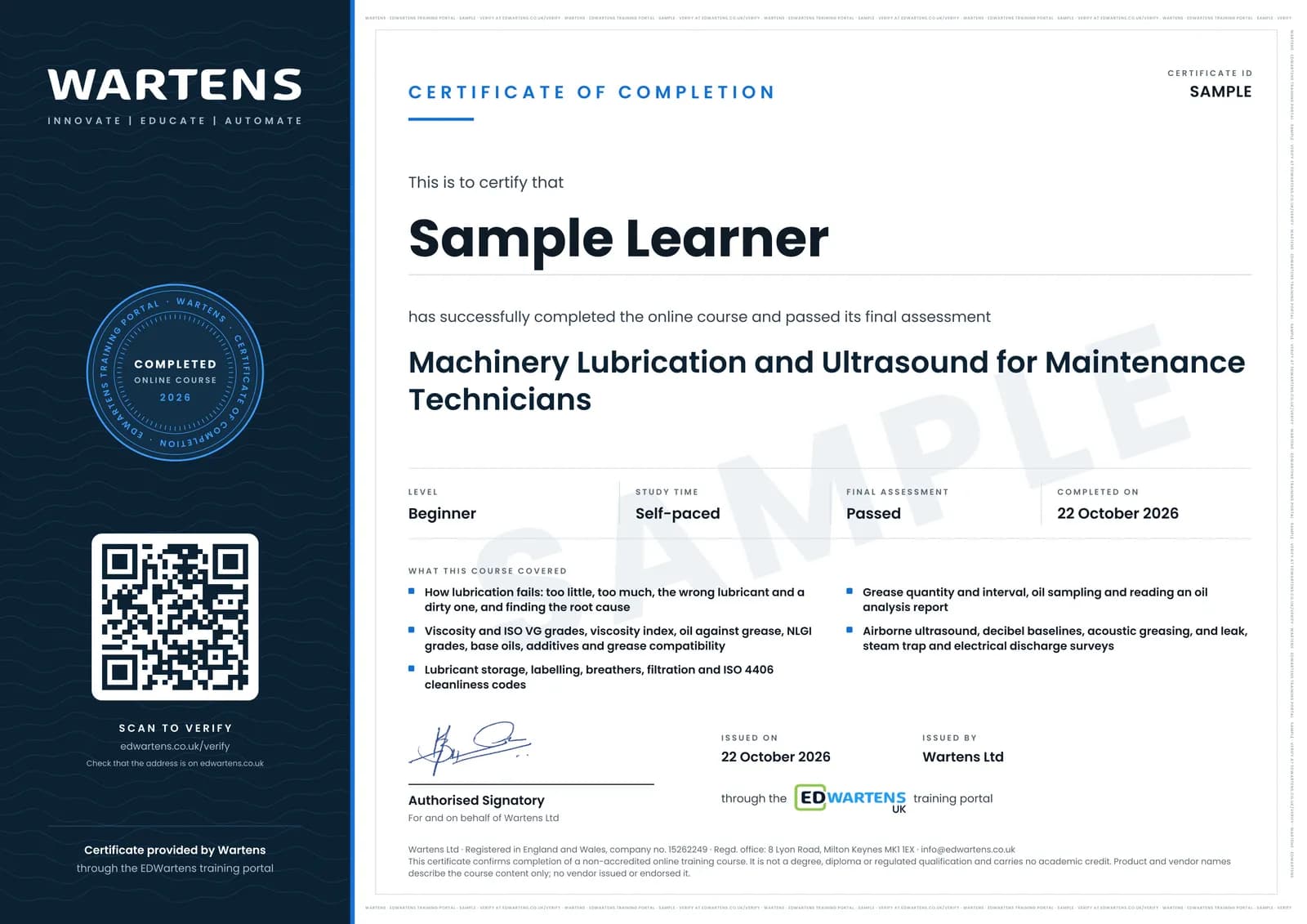
Sample certificate. Optional, issued when you pass the final exam.
- Level
- Beginner
- Modules
- 9
- Length
- About 4 hours
- Price
- Free
Lessons and practice at your own pace. The video is optional extra.
Outcome
What you will be able to do
Explain how too little, too much, the wrong and the dirty lubricant each destroy machines; read an oil data sheet for viscosity grade, viscosity index and NLGI grade and judge whether two products can be mixed; store, label and transfer lubricants without contaminating them and read an ISO 4406 cleanliness code; work out a grease quantity and a regreasing interval for a bearing; take an oil sample from a sound point and read the viscosity, water, particle count and wear metal results; describe how airborne ultrasound and heterodyning work and use decibel baselines and alarm steps; grease a bearing by sound; and survey compressed-air leaks, steam traps and electrical discharge with ultrasound and put a cost on them. It covers the body of knowledge behind machinery lubrication and ultrasound technician work; it is not an ICML MLT or MLA certification and not a vendor ultrasound certification.
- Name the four ways lubrication fails and trace a repeat failure back to its root cause
- Read an ISO VG grade, a viscosity index and an NLGI grade, and judge whether two greases can be mixed
- Store, label and transfer lubricants without cross-contamination, and read an ISO 4406 cleanliness code
- Work out a grease quantity with the 0.005 x D x B rule of thumb, calibrate a gun and set a regreasing interval
- Take a representative oil sample and read viscosity, water, particle count and wear metals on a report
- Explain airborne ultrasound and heterodyning, and take repeatable decibel readings against a baseline
- Apply the 8, 16 and 35 dB alarm steps to a bearing and grease it by sound with a stop rule
- Survey compressed-air leaks and steam traps, cost them, and report corona, tracking and arcing safely
Software
A spreadsheet (LibreOffice Calc is free) for the lubrication route, the grease quantity sums and the ultrasound survey log. Nothing else is needed.
Hardware
None. If you can borrow a grease gun, a bearing sample bottle or an ultrasound detector at work, the practice tasks are better for it, but every task can be done on paper.
Syllabus
9 modules
Each module has video lessons, notes and a short quiz. The final exam closes the course.
- Why machines fail from lubrication2 lessons
- Lubricant basics: viscosity, oil and grease, additives3 lessons
- Storage, handling and contamination control3 lessons
- Greasing: how much and how often2 lessons
- Oil sampling and oil analysis3 lessons
- Airborne ultrasound principles3 lessons
- Ultrasound for bearings and acoustic greasing3 lessons
- Ultrasound for leaks, steam traps and electrical inspection3 lessons
- Final Assessment0 lessons
How it works
How this course works
- Watch the video lessonsOne module at a time, at your own pace.
- Take the module quizA short quiz at the end of each module shows what stuck.
- Keep your notesWrite in My notes beside each module and ask the trainer if you are stuck.
- Sit the final examPass it once you have been through the modules.
- Certificate, if you want oneOptionalPaid, and only after you pass. Anyone can check it online.
Certificate
An optional certificate when you pass
Learning is free. Pass the final exam and you can have a certificate for £19, including VAT, with a number employers can check online. It records that you completed a free online course; it is not a regulated qualification or a CPD certificate.
- Your name, the course, its study time and your final exam score
- A unique certificate number and a QR code to its verification page
- Issued by Wartens Ltd; add it to your LinkedIn profile in one click
- Pay now or after you pass: it is issued the moment you pass the final
Credits
Who made the lessons
The video lessons belong to their creators. EDWartens wrote the study plan, notes, quizzes and the final exam.
- Noria
oil viscosity, overgreasing and the wrong lubricant, lubricant storage, greasing frequency and elemental oil analysis
- SDT Hear More
monitoring bearings with ultrasound, acoustic lubrication, compressed air leaks and steam trap testing
- Lubrication Explained
grease against oil, grease compatibility and reading an oil report
- ABB Motors and Drives
lubricating electric motor bearings
- Des-Case Corporation
contamination control and oil sampling best practice
- Donaldson Hy-Pro
reading ISO 4406 cleanliness codes
- Mobius Institute
heterodyning, the decibel scale and good ultrasound data
- UE Systems
ultrasound inspection of electrical equipment
Jobs
Jobs this course can lead to
The skills in this course are used in maintenance engineer and technician work, for example as a maintenance technician, a lubrication technician and a condition monitoring technician. No course can promise a job, and employers also look for experience, so read what live adverts ask for.
Browse Electrical and maintenance technicians jobs
4,450 jobs live on the UK board
Browse Multi-skilled maintenance engineer jobs
720 jobs live on the UK board
Pay: Metal working production and maintenance fitters (SOC 5223, which includes automation maintenance technicians) had a median of £41,942 a year, full-time, in April 2026. Electrical service and maintenance mechanics (SOC 5246) had £44,785. Source: ONS, Annual Survey of Hours and Earnings 2026 (provisional). Checked 28 Oct 2026.
Questions
About this course
Last reviewed 28 November 2026.
Is this a lubrication or ultrasound certification?
Do I need an ultrasound instrument?
Is the £19 certificate a qualification?
What does the Machinery Lubrication and Ultrasound for Maintenance Technicians course cover?
Where does Machinery Lubrication and Ultrasound for Maintenance Technicians start and where does it end?
How long is Machinery Lubrication and Ultrasound for Maintenance Technicians?
Who is this machinery lubrication and ultrasound course for?
Is the course free to learn?
Does it teach how much grease to put in a bearing?
Is this an ICML MLT or MLA certification, or a vendor ultrasound certification?
What certificate do I get?
How does it differ from your vibration, thermography and reliability courses?
How long does the course take?
What is the project?
Want a live class and career support?
The Professional Module is five live days of Siemens PLC, HMI and SCADA with an instructor, then career sessions with our engineers and a CPD certificate.