Free course · Power systems
Data Centre Operations: Critical Facilities Technician
This free course prepares you for the work of a critical facilities technician in a live data centre. You learn the power and cooling paths, how BMS, EPMS and DCIM alarms read, and how to stay safe near live equipment. Then you follow method statements, take rounds, run UPS and generator transfers, respond to alarms and hand over a shift. It suits electricians, mechanical technicians and graduates targeting data centre operations jobs around London, Slough and Manchester.
Data Centre Operations: Critical Facilities Technician is a free online beginner Power systems course with 9 modules, about 5 hours of lessons and video. Learning is free; an optional verifiable certificate costs £19 including VAT when you pass the final exam. Last updated 28 November 2026.
Free to learn. Verifiable certificate £19 when you pass the final exam (optional, VAT included).
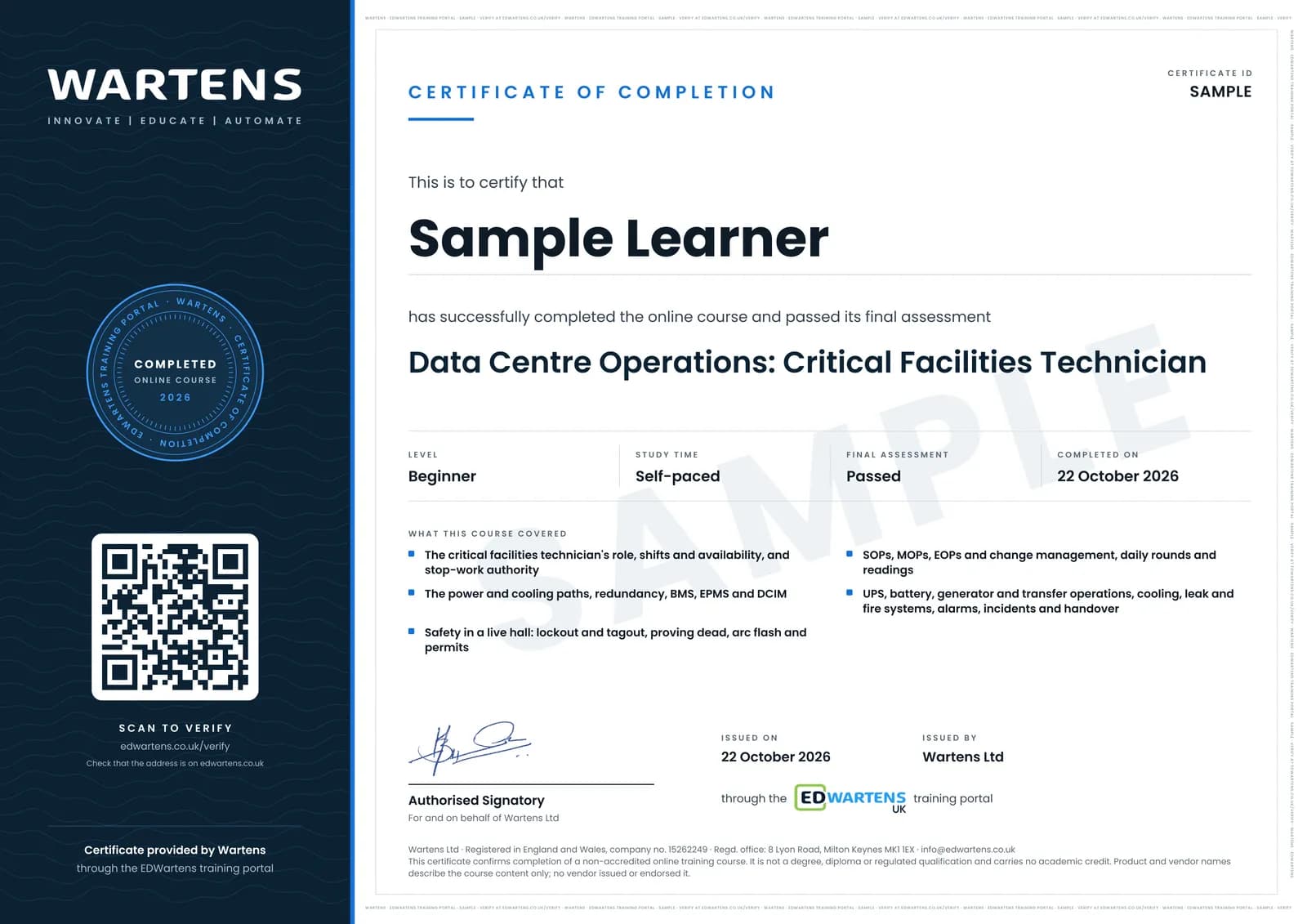
Sample certificate. Optional, issued when you pass the final exam.
- Level
- Beginner
- Modules
- 9
- Length
- About 5 hours
- Price
- Free
Lessons and practice at your own pace. The video is optional extra.
Outcome
What you will be able to do
Describe the work of a critical facilities technician and the shift pattern; trace the power and cooling paths and say what the BMS, EPMS and DCIM each show; apply lockout and tagout, prove dead, read an arc flash label and understand energised work permits; read and follow an SOP, a MOP and an EOP and take part in change control; walk a round and judge readings against normal; explain UPS modes, static and maintenance bypass, battery checks, generator tests and transfers; respond to cooling, leak and fire alarms; handle alarms and incidents, hand over a shift and write an incident report. It prepares you for entry-level data centre operations roles; it is not a data centre certification or an electrical qualification.
- Say what a critical facilities technician does on a shift, and turn availability figures into minutes of downtime
- Trace power and cooling from the utility to the rack, and say what the BMS, EPMS and DCIM each show
- Apply lockout and tagout, prove a circuit dead, read an arc flash label and understand energised work permits
- Read and follow an SOP, a MOP with holds and a back-out, and an EOP, and take part in change control
- Walk a round, record readings as numbers and decide between a note, a ticket and an escalation
- Explain UPS modes, static and maintenance bypass, battery checks, generator tests and ATS transfers
- Find the cause of a hot spot, and respond to cooling, leak, early smoke and gas suppression alarms
- Handle alarms and incidents, hand over a shift, write an incident report and work out PUE and time to restore
Software
A spreadsheet (LibreOffice Calc is free) for the round sheet, the MOP, the EOP and the incident log. Nothing else is needed.
Hardware
None. Every task can be done on paper or in a spreadsheet. If you work in a plant room, your own site's procedures make the practice tasks better.
Syllabus
9 modules
Each module has video lessons, notes and a short quiz. The final exam closes the course.
- The critical facilities technician, shifts and availability1 lessonLab
- The power and cooling paths, BMS, EPMS and DCIM3 lessons
- Safety in a live hall: LOTO, arc flash and permits3 lessons
- SOPs, MOPs, EOPs and change management3 lessons
- Daily rounds and readings1 lesson
- UPS, battery, generator and transfer operations5 lessonsLab
- Cooling operations, fire suppression and leak detection4 lessonsLab
- Alarms, incidents, handover and KPIs2 lessonsLab
- Final Assessment0 lessons
How it works
How this course works
- Watch the video lessonsOne module at a time, at your own pace.
- Take the module quizA short quiz at the end of each module shows what stuck.
- Keep your notesWrite in My notes beside each module and ask the trainer if you are stuck.
- Practise in the labOptionalTry a task from the module in the EDWartens Lab, in your browser.
- Sit the final examPass it once you have been through the modules.
- Certificate, if you want oneOptionalPaid, and only after you pass. Anyone can check it online.
Levels to try with this course
DC-01 · AI Data Centre lab
Safety walk and hall tour
Open in the lab (opens in a new tab)DC-08 · AI Data Centre lab
Power event drill
Open in the lab (opens in a new tab)DC-04 · AI Data Centre lab
Cooling hot spot
Open in the lab (opens in a new tab)DC-05 · AI Data Centre lab
PUE from a month of meters
Open in the lab (opens in a new tab)
Optional. Skip it whenever you like: it never blocks your progress or your certificate.
Why practise in a lab
Technical work is judged on what you can do: wiring, commissioning, finding a fault. Doing a task yourself teaches more than watching it a second time, and a lab lets you try it safely before you meet real equipment. It does not replace working on real hardware.
- Practise safely, so a mistake costs nothing.
- The lab checks your work like a site test, so you know when it is right.
- Free, in your browser, with nothing to install.
Certificate
An optional certificate when you pass
Learning is free. Pass the final exam and you can have a certificate for £19, including VAT, with a number employers can check online. It records that you completed a free online course; it is not a regulated qualification or a CPD certificate.
- Your name, the course, its study time and your final exam score
- A unique certificate number and a QR code to its verification page
- Issued by Wartens Ltd; add it to your LinkedIn profile in one click
- Pay now or after you pass: it is issued the moment you pass the final
Credits
Who made the lessons
The video lessons belong to their creators. EDWartens wrote the study plan, notes, quizzes and the final exam.
- Google Cloud
a facilities technician's day in a large data centre
- TechTrainerNJ
the data centre power chain from utility to rack, animated
- The Engineering Mindset
how a data centre is cooled, with hot and cold aisle containment
- SATCOM School
how a live data centre is monitored through BMS, EPMS and DCIM
- Ally Safety
the four steps of lockout and tagout
- TechTrain Solutions of PA
live-dead-live testing before touching a circuit
- Electrical Safety UK Ltd
what an arc flash is and how to reduce the risk
- CareerHarbor Academy
the method of procedure with its back-out plan, and the emergency operating procedure
- The Knowledge Academy
the change management process
- Eaton
infrared scans of electrical equipment
- Rockz Automation
the operating modes of an online UPS
- Schneider Electric
moving a UPS into maintenance bypass and back online
- Alpine Power Systems
UPS battery room safety
- Custodian Data Centres
running a generator test at a data centre
- IT Events
the ASHRAE TC 9.9 server inlet temperature and humidity conditions
- CoreSite
blanking panels and airflow in the rack
- AKCP
water leak detection in a data hall
- Xtralis
aspirating smoke detection with VESDA
- ServiceNow Documentation
major incident management
- Submer
PUE, DCiE and WUE
Jobs
Jobs this course can lead to
The skills in this course are used in power, renewable energy and data centre work, for example as a critical facilities technician, a data centre operations technician and a data centre engineer. No course can promise a job, and employers also look for experience, so read what live adverts ask for.
Pay: Electrical engineers (SOC 2123) had a median of £63,136 a year, full-time, in April 2026. Source: ONS, Annual Survey of Hours and Earnings 2026 (provisional). Checked 28 Oct 2026.
Questions
About this course
Last reviewed 28 November 2026.
Do I need data centre experience to start?
Does it replace site induction or electrical authorisation?
Is the £19 certificate a qualification?
What does the Data Centre Operations: Critical Facilities Technician course cover?
Where does Data Centre Operations: Critical Facilities Technician start and where does it end?
How long is Data Centre Operations: Critical Facilities Technician?
Can I practise Data Centre Operations: Critical Facilities Technician in the browser?
Who is this data centre operations course for?
Is the course free to learn?
What is a critical facilities technician?
Is this a data centre certification or an electrical qualification?
What certificate do I get?
How does it differ from your other data centre courses?
How long does the course take?
What is the project?
Want a live class and career support?
The Professional Module is five live days of Siemens PLC, HMI and SCADA with an instructor, then career sessions with our engineers and a CPD certificate.