Free course · Maintenance
Cathodic Protection and Corrosion Control for Pipelines and Tanks
This free course teaches how cathodic protection stops buried and submerged steel from corroding. You learn the corrosion cell, soil resistivity, the part coatings play and how galvanic anodes and impressed current systems work. You calculate current demand, anode life and rectifier output, read pipe-to-soil potentials against the criteria, and see CIPS, DCVG and tank bottom surveys, stray current and records. It suits engineers and technicians in UK pipeline, gas, water and tank operations.
Cathodic Protection and Corrosion Control for Pipelines and Tanks is a free online beginner Maintenance course with 9 modules, about 4 hours of lessons and video. Learning is free; an optional verifiable certificate costs £19 including VAT when you pass the final exam. Last updated 28 November 2026.
Free to learn. Verifiable certificate £19 when you pass the final exam (optional, VAT included).
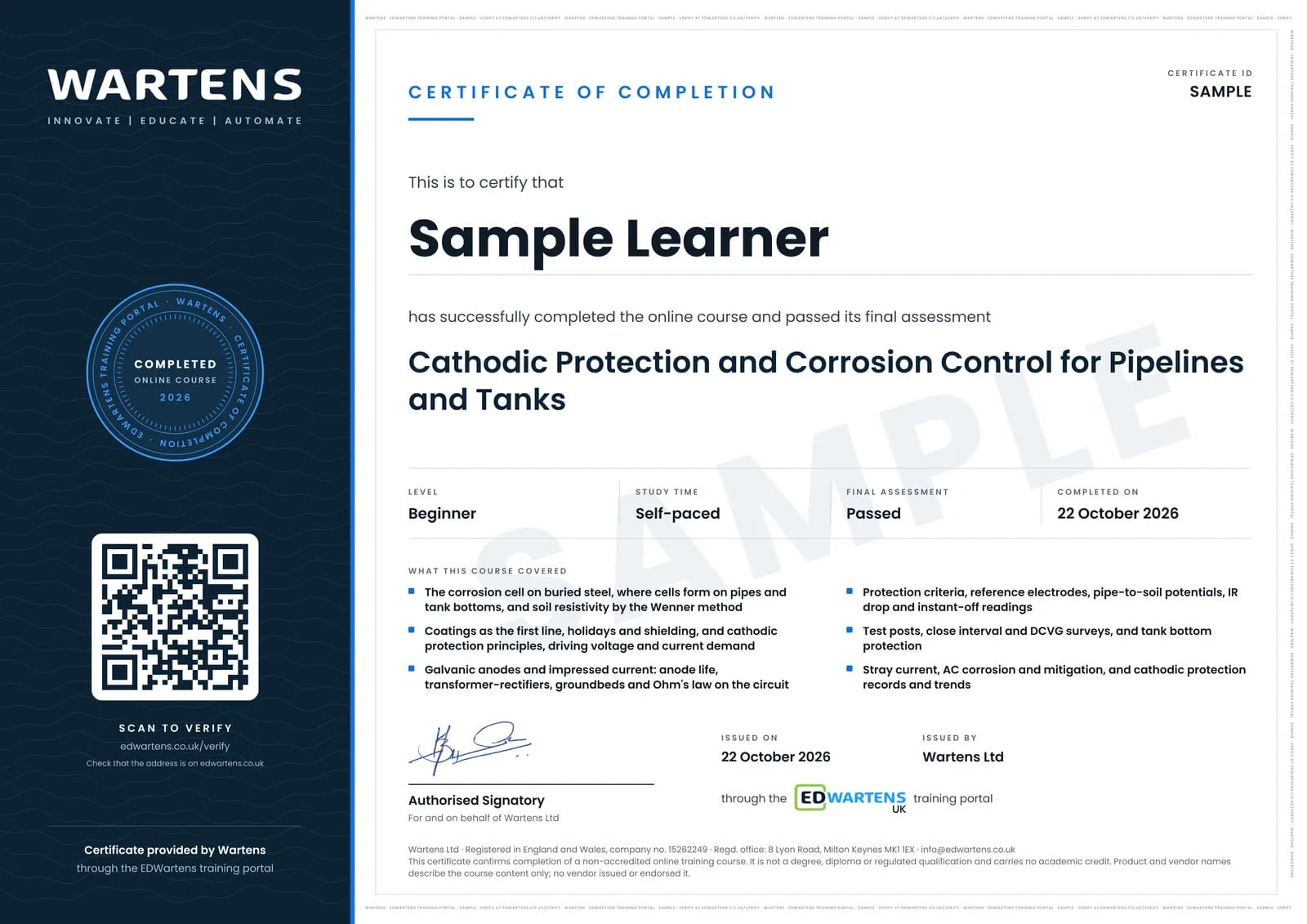
Sample certificate. Optional, issued when you pass the final exam.
- Level
- Beginner
- Modules
- 9
- Length
- About 4 hours
- Price
- Free
Lessons and practice at your own pace. The video is optional extra.
Outcome
What you will be able to do
Explain the four parts of a corrosion cell and where cells form on pipes and tank bottoms; measure and calculate soil resistivity with the Wenner method; explain why coatings come first and how CP backs them up; tell galvanic anode and impressed current systems apart and size each with simple sums; calculate current demand, anode life and a rectifier rating; apply the -850 mV and 100 mV polarisation criteria to on and instant-off readings; convert between reference electrodes; read test posts and rectifier logs; describe CIPS, DCVG and tank bottom CP; explain stray current and AC corrosion and how they are controlled; and keep monthly CP records. It covers the body of knowledge behind CP technician and tester work and prepares you for junior CP and corrosion roles; it is not an AMPP, NACE or any other certification.
- Name the four parts of a corrosion cell, find where cells form on pipes and tank bottoms and measure soil resistivity with the Wenner method
- Put coatings, cathodic protection, inhibitors and materials in order and explain holidays, disbondment and shielding
- Tell galvanic anode and impressed current systems apart and calculate a current demand from area, coating breakdown and current density
- Calculate galvanic anode life from mass, capacity, utilisation and current output
- Use Ohm's law on a groundbed, size a rectifier voltage and read a shunt and a monthly rectifier log
- Apply the -850 mV instant-off and 100 mV polarisation criteria, and convert readings between reference electrodes
- Describe test posts, close interval surveys, DCVG and tank bottom reference tubes, and plan a year of CP checks
- Explain stray current and AC corrosion, work out an AC current density, and keep CP records that can be audited
Software
A spreadsheet (LibreOffice Calc is free) for resistivity, anode life, rectifier and survey calculations. Nothing else is needed.
Hardware
None. If you can borrow a high-impedance multimeter and a copper/copper sulphate reference electrode at work, the practice is better for it, but every task can be done on paper.
Syllabus
9 modules
Each module has video lessons, notes and a short quiz. The final exam closes the course.
- How corrosion cells work, and why soil matters3 lessons
- Corrosion control options: coatings first, CP as backup2 lessons
- Cathodic protection principles: galvanic and impressed current2 lessons
- Galvanic anode systems3 lessons
- Impressed current: transformer-rectifiers and groundbeds4 lessons
- Criteria, pipe-to-soil potentials, reference electrodes and IR drop3 lessons
- Test posts and surveys: CIPS, DCVG and tank bottoms3 lessons
- Interference, AC corrosion and records2 lessons
- Final Assessment0 lessons
How it works
How this course works
- Watch the video lessonsOne module at a time, at your own pace.
- Take the module quizA short quiz at the end of each module shows what stuck.
- Keep your notesWrite in My notes beside each module and ask the trainer if you are stuck.
- Sit the final examPass it once you have been through the modules.
- Certificate, if you want oneOptionalPaid, and only after you pass. Anyone can check it online.
Certificate
An optional certificate when you pass
Learning is free. Pass the final exam and you can have a certificate for £19, including VAT, with a number employers can check online. It records that you completed a free online course; it is not a regulated qualification or a CPD certificate.
- Your name, the course, its study time and your final exam score
- A unique certificate number and a QR code to its verification page
- Issued by Wartens Ltd; add it to your LinkedIn profile in one click
- Pay now or after you pass: it is issued the moment you pass the final
Credits
Who made the lessons
The video lessons belong to their creators. EDWartens wrote the study plan, notes, quizzes and the final exam.
- KINETIC SCHOOL
the corrosion cell as an animation
- M. C. Miller Co.
a four-pin Wenner soil resistivity test in the field
- Cathodic Academy
turning a Wenner resistance reading into soil resistivity
- The Institute for Oil & Gas Sector (IOGS)
how fusion bonded epoxy is applied to pipe and inspected
- Interesting Chemistry
how corrosion inhibitors protect oil and gas pipelines from inside
- Corrosion Technologies
what cathodic protection is and the two ways of supplying current
- Corrosion Coach
the practical galvanic series and galvanic cathodic protection of steel
- Electrical Instrumentation & Cathodic Protection
Faraday's law and converting between reference electrode scales
- TOE Academy
sizing and placing sacrificial anodes on an offshore structure
- CorrConnect
an impressed current system and measurements on a rectifier
- MATCOR
mixed metal oxide anodes for cathodic protection
- isiFundi Training
Ohm's law on CP circuits, the -850 mV criterion and the close interval survey
- Cena Technical Limited
instant ON and instant OFF potential measurement with an interrupter
- Corroconsult UK Limited
finding, centring and measuring a coating defect in a DCVG survey
- Ducorr Media
installing cathodic protection under an aboveground storage tank
- Allied Corrosion Industries, Inc.
DC stray current corrosion and AC interference on pipelines
Jobs
Jobs this course can lead to
The skills in this course are used in maintenance engineer and technician work, for example as a cathodic protection technician, a corrosion technician and a pipeline integrity technician. No course can promise a job, and employers also look for experience, so read what live adverts ask for.
Browse Electrical and maintenance technicians jobs
4,446 jobs live on the UK board
Browse Multi-skilled maintenance engineer jobs
720 jobs live on the UK board
Pay: Metal working production and maintenance fitters (SOC 5223, which includes automation maintenance technicians) had a median of £41,942 a year, full-time, in April 2026. Electrical service and maintenance mechanics (SOC 5246) had £44,785. Source: ONS, Annual Survey of Hours and Earnings 2026 (provisional). Checked 28 Oct 2026.
Questions
About this course
Last reviewed 28 November 2026.
Is this a cathodic protection certification?
Do I need a strong maths background?
Is the £19 certificate a qualification?
What does the Cathodic Protection and Corrosion Control for Pipelines and Tanks course cover?
Where does Cathodic Protection and Corrosion Control for Pipelines and Tanks start and where does it end?
How long is Cathodic Protection and Corrosion Control for Pipelines and Tanks?
Is the course free to learn?
Which standards does it use?
What certificate do I get?
Will it let me sign off cathodic protection work on a plant?
How long does the course take?
What is the project?
Want a live class and career support?
The Professional Module is five live days of Siemens PLC, HMI and SCADA with an instructor, then career sessions with our engineers and a CPD certificate.