
Free course · Quality management
Lean Six Sigma Black Belt
This free course is the step after Green Belt. You rank and charter projects against business goals, plan data collection, handle data that is not normal, run hypothesis tests with power and sample size, use ANOVA and regression, and design full and fractional factorial experiments. Every calculation uses data you can repeat in a spreadsheet or JASP. It suits Green Belts, quality and continuous improvement engineers in UK manufacturing and services. It covers the Black Belt body of knowledge, but it cannot promise a job.
Free to learn. Verifiable certificate £19 when you pass the final exam (optional, VAT included).
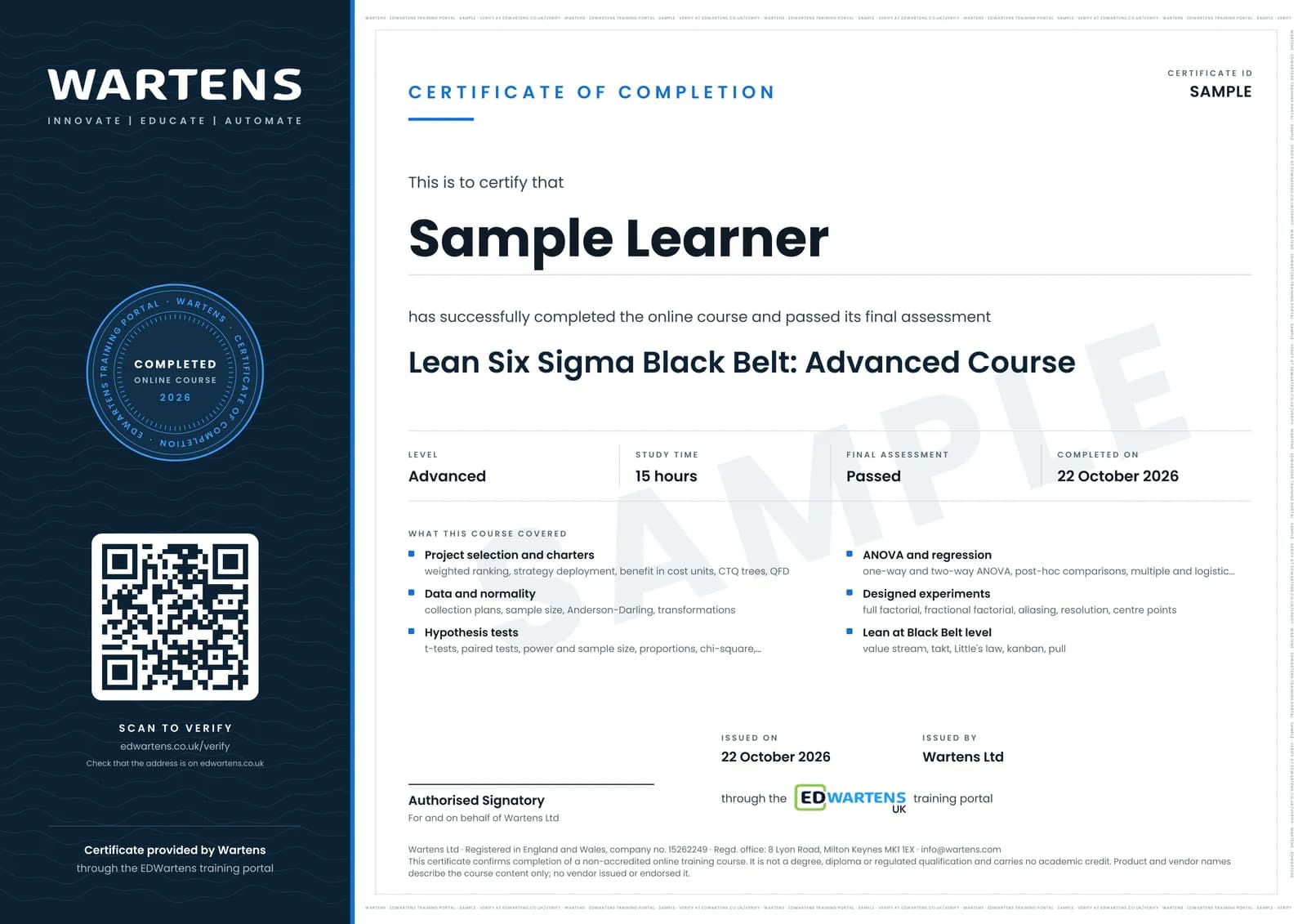
Sample certificate. Optional, issued when you pass the final exam.
- Level
- Advanced
- Modules
- 13
- Video
- 18 hours
- Price
- Free
Outcome
What you will be able to do
Choose and rank improvement projects against business goals and write a charter whose benefit is stated in cost units; turn customer needs into a CTQ tree and a data collection plan; test data for normality and transform it or switch tests when it fails; run and read one-sample, two-sample, paired, proportion, chi-square and rank-based tests with power and sample size; run one-way and two-way ANOVA with post-hoc comparisons; fit and check multiple and logistic regression; plan, run and analyse full and fractional factorial experiments with centre points and read resolution and aliasing; map a value stream and design flow and pull; write a control plan and know where SPC and gauge studies fit; lead change and coach Green Belts; and carry a complete DMAIC case from charter to handover.
- Rank and charter projects against business goals with the benefit stated in cost units
- Plan data collection, size samples and handle non-normal data with transforms or rank-based tests
- Run t-tests, paired tests, proportion, chi-square and Mann-Whitney tests with power and sample size
- Build one-way and two-way ANOVA tables, follow them with post-hoc comparisons and read interactions
- Fit multiple and logistic regression and check residuals and multicollinearity
- Plan and analyse full and fractional factorial experiments with centre points and read aliasing
- Map a value stream and apply flow, pull, kanban and Little's law
- Write a control plan, set X-bar and R chart limits, lead change and coach Green Belts
Software
A spreadsheet (Microsoft Excel or the free LibreOffice Calc) is enough for every worked problem in the notes. JASP (free, open source) or R give the full ANOVA, regression and designed-experiment outputs. Minitab is shown in a few lessons and is optional: Minitab offers a free trial on its own website (checked 1 November 2026), so read its current terms there.
Hardware
None. A computer that runs a spreadsheet.
Syllabus
13 modules
Each module has video lessons, notes and a short quiz. The final exam closes the course.
- The Black Belt role, project selection and portfolio alignment3 lessons
- Define at depth: charters, financial benefit and the voice of the customer2 lessons
- Data collection, distributions and non-normal data5 lessons
- Hypothesis testing in depth: t-tests, paired tests, power and sample size4 lessons
- Proportions, chi-square and non-parametric tests4 lessons
- One-way and two-way ANOVA3 lessons
- Correlation, multiple regression and logistic regression6 lessons
- Design of experiments I: why experiment and full factorial designs4 lessons
- Design of experiments II: fractional factorials, resolution and centre points6 lessons
- Lean at Black Belt level: value stream, flow and pull5 lessons
- Control phase: control plans, sustaining the gain and a short SPC section3 lessons
- Change leadership, coaching Green Belts and a full DMAIC case4 lessons
- Final assessment1 lesson
How it works
How this course works
- Watch the video lessonsOne module at a time, at your own pace.
- Take the module quizA short quiz at the end of each module shows what stuck.
- Keep your notesWrite in My notes beside each module and ask the trainer if you are stuck.
- Sit the final examPass it once you have been through the modules.
- Certificate, if you want oneOptionalPaid, and only after you pass. Anyone can check it online.
Certificate
An optional certificate when you pass
Learning is free. Pass the final exam and you can have a certificate for £19, including VAT, with a number employers can check online. It records that you completed a free online course; it is not a regulated qualification or a CPD certificate.
- Your name, the course, its study time and your final exam score
- A unique certificate number and a QR code to its verification page
- Issued by Wartens Ltd; add it to your LinkedIn profile in one click
- Pay now or after you pass: it is issued the moment you pass the final
Credits
Who made the lessons
The video lessons belong to their creators. EDWartens wrote the study plan, notes, quizzes and the final exam.
- NPTEL IIT Kharagpur
the Six Sigma lectures on the project charter, quality function deployment, hypothesis testing fundamentals, one-way and two-way ANOVA, regression model validation, factorial and fractional factorial design, non-normal capability, SPC in Minitab and a short case study
- Operations & Supply Chain Management University
the Black Belt lessons on course expectations, successful projects, strategy deployment, data collection, sample size, p-values, t-tests, regression, DOE examples, facilitation, coaching, leader standard work, Toyota Kata and utilisation analysis
- StatQuest with Josh Starmer
power analysis, multiple regression and logistic regression with its coefficients
- The Open Educator
one-half fractional factorial designs, design resolution and confounding
- Institute of Quality and Reliability
fractional designs with confounding and resolution codes, and fractional designs with centre points
- numiqo
two-way ANOVA and its interaction
- Lean Six Sigma Toolbox
working with non-normal data by transforming it
- JMP Statistical Discovery
an overview of non-parametric tests
- Advance Innovation Group
the Mann-Whitney test procedure
- All Things Quality
value stream mapping to find waste and cut lead time
- LeanVlog
drawing the future-state value stream map
- Lean
a worked flow and pull system example
- Pankaj Aggarwal (Simply Dhruv)
the chi-square test and test of hypothesis in long form
- Joshua Emmanuel
the regression ANOVA table, F test and R-squared
- Ibrahim Lashin
a Black Belt final project walk-through
Jobs
Jobs this course can lead to
The skills in this course are used in quality and project engineering work, for example as a continuous improvement engineer, a quality engineer and an operational excellence manager. No course can promise a job, and employers also look for experience, so read what live adverts ask for.
Questions
About this course
Last reviewed 1 November 2026.
Does this make me a certified Black Belt?
Do I need Minitab?
Should I take Green Belt first?
What is the Lean Six Sigma Black Belt course?
Who is this Black Belt course for?
What statistics do I need to start?
How long does the course take, and is it free?
What certificate do I get?
Is Black Belt knowledge useful in quality jobs?

Want a live class and career support?
The Professional Module is five live days of Siemens PLC, HMI and SCADA with an instructor, then a resume session and a CPD certificate.