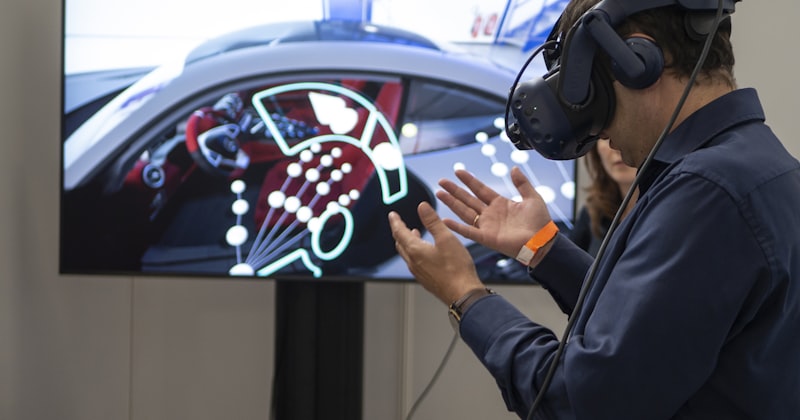

Virtual reality is transforming how engineers learn. At EDWartens, we have integrated Meta Quest VR headsets into our training programmes to create immersive learning experiences that bridge the gap between classroom theory and real-world practice.
The Problem with Traditional Training
Traditional automation training faces inherent limitations:
- Safety constraints prevent students from experiencing fault scenarios on live equipment
- Equipment costs limit the variety of systems available in a training centre
- Space limitations make it impossible to recreate full-scale industrial environments
- Time pressures mean students may not encounter certain scenarios during their course
These limitations mean that graduates often face a steep learning curve when they first step onto an industrial site. VR helps close this gap.
How We Use VR
Our VR training modules complement hands-on PLC programming with immersive industrial environments. Students can:
Explore Virtual Factories
Walk through realistic manufacturing environments, examine control panels, follow cable routes, and understand how automation systems fit into the broader production process. This spatial awareness is difficult to develop in a classroom setting.
Practise Safety Procedures
Experience lock-out/tag-out procedures, hazard identification, and emergency response scenarios in a safe virtual environment. Making mistakes in VR has no real-world consequences, which encourages exploration and learning.
Simulate Commissioning Scenarios
Perform virtual commissioning tasks including I/O testing, sequence verification, and fault diagnosis. Students experience the pressure and complexity of commissioning without the cost and risk of working on real production equipment.
Understand Process Operations
Visualise how automated processes work from the operator's perspective. Understanding what operators see and do helps programmers design better HMI screens and more intuitive control sequences.
Why Meta Quest?
We chose the Meta Quest platform for several practical reasons:
- Standalone operation — No need for expensive gaming PCs or external sensors
- Portability — Headsets can be used in classrooms, at home, or on customer sites
- Comfort — Lightweight design suitable for extended training sessions
- Quality — High-resolution displays and accurate hand tracking
- Accessibility — Intuitive controls that students learn quickly
Integration with PLC Training
VR is not a replacement for hands-on PLC programming — it is a complement. Our training model integrates VR modules at specific points in the curriculum:
- Orientation — VR factory tours before touching any equipment, building context and familiarity
- Safety training — Virtual safety scenarios before working with real electrical equipment
- Commissioning simulation — Virtual practice before moving to real PLC hardware
- Advanced scenarios — Fault conditions and emergency situations that cannot be safely recreated
Student Feedback
Students consistently report that VR modules enhance their learning experience:
- Improved spatial understanding of industrial environments
- Greater confidence before entering real factory settings
- Better retention of safety procedures through experiential learning
- Enhanced engagement and motivation compared to purely classroom-based sessions
The Future of VR in Engineering Training
We are continuously developing new VR content and exploring emerging technologies. Our roadmap includes:
- Mixed reality integration combining virtual overlays with real PLC hardware
- Collaborative VR environments where multiple students work together
- AI-driven scenarios that adapt to individual student performance
- Integration with digital twin technology for site-specific training
At EDWartens, we believe that the best training uses every tool available to develop confident, capable engineers. Virtual reality is one of those tools, and we are committed to pushing its boundaries in engineering education.
